



For years, businesses protected their data like a medieval castle: build a thick wall (a…
Read More
Most businesses know they need good IT support, but few realise how much difference local expertise can make. Local IT providers do not just react to problems, they actually help firms cut system downtime by up to 47 percent, according to Gartner. That is not just a minor upgrade, it changes the entire game for regional companies because a local approach means technology really fits the community and the business it serves.
| Takeaway | Explanation |
|---|---|
| Local IT services offer tailored support. | These services provide specialised technological solutions for businesses within a specific geographic area, addressing unique regional challenges. |
| Proximity results in faster response times. | Local IT providers can respond quickly to technical issues, minimising downtime compared to larger, national providers. |
| Custom solutions enhance operational efficiency. | Local IT services develop strategies that directly align with a business’s specific needs, leading to improved performance and reduced costs. |
| Strategic partnerships boost business resilience. | By outsourcing to local experts, businesses can enhance their technological capabilities and focus on core activities while ensuring a strong tech foundation. |
| Proactive monitoring prevents technology issues. | Continuous system surveillance by local IT services helps identify and resolve potential problems before they impact business operations. |
Local IT services represent specialised technology support solutions designed specifically for businesses operating within a specific geographical region. These services go beyond generic technical assistance, offering tailored technological strategies that address the unique challenges faced by regional enterprises.
At their foundation, local IT services encompass a comprehensive range of technological support mechanisms. These typically include network management, cybersecurity protection, hardware maintenance, and strategic technology consulting. Our guide on IT services provides deeper insights into how these components integrate to support business operations.
Businesses benefit from local IT services through:
Unlike large, impersonal national IT service providers, local IT services offer nuanced technological solutions. According to Gartner Research, regional IT support providers can reduce system downtime by up to 47% through targeted, quick interventions.
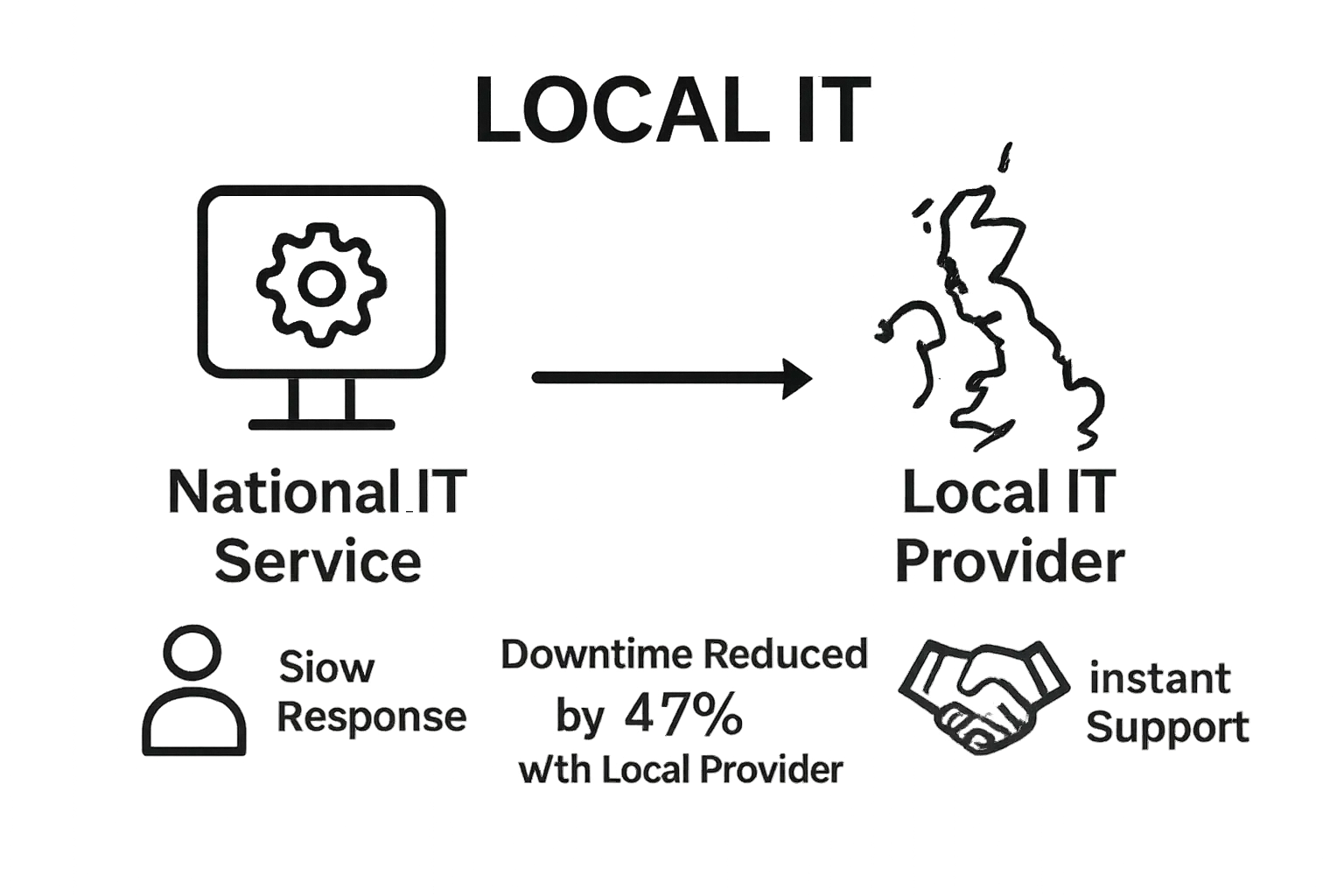
These services adapt to the specific technological ecosystems of local businesses, considering factors like regional internet infrastructure, local regulatory requirements, and the unique technological challenges of specific industry sectors within the area. By focusing on proximity and personalised support, local IT services transform technological management from a reactive problem-solving approach to a proactive strategic partnership.
To clarify the varied features that distinguish local IT services from national providers, the table below compares key aspects discussed in the article.
| Aspect | Local IT Services | National IT Providers |
|---|---|---|
| Response Times | Fast, due to geographical proximity | Can be slower due to distance |
| Solution Customisation | Personalised to regional business needs | Often generic, less tailored |
| Understanding of Local Context | In-depth knowledge of regional challenges and regulations | Limited understanding of local nuances |
| Communication | Direct, with experts familiar with local infrastructure | More impersonal, centralised support |
| Downtime Reduction (per Gartner) | Up to 47% less system downtime through targeted intervention | Generally less effective in this area |
| Cost-Effectiveness | Can offer cost savings via focused, localised services | Pricing often standardised, less flexible |
Local IT services have transformed from optional support to critical infrastructure for businesses seeking technological resilience and competitive advantage. These specialised services deliver strategic technological solutions that directly impact a company’s operational efficiency, security, and growth potential.
Businesses require robust technological frameworks that adapt to their specific operational needs. Our comprehensive guide on business IT support explores how targeted technological strategies can revolutionise business performance.
The critical advantages of local IT services include:
Local IT services represent more than technical support they are strategic investments in business infrastructure. According to The Federation of Small Businesses, small businesses implementing targeted IT support can improve operational efficiency by up to 35% while reducing technology-related expenses.
These services provide businesses with expert technological guidance, helping organisations navigate complex digital landscapes without requiring extensive internal technical expertise. By outsourcing IT management to local professionals, companies can focus on core business objectives while maintaining cutting-edge technological capabilities.
The following table summarises the core technological components and operational strategies integral to local IT services, as detailed in the article.
| Component/Strategy | Description |
|---|---|
| Network Management | Overseeing local business connectivity and performance |
| Cybersecurity Protection | Safeguarding systems against localised and broader digital threats |
| Hardware Maintenance | Maintaining and repairing computers and equipment on-site |
| Technology Consulting | Advising on optimal technology strategies for regional needs |
| Real-Time Monitoring | Continuous surveillance of systems to prevent and address issues early |
| Predictive Maintenance | Scheduling interventions before failures can disrupt operations |
| On-site and Remote Support | Offering both in-person and remote assistance for efficient solutions |

Local IT services function through a sophisticated blend of proactive monitoring, strategic technological management, and responsive support mechanisms. These services create comprehensive technological ecosystems that enable businesses to maintain robust, secure, and efficient digital infrastructures.
The operational framework of local IT services revolves around continuous system surveillance and preemptive problem identification. Our remote support guide details the intricate processes behind maintaining seamless technological environments.
Key operational strategies include:
Local IT service providers deploy multifaceted approaches to technological support. According to CompTIA’s Technology Trends Report, successful IT service delivery combines remote monitoring technologies with strategically positioned local technical expertise.
These services integrate advanced diagnostic tools, cloud-based management platforms, and on-site technical support to create a holistic technological management approach. Businesses receive seamless support through a combination of automated systems and human expertise, ensuring rapid problem resolution and minimal operational disruption.
Local IT services represent a sophisticated technological ecosystem designed to provide comprehensive support for businesses. These services integrate complex infrastructure management with strategic technological support, creating robust frameworks that enable seamless digital operations.
The fundamental infrastructure of local IT services encompasses multiple interconnected technological layers. Our comprehensive guide on understanding IT support provides deeper insights into the intricate technological frameworks businesses rely upon.
Critical infrastructure elements include:
Local IT service providers develop nuanced support strategies that transcend traditional technical assistance. According to Deloitte’s Technology Services Research, modern IT support models emphasise proactive technological management over reactive problem solving.
These support frameworks integrate advanced diagnostic tools, predictive maintenance technologies, and human expertise to create comprehensive technological ecosystems. By combining automated monitoring systems with skilled technical professionals, local IT services deliver targeted solutions that address unique business technological requirements while maintaining operational efficiency and security.
Local IT services have demonstrated transformative capabilities across diverse business sectors in Manchester and Lancashire, showcasing their critical role in driving technological innovation and operational efficiency. These real-world applications illustrate the tangible impact of targeted technological support.
Businesses in Lancashire’s manufacturing landscape have leveraged local IT services to revolutionise operational processes. Our comprehensive case studies highlight the remarkable technological transformations achieved by regional enterprises.
Key technological interventions include:
According to Greater Manchester Digital Health Insights, localised IT services have enabled sophisticated technological integrations across complex professional environments. Healthcare providers and professional service organisations have successfully implemented sophisticated technological frameworks that improve operational efficiency, data management, and service delivery.
These interventions demonstrate how local IT services go beyond traditional technical support, acting as strategic partners that understand regional business ecosystems, technological challenges, and specific industry requirements. By providing targeted, context aware technological solutions, local IT services enable businesses to unlock significant competitive advantages and operational improvements.
Are IT disruptions and slow connections holding your business back? As explored in this guide, local IT services can transform your day-to-day operations through proactive support and tailored solutions. If downtime, security fears, or unreliable networks sound familiar, our team in Lancashire delivers exactly the infrastructure and responsive care discussed here. Explore how strong connectivity and managed IT can protect your business and keep everything running smoothly.
Stop wasting time and money on reactive fixes. With J700 Group, you gain trusted expertise in Microsoft 365, cloud computing, and cybersecurity for businesses across Lancashire and the North West. Reach out now via our contact page to future-proof your business and experience true peace of mind.
Local IT services are specialised technology support solutions tailored for businesses within a specific geographical region. They provide targeted technological strategies that address the unique challenges faced by regional enterprises.
Local IT services improve business operations by offering immediate on-site support, faster response times, personalised solutions, and enhanced understanding of local technology needs, which leads to increased operational efficiency and reduced downtime.
Local IT services offer significant advantages, including personalised support, a deeper understanding of regional business challenges, quicker response times, and reduced system downtime due to localised expertise and proactive management.
Local IT services typically include network management, cybersecurity protection, hardware maintenance, and strategic technology consulting, which all work together to create a comprehensive technological support framework for businesses.
For years, businesses protected their data like a medieval castle: build a thick wall (a…
Read More
For many small and medium-sized businesses, cybersecurity is still viewed as an IT problem. Firewalls,…
Read More
Cloud technology is no longer a luxury or a cost-saving alternative to on-site servers. For…
Read More
Remember when we jokingly wondered if Apple was borrowing our name? Well, the rumours were…
Read More
AI hasn’t just changed the way we work, it has completely rewritten the rulebook for…
Read More
For many businesses, the office phone is like part of the furniture, it’s always there,…
Read More
We are thrilled to announce a significant milestone in the J700 Group journey. To keep…
Read More
For years, many small and medium-sized business owners in the North West have operated under…
Read More
In a modern healthcare setting, the stethoscope and the blood pressure cuff aren’t the only…
Read More
When people hear the word cybersecurity, they often imagine complex systems, expensive software and specialist…
Read More
As we count down to midnight, most of us are thinking about gym memberships or…
Read More
It’s Christmas Eve in Lancashire. The Preston bypass is a nightmare, the last-minute dash to…
Read More
For many businesses, the Christmas period means quieter offices, reduced staffing and systems left running…
Read More
Or: Why we’d like to have a word with Tim Cook this Christmas. There are…
Read More
Hackers Love Christmas: Learn Why your Business Could be at Risk This Holiday SeasonThe festive…
Read More
In recent months, high-profile companies like Land Rover and Co-op have made headlines due to…
Read More
Explore 7 essential tips for effective cloud solutions comparison to find the best fit for…
Read More
Learn how to secure business data for UK SMEs with this step-by-step guide focused on…
Read More
Cybersecurity basics explained for UK businesses—core concepts, major threats, essential safeguards, and compliance requirements. A…
Read More
Discover the essential role of IT support desks, core functions, key benefits, types of support,…
Read More
Discover 10 microsoft 365 alternatives for UK SMEs, comparing features and benefits to help your…
Read More
Discover the best microsoft 365 alternatives in our comparison of 10 top products to enhance…
Read More
Discover a business connectivity checklist with 7 actionable steps to boost IT reliability, security, and…
Read More
Discover 7 essential business continuity planning steps to protect your SME. Learn practical strategies for…
Read More
Small Business Office 365 comprehensive guide for UK SMEs: core features, setup process, security essentials,…
Read More
Small Business Office 365 guide for UK firms. Learn core features, setup, security, costs, and…
Read More
Small business Office 365 guide covering essential features, security, costs, local support, and practical benefits…
Read More
Follow this cybersecurity checklist for SMEs to secure your business in Lancashire and Manchester. Step-by-step…
Read More
Follow this cybersecurity checklist for SMEs to boost protection, reduce risks, and secure business data…
Read More
Cloud security explained: A comprehensive guide for UK businesses covering threat types, protection strategies, compliance,…
Read More
Data protection strategies for UK SMEs—types, key components, GDPR compliance, business risks, and best practices…
Read More
Why cybersecurity matters for UK businesses: core concepts, main risks, common threats, legal requirements, and…
Read More
Comprehensive guide to IT issues Lancashire businesses face, including security threats, system downtime, cloud solutions,…
Read More
Comprehensive guide on cyber security threats in the UK. Learn common types, key characteristics, real-world…
Read More
Follow this IT security checklist for a step-by-step process to secure your business effectively in…
Read More
Explore the benefits of managed IT services for businesses in Manchester and Lancashire, enhancing efficiency…
Read More
Explore the role of cybersecurity in business. Understand its importance, how it works, and key…
Read More
Discover 7 key advantages of Microsoft 365 for SMEs that can enhance productivity, collaboration, and…
Read More
Explore why use managed IT services and how they benefit businesses. Gain comprehensive insights on…
Read More
Comprehensive guide explaining cyber threats, focusing on their importance, how they work, and the key…
Read More