



For years, businesses protected their data like a medieval castle: build a thick wall (a…
Read More
Managed IT services are changing the way businesses handle their technology. In the UK alone, over half of organisations now rely on external providers for critical IT support, according to recent government research. Many assume this is just about fixing computers when they break. The real value is much bigger, with managed IT services quietly shaping stronger, safer, more efficient businesses from the inside out.
| Takeaway | Explanation |
|---|---|
| Outsource IT for strategic growth | Managed IT services enable businesses to transform technology from a burden into a strategic asset, enhancing growth and innovation. |
| Predictable technology costs | With managed IT services, expenses shift from unpredictable capital costs to consistent monthly operational costs, aiding financial planning. |
| Access to advanced expertise | Companies gain immediate access to enterprise-grade technological capabilities without heavy upfront investments, ensuring competitive agility. |
| Proactive risk management | Managed IT services help mitigate technological threats such as cybersecurity risks and data breaches, enhancing business continuity. |
| Streamlined IT operations | These services reduce complexity by consolidating IT management, allowing companies to focus on core business objectives. |
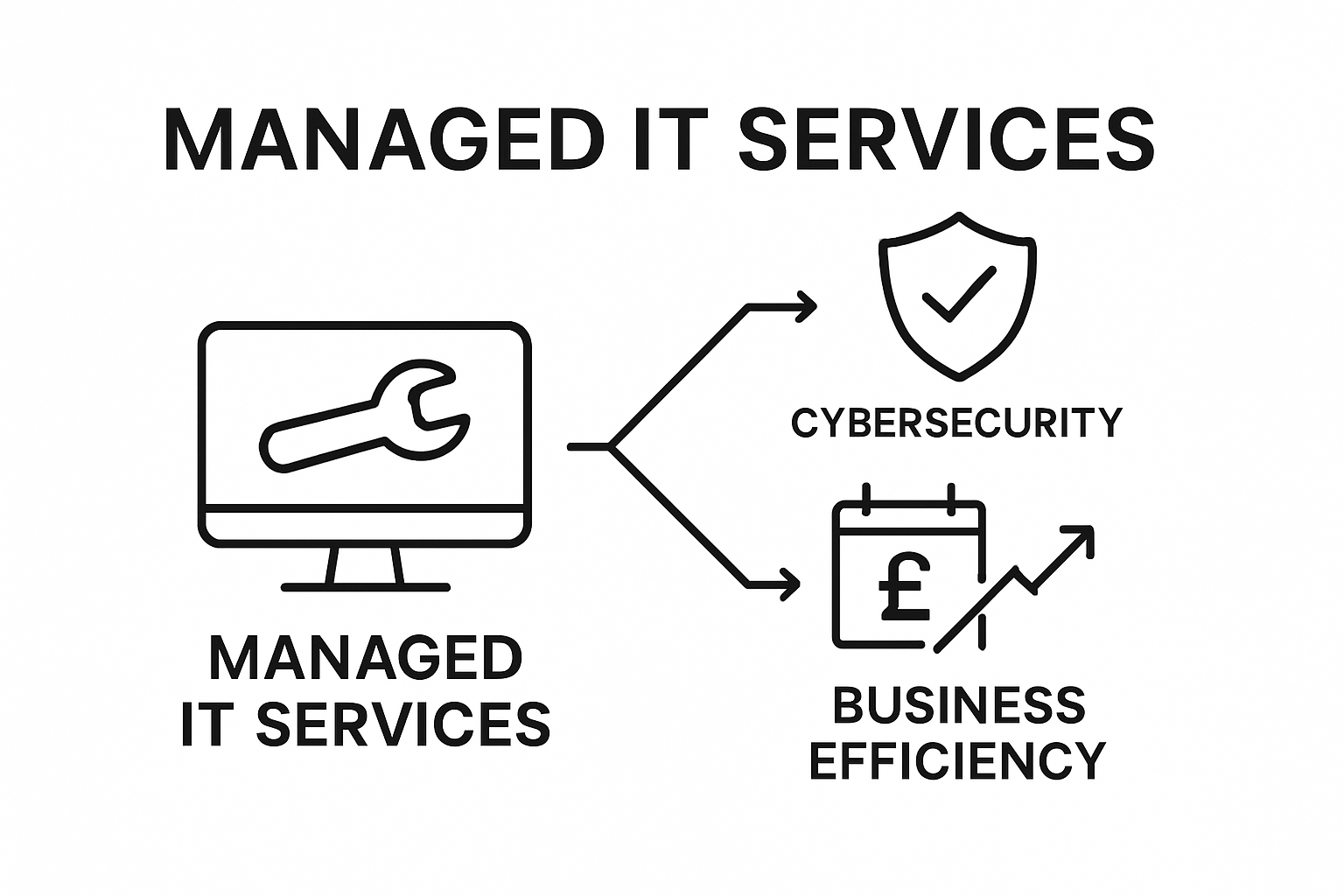
Managed IT services represent a comprehensive approach to handling an organisation’s technology infrastructure and support needs through external expert providers. Unlike traditional break-fix IT support models, managed services offer proactive, continuous technological management designed to optimise business performance and reduce operational risks.
The following table summarises the core features that distinguish managed IT services from traditional IT support, highlighting how managed services provide ongoing value to businesses.
| Feature/Characteristic | Managed IT Services | Traditional IT Support |
|---|---|---|
| Approach | Proactive and continuous management | Reactive (break-fix) |
| Pricing Structure | Predictable monthly operational costs | Unpredictable capital expenses |
| Expertise Access | Enterprise-grade, wide-ranging expertise | Usually limited to in-house team |
| Risk Management | Proactive risk identification and prevention | Often responds post-incident |
| Scalability | Easily scalable to business needs | More difficult to scale |
| Business Focus | Enables focus on core business activities | Time-consuming internal IT tasks |
| System Monitoring | Continuous and automated | Typically ad hoc/manual |
At its fundamental level, managed IT services involve outsourcing specific technology responsibilities to specialised providers who assume complete accountability for maintaining, monitoring, and improving technological systems. According to UK Government Research, these services encompass a broad spectrum of technological support, involving organisations that deliver critical IT solutions across multiple business domains.
Key characteristics of managed IT services include:
Businesses increasingly recognise managed IT services as strategic investments rather than mere operational expenses. By partnering with professional technology providers, organisations can redirect internal resources towards core business objectives while ensuring robust, secure, and efficient technological infrastructure.
The primary objective of managed IT services is transforming technology from a potential operational burden into a strategic enabler of business growth. Providers like J700 Group offer comprehensive solutions that integrate seamless technological support, cybersecurity protection, cloud computing, and connectivity solutions specifically designed for small and medium enterprises across Lancashire and the North West.
Through professional managed IT services, businesses gain access to enterprise-grade technological capabilities without substantial upfront capital investments, allowing for more agile and responsive technological strategies.
Businesses today operate in an increasingly complex technological landscape where robust, secure, and efficient IT infrastructure is not merely an advantage but a fundamental requirement for survival and growth. Managed IT services have emerged as a critical solution for organisations seeking to navigate these technological challenges effectively.
In the current digital environment, technological risks represent significant potential threats to business continuity. UK Government Research emphasises that managed services provide organisations with structured approaches to mitigating technological vulnerabilities. By partnering with professional IT service providers, businesses can address critical risk management challenges.
Key technological risk areas managed through professional services include:
Managed IT services transform technology expenditure from unpredictable capital investments into structured, predictable operational expenses. Small and medium enterprises particularly benefit from this model, gaining access to enterprise-grade technological capabilities without substantial upfront investments. Learn more about outsourcing IT support for your business.
Businesses leveraging managed IT services can reallocate internal resources towards core strategic objectives, instead of dedicating significant time and personnel to complex technological management. This approach enables organisations to maintain technological agility while reducing overall operational complexity.
The strategic value of managed IT services extends beyond immediate technological support. These services provide businesses with continuous technological expertise, ensuring systems remain updated, secure, and aligned with evolving business requirements. By transforming technology from a potential operational burden into a strategic enabler, managed IT services help organisations build more resilient, efficient, and competitive technological infrastructures.

Managed IT services represent a sophisticated ecosystem of technological support, delivering comprehensive solutions through structured, strategic approaches. These services go far beyond simple technical maintenance, integrating advanced methodologies to ensure businesses receive holistic technological management.
The operational model of managed IT services is built upon a robust framework of proactive monitoring, strategic planning, and continuous improvement.
This table organises the key components of managed IT services to clarify the main areas these providers cover for businesses seeking comprehensive technological management.
| Key Component | Purpose/Description |
|---|---|
| Continuous System Monitoring | 24/7 observation to detect and prevent issues early |
| Predictive Maintenance | Routine upkeep to address potential disruptions proactively |
| Incident Response | Rapid intervention to resolve IT problems swiftly |
| Performance Assessments | Regular reviews to ensure systems operate optimally |
| Technology Infrastructure Optimisation | Strategic improvements to maximise efficiency and resilience |
| Strategic Planning | Aligning IT with business goals and growth |
| UK Government Research highlights the importance of structured service management approaches that enable businesses to maintain technological resilience. |
Key operational components include:
Professional managed IT services employ sophisticated processes designed to address technological challenges comprehensively. Proactive management means identifying potential issues before they escalate, implementing preventative measures that minimize disruption and maintain operational continuity. Explore our comprehensive IT support solutions to understand how these processes work in practice.
The service delivery typically encompasses multiple interconnected stages: initial assessment, strategic planning, implementation, continuous monitoring, and periodic review. This cyclical approach ensures that technological infrastructure remains adaptive, secure, and aligned with evolving business objectives.
By integrating advanced technological expertise with strategic planning, managed IT services transform complex technological ecosystems into streamlined, efficient operational frameworks. The ultimate goal is creating technological environments that not only support but actively enhance business performance and innovation.
In an increasingly digital business landscape, managed IT services have transformed from optional extras to fundamental strategic assets. Companies seeking competitive advantages recognize these services as critical investments that deliver substantial operational and financial benefits beyond traditional technological support.
UK Government Research demonstrates that managed IT services offer significant economic benefits for organisations. By converting unpredictable capital expenditures into structured, predictable operational expenses, businesses can achieve more precise financial planning and resource allocation.
Key financial benefits include:
Managed IT services provide businesses with access to enterprise-grade technological expertise that would typically be prohibitively expensive to develop internally. Advanced technological capabilities become immediately accessible, enabling organisations to leverage cutting-edge solutions without substantial upfront investments. Discover whether outsourcing IT support is right for your business.
Professional managed services deliver comprehensive technological support that encompasses cybersecurity, system maintenance, cloud infrastructure, and strategic technological planning. This holistic approach ensures businesses remain technologically agile, secure, and competitive in rapidly evolving digital environments.
By partnering with managed IT service providers, companies transform technology from a potential operational burden into a strategic enabler of growth, innovation, and operational efficiency. The result is a more resilient, adaptable, and technologically sophisticated business infrastructure that supports long-term organisational objectives.
Are you feeling overwhelmed by unreliable systems or worried about security gaps? As discussed in the article, managed IT services remove the constant stress of technological issues by giving your business continuous performance, predictable costs and advanced protection. At J700 Group, we specialise in solutions designed to keep Lancashire and North West businesses safe, efficient and ahead of the curve. Discover more about our tailored IT support by exploring our Microsoft expertise for smarter productivity and seamless tech experiences.
Stop letting slow networks and technical breakdowns disrupt your workflow. Join other forward-thinking SMEs who have switched to J700 Group for genuine managed IT support and direct help from local experts. Visit our home page now to secure your business technology and unlock smoother operations. The risks of waiting are too high and support for your growth is close at hand.
Managed IT services involve outsourcing specific technology responsibilities to expert providers who handle the maintenance, monitoring, and improvement of a business’s technological systems.
Managed IT services provide businesses with proactive technological management, cost-effective solutions, access to advanced expertise, and the ability to focus on core business objectives, ultimately transforming technology into a strategic enabler of growth.
Key components include continuous system monitoring, predictive maintenance strategies, incident response protocols, regular performance assessments, and overall technology infrastructure optimisation.
Managed IT services address critical risk management areas such as cybersecurity protection, data breach prevention, regulatory compliance, network security monitoring, and disaster recovery planning, enabling businesses to mitigate potential technological threats.
For years, businesses protected their data like a medieval castle: build a thick wall (a…
Read More
For many small and medium-sized businesses, cybersecurity is still viewed as an IT problem. Firewalls,…
Read More
Cloud technology is no longer a luxury or a cost-saving alternative to on-site servers. For…
Read More
Remember when we jokingly wondered if Apple was borrowing our name? Well, the rumours were…
Read More
AI hasn’t just changed the way we work, it has completely rewritten the rulebook for…
Read More
For many businesses, the office phone is like part of the furniture, it’s always there,…
Read More
We are thrilled to announce a significant milestone in the J700 Group journey. To keep…
Read More
For years, many small and medium-sized business owners in the North West have operated under…
Read More
In a modern healthcare setting, the stethoscope and the blood pressure cuff aren’t the only…
Read More
When people hear the word cybersecurity, they often imagine complex systems, expensive software and specialist…
Read More
As we count down to midnight, most of us are thinking about gym memberships or…
Read More
It’s Christmas Eve in Lancashire. The Preston bypass is a nightmare, the last-minute dash to…
Read More
For many businesses, the Christmas period means quieter offices, reduced staffing and systems left running…
Read More
Or: Why we’d like to have a word with Tim Cook this Christmas. There are…
Read More
Hackers Love Christmas: Learn Why your Business Could be at Risk This Holiday SeasonThe festive…
Read More
In recent months, high-profile companies like Land Rover and Co-op have made headlines due to…
Read More
Explore 7 essential tips for effective cloud solutions comparison to find the best fit for…
Read More
Learn how to secure business data for UK SMEs with this step-by-step guide focused on…
Read More
Cybersecurity basics explained for UK businesses—core concepts, major threats, essential safeguards, and compliance requirements. A…
Read More
Discover the essential role of IT support desks, core functions, key benefits, types of support,…
Read More
Discover 10 microsoft 365 alternatives for UK SMEs, comparing features and benefits to help your…
Read More
Discover the best microsoft 365 alternatives in our comparison of 10 top products to enhance…
Read More
Discover a business connectivity checklist with 7 actionable steps to boost IT reliability, security, and…
Read More
Discover 7 essential business continuity planning steps to protect your SME. Learn practical strategies for…
Read More
Small Business Office 365 comprehensive guide for UK SMEs: core features, setup process, security essentials,…
Read More
Small Business Office 365 guide for UK firms. Learn core features, setup, security, costs, and…
Read More
Small business Office 365 guide covering essential features, security, costs, local support, and practical benefits…
Read More
Follow this cybersecurity checklist for SMEs to secure your business in Lancashire and Manchester. Step-by-step…
Read More
Follow this cybersecurity checklist for SMEs to boost protection, reduce risks, and secure business data…
Read More
Cloud security explained: A comprehensive guide for UK businesses covering threat types, protection strategies, compliance,…
Read More
Data protection strategies for UK SMEs—types, key components, GDPR compliance, business risks, and best practices…
Read More
Why cybersecurity matters for UK businesses: core concepts, main risks, common threats, legal requirements, and…
Read More
Comprehensive guide to IT issues Lancashire businesses face, including security threats, system downtime, cloud solutions,…
Read More
Comprehensive guide on cyber security threats in the UK. Learn common types, key characteristics, real-world…
Read More
Follow this IT security checklist for a step-by-step process to secure your business effectively in…
Read More
Explore the benefits of managed IT services for businesses in Manchester and Lancashire, enhancing efficiency…
Read More
Explore the role of cybersecurity in business. Understand its importance, how it works, and key…
Read More
Discover 7 key advantages of Microsoft 365 for SMEs that can enhance productivity, collaboration, and…
Read More
Explore why use managed IT services and how they benefit businesses. Gain comprehensive insights on…
Read More
Comprehensive guide explaining cyber threats, focusing on their importance, how they work, and the key…
Read More