



For years, businesses protected their data like a medieval castle: build a thick wall (a…
Read More
Business continuity sounds like a complicated phrase, but every organisation relies on it to stay afloat when the unexpected hits. Think floods, cyber attacks, or global health crises. Yet while many believe only major disasters threaten survival, the reality is striking. Companies with solid business continuity plans are 2.5 times more likely to survive major disruptions. You might expect high costs or complexity, but what actually sets these plans apart is their ability to turn chaos into calm with clear, structured action.
| Takeaway | Explanation |
|---|---|
| Business continuity ensures operational resilience | It focuses on maintaining critical business functions during disruptions, safeguarding against potential threats. |
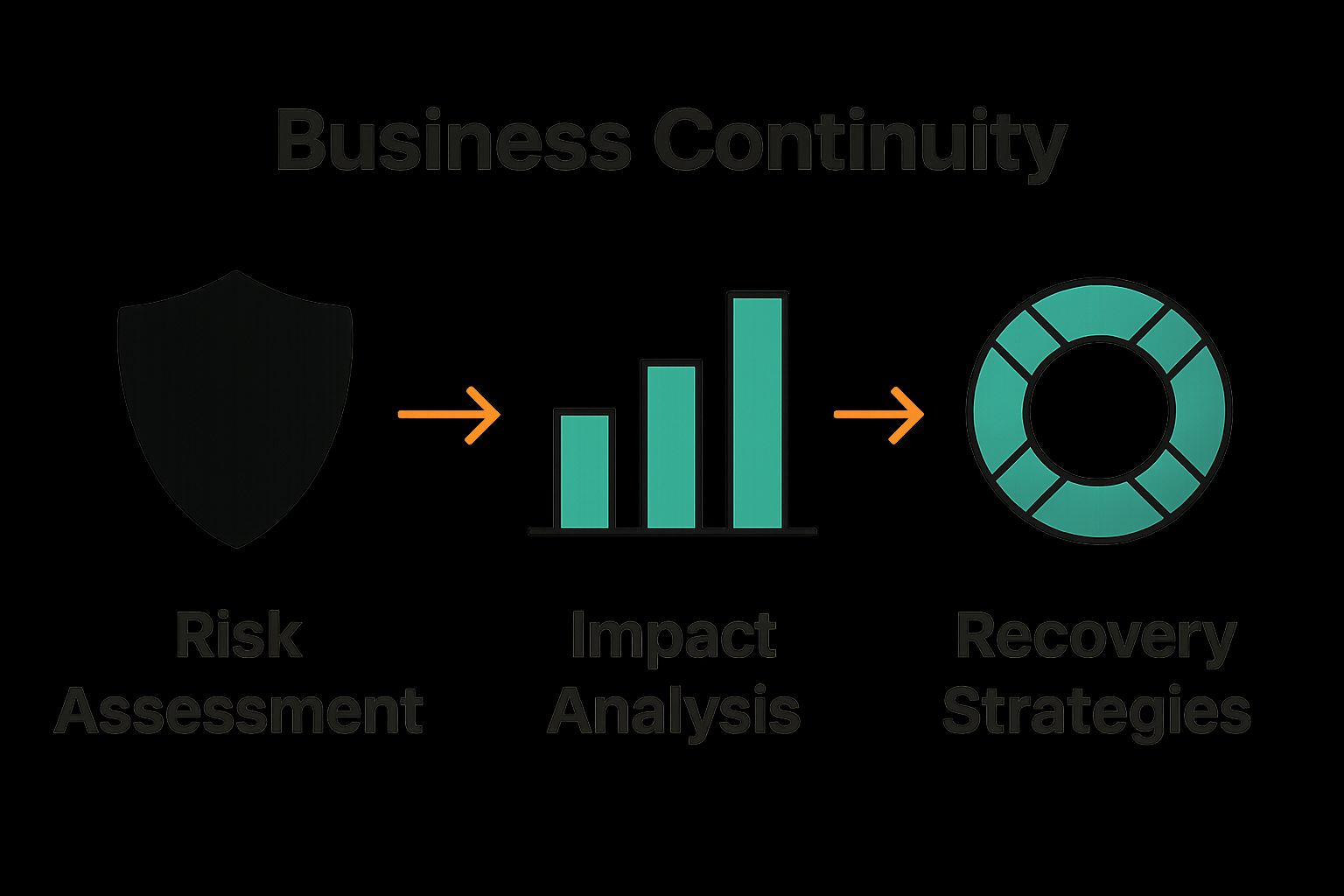
| Effective planning includes risk assessments | Systematic identification of threats and impact analysis are vital for developing strong recovery strategies. |
| Organisations with plans recover faster | Companies with robust business continuity strategies significantly reduce recovery times and financial losses during unexpected events. |
| Integration of technology and human resources is crucial | A holistic approach enhances resilience by combining advanced tech with effective human adaptability and teamwork. |
| Prepare for diverse risks, including cyber threats | Anticipating technological and cybersecurity risks allows businesses to establish proactive protective measures against disruptions. |
Business continuity represents a strategic approach organisations use to prepare for, respond to, and recover from potential disruptions that could threaten normal operational processes. Unlike traditional risk management, business continuity focuses on maintaining critical functions during unexpected challenges, ensuring your enterprise remains resilient and operational.
At its core, business continuity is about creating comprehensive plans that safeguard an organisation’s ability to function during and after significant interruptions. According to Disaster Recovery Journal, effective business continuity planning involves multiple critical components
 :
:
These strategies help businesses anticipate potential scenarios and develop robust response mechanisms. By understanding potential vulnerabilities, organisations can create proactive frameworks that minimise downtime and financial losses.
Business continuity goes beyond mere survival. It represents a strategic investment in organisational resilience. The Business Continuity Institute reports that companies with comprehensive continuity plans experience significantly reduced recovery times and financial impact during unexpected events.
The primary objectives of business continuity include:
By developing a robust business continuity strategy, organisations demonstrate their commitment to sustainable operations, stakeholder protection, and long-term strategic planning. This approach transforms potential vulnerabilities into structured, manageable challenges that can be systematically addressed and overcome.
In an increasingly complex and unpredictable business landscape, business continuity has transformed from a peripheral consideration to a critical strategic imperative. Modern enterprises face multifaceted risks that can emerge suddenly and disrupt operations with devastating consequences.
Technological disruptions, cybersecurity threats, and economic volatility demand sophisticated preparedness. Gartner Research highlights that organisations with robust business continuity plans are 2.5 times more likely to survive major operational challenges. These plans are not merely defensive mechanisms but strategic tools for maintaining competitive advantage.
Key technological vulnerabilities include:
By anticipating these risks, businesses can develop proactive strategies that protect their core operational capabilities and maintain stakeholder confidence. Our guide on business continuity planning essentials provides deeper insights into developing comprehensive protective strategies.
Below is a comparative table outlining the main types of risks that modern enterprises must anticipate as part of business continuity planning, alongside example scenarios and their possible impacts.
| Risk Type | Example Scenario | Potential Impact |
|---|---|---|
| Cybersecurity Threats | Ransomware attack on IT systems | Loss of data access, reputational harm, and financial penalties |
| System/Technology Failure | Server outage or network crash | Interruption of business operations and possible revenue loss |
| Economic Volatility | Sudden market downturn | Reduced customer demand, tightened cash flow, risk to sustainability |
| Data Loss | Corrupted or accidentally deleted files | Loss of critical records and operational disruption |
| Natural Disasters | Flooding of business premises | Physical asset damage, prolonged operational downtime |
| Health Crises | Pandemic limiting workforce presence | Disrupted supply chains and forced closure of physical sites |
Business continuity extends far beyond technical preparedness. According to The Economist Intelligence Unit, organisations without effective continuity plans can experience significant financial losses, potentially compromising long-term sustainability.
The financial implications of inadequate business continuity include:
Successful business continuity strategies demonstrate an organisation’s commitment to resilience, transforming potential vulnerabilities into opportunities for strategic adaptation and growth. By systematically addressing potential disruptions, enterprises can create more agile, responsive operational frameworks that protect their most valuable assets: their people, processes, and reputation.

Developing a comprehensive business continuity plan requires strategic thinking, detailed analysis, and systematic preparation. These plans serve as critical blueprints for organisational resilience, enabling businesses to navigate complex challenges with precision and confidence.
Effective business continuity planning begins with thorough risk identification and evaluation. Deloitte’s Risk Management Framework emphasises the importance of understanding potential vulnerabilities across operational, technological, and human resource domains.
Key components of comprehensive risk assessment include:
Organisations must develop nuanced approaches that consider both predictable and unexpected scenarios. Our guide to business continuity planning provides deeper insights into creating robust strategic frameworks.
Beyond identifying risks, business continuity planning requires developing precise, actionable recovery strategies. According to The Business Continuity Institute, successful plans incorporate multiple layers of response mechanisms that enable rapid, coordinated action.
Critical recovery strategy elements encompass:
These strategies transform potential vulnerabilities into structured, manageable challenges. By creating flexible, adaptable frameworks, organisations can maintain operational integrity during unexpected disruptions, protecting their most valuable assets and stakeholder interests.
The following table provides a summary of the key elements found in a comprehensive business continuity plan, offering readers a succinct view of critical planning components and their core purposes.
| Key Element | Purpose/Explanation |
|---|---|
| Risk Assessment | Systematically identifies internal and external threats to business operations |
| Impact Analysis | Evaluates the likely consequences of operational disruptions |
| Recovery Strategies | Outlines specific methods to restore critical business functions |
| Communication Protocols | Establishes clear channels and guidelines for communication during a disruption |
| Alternate Operational Procedures | Defines backup processes to ensure continuity of essential functions |
| Technology and Data Recovery | Details mechanisms for recovering technical systems and vital company data |
| Regular Testing and Refinement | Ensures plans remain effective, up-to-date, and aligned with changing operational needs through routine reviews |
Business continuity operates as a dynamic, integrated system that enables organisations to anticipate, respond, and recover from potential operational disruptions. It is not a static document but a living, adaptable strategy that evolves with changing business landscapes and emerging technological challenges.
The International Organization for Standardization (ISO) provides detailed frameworks for implementing robust business continuity processes. These frameworks emphasise a systematic approach that transforms potential vulnerabilities into structured, manageable strategies.
Key implementation stages include:
Effective business continuity requires ongoing commitment, transforming theoretical plans into practical, actionable strategies. Our comprehensive overview on the importance of business continuity offers additional insights into developing resilient organisational strategies.
Successful business continuity transcends technological solutions, integrating human expertise with advanced technological capabilities. According to Gartner Research, organisations with integrated human and technological approaches demonstrate significantly higher resilience.
Critical integration components involve:
By creating holistic frameworks that balance technological infrastructure with human adaptability, organisations can develop comprehensive business continuity strategies that protect their operational integrity and strategic objectives.
Business continuity strategies are not abstract theoretical concepts but practical frameworks that have proven crucial in protecting organisations during unprecedented challenges. Real-world scenarios demonstrate how comprehensive planning can make the difference between organisational survival and catastrophic failure.
Harvard Business Review documented how organisations with robust business continuity plans rapidly adapted during the COVID-19 pandemic. Companies with pre-existing remote work infrastructure and flexible operational strategies experienced minimal disruption, while those lacking preparedness struggled significantly.
Successful pandemic business continuity strategies typically involved:
Our comprehensive overview on business continuity planning provides deeper insights into developing adaptive organisational strategies.
Cybersecurity incidents represent another critical domain where business continuity planning proves essential. According to IBM’s Security Report, organisations with comprehensive incident response plans reduced potential financial losses by an average of 35% during cyber attacks.
Effective cybersecurity business continuity approaches include:
These examples illustrate that business continuity is not about preventing every possible disruption, but about creating adaptive, responsive frameworks that enable organisations to maintain operational integrity under challenging circumstances.
If you have just read about business continuity, you understand how a single disruption or cyber incident can put your operations at risk. Are you anxious about system outages, data security threats, or not having the right recovery strategy? Many local businesses face these exact pain points, often watching valuable time and money slip away. The article highlighted the need for proactive planning, robust recovery strategies, and dependable IT support. This is where J700 Group becomes your trusted partner for resilience and operational peace of mind.

Do not wait until your business faces a real crisis to act. Discover how our Lancashire-based team delivers comprehensive IT services, including managed systems, cybersecurity, and cloud solutions, designed to keep your business safe and productive. Get expert advice tailored to your needs and safeguard your business functions. Start securing your future today by contacting J700 Group. If you want to learn more about creating a robust continuity strategy, read our business continuity plan essentials guide or check the comprehensive business continuity planning guide.
Business continuity refers to the strategies and processes that organisations use to prepare for, respond to, and recover from disruptions that affect normal operations. It ensures that critical functions remain operational during unexpected challenges.
Business continuity is crucial as it protects critical business processes, maintains customer confidence, minimises financial and reputational damage, ensures regulatory compliance, and provides guidance during crises. It represents an investment in organisational resilience.
A comprehensive business continuity plan typically includes risk assessment, impact analysis, developing recovery strategies, clear communication protocols, and regular testing and refinement of strategies to ensure effectiveness in the face of disruptions.
A business continuity plan should be regularly reviewed and updated, ideally annually or whenever there are significant changes in operations, technology, or personnel. Regular testing and drills also help identify areas for improvement and ensure preparedness.
For years, businesses protected their data like a medieval castle: build a thick wall (a…
Read More
For many small and medium-sized businesses, cybersecurity is still viewed as an IT problem. Firewalls,…
Read More
Cloud technology is no longer a luxury or a cost-saving alternative to on-site servers. For…
Read More
Remember when we jokingly wondered if Apple was borrowing our name? Well, the rumours were…
Read More
AI hasn’t just changed the way we work, it has completely rewritten the rulebook for…
Read More
For many businesses, the office phone is like part of the furniture, it’s always there,…
Read More
We are thrilled to announce a significant milestone in the J700 Group journey. To keep…
Read More
For years, many small and medium-sized business owners in the North West have operated under…
Read More
In a modern healthcare setting, the stethoscope and the blood pressure cuff aren’t the only…
Read More
When people hear the word cybersecurity, they often imagine complex systems, expensive software and specialist…
Read More
As we count down to midnight, most of us are thinking about gym memberships or…
Read More
It’s Christmas Eve in Lancashire. The Preston bypass is a nightmare, the last-minute dash to…
Read More
For many businesses, the Christmas period means quieter offices, reduced staffing and systems left running…
Read More
Or: Why we’d like to have a word with Tim Cook this Christmas. There are…
Read More
Hackers Love Christmas: Learn Why your Business Could be at Risk This Holiday SeasonThe festive…
Read More
In recent months, high-profile companies like Land Rover and Co-op have made headlines due to…
Read More
Explore 7 essential tips for effective cloud solutions comparison to find the best fit for…
Read More
Learn how to secure business data for UK SMEs with this step-by-step guide focused on…
Read More
Cybersecurity basics explained for UK businesses—core concepts, major threats, essential safeguards, and compliance requirements. A…
Read More
Discover the essential role of IT support desks, core functions, key benefits, types of support,…
Read More
Discover 10 microsoft 365 alternatives for UK SMEs, comparing features and benefits to help your…
Read More
Discover the best microsoft 365 alternatives in our comparison of 10 top products to enhance…
Read More
Discover a business connectivity checklist with 7 actionable steps to boost IT reliability, security, and…
Read More
Discover 7 essential business continuity planning steps to protect your SME. Learn practical strategies for…
Read More
Small Business Office 365 comprehensive guide for UK SMEs: core features, setup process, security essentials,…
Read More
Small Business Office 365 guide for UK firms. Learn core features, setup, security, costs, and…
Read More
Small business Office 365 guide covering essential features, security, costs, local support, and practical benefits…
Read More
Follow this cybersecurity checklist for SMEs to secure your business in Lancashire and Manchester. Step-by-step…
Read More
Follow this cybersecurity checklist for SMEs to boost protection, reduce risks, and secure business data…
Read More
Cloud security explained: A comprehensive guide for UK businesses covering threat types, protection strategies, compliance,…
Read More
Data protection strategies for UK SMEs—types, key components, GDPR compliance, business risks, and best practices…
Read More
Why cybersecurity matters for UK businesses: core concepts, main risks, common threats, legal requirements, and…
Read More
Comprehensive guide to IT issues Lancashire businesses face, including security threats, system downtime, cloud solutions,…
Read More
Comprehensive guide on cyber security threats in the UK. Learn common types, key characteristics, real-world…
Read More
Follow this IT security checklist for a step-by-step process to secure your business effectively in…
Read More
Explore the benefits of managed IT services for businesses in Manchester and Lancashire, enhancing efficiency…
Read More
Explore the role of cybersecurity in business. Understand its importance, how it works, and key…
Read More
Discover 7 key advantages of Microsoft 365 for SMEs that can enhance productivity, collaboration, and…
Read More
Explore why use managed IT services and how they benefit businesses. Gain comprehensive insights on…
Read More
Comprehensive guide explaining cyber threats, focusing on their importance, how they work, and the key…
Read More