





Why Zero Trust Security Is No Longer Optional for Lancashire and Manchester SMEs Most small…
Read More
Every organisation faces the risk of sudden disruption, with nearly 1 in 5 businesses in the UK experiencing major interruptions each year. You might think the biggest challenge is surviving the initial shock or crisis. What really matters is whether a business can keep running smoothly no matter what comes its way, and that’s where true continuity unfolds.
| Takeaway | Explanation |
|---|---|
| Business continuity ensures operational resilience. | It prepares organisations to sustain critical functions during unexpected disruptions, maintaining service delivery. |
| Key components include risk assessment and planning. | Identifying threats and creating strategies are vital for managing potential disruptions effectively. |
| Public and private sectors demonstrate successful practices. | Real-world examples show agility through protocols, backup systems, and remote work capabilities. |
| Regularly updating plans is essential. | Continuous reviews keep business continuity strategies relevant and adaptive to changing circumstances and emerging risks. |
| View business continuity as a strategic investment. | Effective planning transforms potential threats into opportunities, enhancing overall organisational competitiveness. |
Business continuity represents a strategic approach organisations use to prepare for, respond to, and recover from unexpected disruptions that could potentially interrupt normal business operations. At its core, business continuity is about maintaining critical functions and ensuring an organisation can continue delivering essential products or services during challenging circumstances.
According to the UK Government guidance, business continuity is defined as “the capability of an organisation to continue delivery of products or services at acceptable pre-defined levels following a disruptive incident”. This definition encapsulates several critical aspects of the concept:
Effective business continuity involves multiple interconnected elements that work together to protect an organisation’s operational integrity. These components typically include:
Business continuity goes beyond simple disaster recovery. While disaster recovery focuses primarily on restoring technical infrastructure, business continuity encompasses a broader approach that considers the entire organisational ecosystem, including people, processes, technology, and stakeholder relationships.
The ultimate goal is resilience: building an organisation capable of withstanding, adapting to, and rapidly recovering from unexpected challenges while minimising potential negative impacts on performance, reputation, and financial stability.
Below is a table summarising the key components of business continuity, clarifying their purpose and how they contribute to organisational resilience.
| Component | Purpose | Contribution to Resilience |
|---|---|---|
| Risk Assessment | Identify potential threats and vulnerabilities | Enables early insight into risks and informed action |
| Planning | Develop strategies to mitigate disruptions | Ensures preparedness across all business areas |
| Response Mechanisms | Establish clear protocols for immediate action | Promotes swift and coordinated crisis management |
| Recovery Strategies | Create procedures to restore normal operations | Minimises downtime and financial loss |
| Ongoing Review and Update | Continually revise and test plans | Ensures adaptability and relevance for emerging risks |
Business continuity represents a critical strategic framework that enables organisations to protect their operational integrity, maintain stakeholder confidence, and ensure long-term sustainability in an increasingly unpredictable business environment. By proactively preparing for potential disruptions, businesses can transform potential vulnerabilities into opportunities for resilience and strategic adaptation.
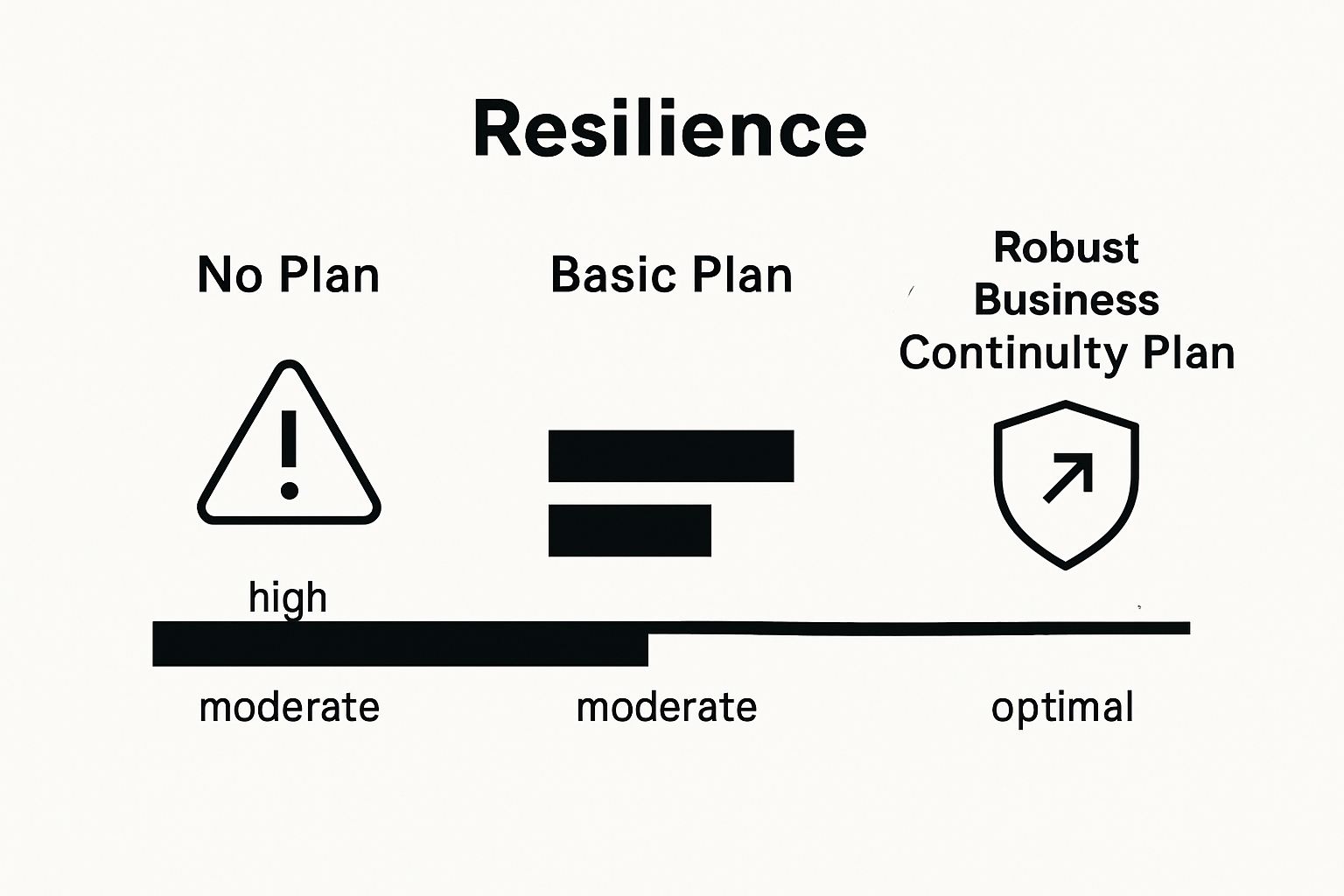
UK Government research highlights the vital role of business continuity, particularly for small and medium-sized enterprises (SMEs) that form the backbone of economic growth. These organisations must develop robust strategies to manage potential challenges effectively. The financial implications of poor business continuity planning can be substantial, potentially resulting in:
Business continuity goes beyond mere risk management. It is a strategic approach that demonstrates an organisation’s ability to respond dynamically to unexpected challenges. Companies with comprehensive continuity plans gain several competitive advantages:
Moreover, business continuity planning enables organisations to systematically identify potential vulnerabilities, develop targeted mitigation strategies, and create flexible response mechanisms. This approach transforms potential threats into opportunities for innovation and strategic refinement.
The most successful organisations view business continuity not as a compliance exercise, but as a strategic investment in their long-term resilience and adaptability. By developing comprehensive plans that address technological, human, and operational dimensions, businesses can build a robust framework capable of navigating complex and unpredictable business landscapes.
Business continuity operates as a systematic approach that enables organisations to design, implement, and maintain strategies for managing potential disruptions. It is a comprehensive process that requires careful planning, continuous assessment, and adaptive implementation across multiple organisational dimensions.
According to British Standard guidance, the initial phase of business continuity involves a structured framework for understanding and preparing an organisation’s resilience. This critical stage encompasses several essential activities:
Effective business continuity requires creating robust response strategies that can be rapidly deployed during unexpected events. These mechanisms must be flexible, practical, and tailored to the specific needs of the organisation. Key elements include:
The most successful business continuity approaches integrate these components into a holistic system that allows organisations to anticipate, respond to, and recover from potential disruptions with minimal operational impact. By treating business continuity as a dynamic, ongoing process rather than a static document, organisations can build genuine resilience that adapts to changing business landscapes and emerging challenges.

Business continuity planning transcends theoretical frameworks, revealing its true value through practical implementation across diverse organisational contexts. Real-world scenarios demonstrate how strategic preparation can make the difference between organisational survival and potential collapse during unexpected disruptions.
UK Cabinet Office research reveals that nearly 1 in 5 businesses encounter major disruptions annually, underscoring the critical importance of robust continuity strategies. Public sector organisations have developed sophisticated approaches to managing potential risks:
Private sector organisations have implemented innovative business continuity strategies that demonstrate remarkable adaptability. Successful approaches typically involve:
These real-world implementations highlight that effective business continuity is not about preventing all potential disruptions, but about developing organisational flexibility and rapid response mechanisms. By understanding potential vulnerabilities and creating adaptive strategies, businesses can transform potential challenges into opportunities for demonstrating resilience and professionalism.
This table compares public sector and private sector approaches to business continuity planning, highlighting their typical strategies and main objectives.
| Sector | Typical Strategies | Main Objectives |
|---|---|---|
| Public Sector | Emergency response protocols, multi-tier communication, | Ensure uninterrupted public services, |
| flexible backup systems | safeguard community confidence | |
| Private Sector | Technological redundancy, remote work capabilities, | Protect revenue, maintain business reputation, |
| rapid decision-making, cross-training staff | enhance agility and competitive advantage |
Business continuity planning is not a straightforward process, but a complex journey involving multiple strategic considerations and potential obstacles. Organisations must navigate intricate challenges while developing robust frameworks that can effectively protect their operational integrity and respond to unpredictable disruptions.
UK Cabinet Office guidance emphasises the critical importance of understanding an organisation’s unique risk landscape. These vulnerabilities can manifest in various dimensions:
Successful business continuity requires a proactive and holistic approach to addressing potential challenges. Key strategic solutions include:
The most effective organisations treat business continuity not as a static document, but as a dynamic, evolving process. By embracing technological innovations, fostering organisational adaptability, and maintaining a forward-looking perspective, businesses can transform potential vulnerabilities into opportunities for strategic resilience and continuous improvement.
Are you struggling to maintain operational continuity while facing ongoing IT challenges? The article highlighted how critical business continuity is for real resilience, yet many organisations are left vulnerable due to unreliable infrastructure, outdated technology, or lack of proactive planning. Downtime, data loss, and slow systems quickly erode both profits and confidence.
With J700 Group, you do not have to face these risks alone. We understand the stress that comes from technical disruptions, security threats, or uncertainty about your digital future. Our team in Lancashire delivers managed IT services, robust cybersecurity, and business connectivity that aligns with the principles of strong business continuity. Your systems stay reliable, secure, and always ready—no matter what.

Let us help you build the resilience your business deserves. Speak to a local expert and discover how we keep SMEs running safely and efficiently, every single day. Now is the time to turn IT vulnerabilities into strengths for lasting peace of mind. Take the next step and get in touch with the J700 Group team to protect your business today.
Business continuity is a strategic approach that organisations use to prepare for, respond to, and recover from unexpected disruptions in order to maintain critical functions and ensure continued delivery of essential products or services.
Business continuity is crucial as it protects operational integrity, maintains stakeholder confidence, and ensures long-term sustainability by proactively preparing for potential disruptions, thus transforming vulnerabilities into opportunities.
Key components include risk assessment, planning, response mechanisms, and recovery strategies. These elements work together to help organisations maintain operations during disruptions and ensure a swift recovery.
Organisations can implement effective business continuity plans by conducting comprehensive risk assessments, developing flexible response strategies, maintaining regular updates to plans, and fostering cross-functional training to enhance workforce resilience.

Why Zero Trust Security Is No Longer Optional for Lancashire and Manchester SMEs Most small…
Read More
A practical guide for SMEs across Lancashire and the North West If you’ve been hearing…
Read More
Running a business in Lancashire is hard enough without your IT company adding to your…
Read More
Most businesses don’t lose data because of a dramatic cyberattack. They lose it, or expose…
Read More
For manufacturers, downtime isn’t just frustrating, it’s expensive. When production stops, everything slows down. Orders…
Read More
Artificial Intelligence is no longer something businesses are experimenting with. In 2026, it’s becoming part…
Read More
An email landed in my inbox this week from “Jonathan Cundliffe” — our Managing Director.…
Read More
For years, businesses protected their data like a medieval castle: build a thick wall (a…
Read More
For many small and medium-sized businesses, cybersecurity is still viewed as an IT problem. Firewalls,…
Read More
Cloud technology is no longer a luxury or a cost-saving alternative to on-site servers. For…
Read More
Remember when we jokingly wondered if Apple was borrowing our name? Well, the rumours were…
Read More
AI hasn’t just changed the way we work, it has completely rewritten the rulebook for…
Read More
For many businesses, the office phone is like part of the furniture, it’s always there,…
Read More
We are thrilled to announce a significant milestone in the J700 Group journey. To keep…
Read More
For years, many small and medium-sized business owners in the North West have operated under…
Read More
In a modern healthcare setting, the stethoscope and the blood pressure cuff aren’t the only…
Read More
When people hear the word cybersecurity, they often imagine complex systems, expensive software and specialist…
Read More
As we count down to midnight, most of us are thinking about gym memberships or…
Read More
It’s Christmas Eve in Lancashire. The Preston bypass is a nightmare, the last-minute dash to…
Read More
For many businesses, the Christmas period means quieter offices, reduced staffing and systems left running…
Read More
Or: Why we’d like to have a word with Tim Cook this Christmas. There are…
Read More
Hackers Love Christmas: Learn Why your Business Could be at Risk This Holiday SeasonThe festive…
Read More
In recent months, high-profile companies like Land Rover and Co-op have made headlines due to…
Read More
Explore 7 essential tips for effective cloud solutions comparison to find the best fit for…
Read More
Learn how to secure business data for UK SMEs with this step-by-step guide focused on…
Read More
Cybersecurity basics explained for UK businesses—core concepts, major threats, essential safeguards, and compliance requirements. A…
Read More
Discover the essential role of IT support desks, core functions, key benefits, types of support,…
Read More
Discover 10 microsoft 365 alternatives for UK SMEs, comparing features and benefits to help your…
Read More
Discover the best microsoft 365 alternatives in our comparison of 10 top products to enhance…
Read More
Discover the best microsoft 365 alternatives in our comparison of 10 top products to enhance…
Read More
Discover a business connectivity checklist with 7 actionable steps to boost IT reliability, security, and…
Read More
Discover 7 essential business continuity planning steps to protect your SME. Learn practical strategies for…
Read More
Small Business Office 365 comprehensive guide for UK SMEs: core features, setup process, security essentials,…
Read More
Small Business Office 365 guide for UK firms. Learn core features, setup, security, costs, and…
Read More
Small business Office 365 guide covering essential features, security, costs, local support, and practical benefits…
Read More
Follow this cybersecurity checklist for SMEs to secure your business in Lancashire and Manchester. Step-by-step…
Read More
Follow this cybersecurity checklist for SMEs to boost protection, reduce risks, and secure business data…
Read More
Cloud security explained: A comprehensive guide for UK businesses covering threat types, protection strategies, compliance,…
Read More
Data protection strategies for UK SMEs—types, key components, GDPR compliance, business risks, and best practices…
Read More
Why cybersecurity matters for UK businesses: core concepts, main risks, common threats, legal requirements, and…
Read More