



Most businesses don’t lose data because of a dramatic cyberattack. They lose it, or expose…
Read More
Business continuity planning may sound like a safety net for rare disasters. Yet, over 80 percent of businesses hit by major incidents close within 18 months. It is not the disaster itself but the lack of preparation that proves fatal for most companies.
| Takeaway | Explanation |
|---|---|
| Business continuity ensures operational resilience. | It helps organisations maintain critical functions during disruptions, safeguarding their operations against unexpected events. |
| Identify critical business functions. | Knowing which functions are essential allows for targeted recovery strategies in times of crisis to minimise operational impact. |
| Develop a proactive response strategy. | Anticipating potential risks through planning allows organisations to react quickly, significantly reducing the negative effects of disruptions. |
| Enhance stakeholder confidence. | A solid business continuity plan fosters trust among customers and partners, demonstrating reliability during challenging times. |
| Regularly test and update plans. | Dynamic plans that evolve with changing circumstances ensure that preparedness remains robust and responsive to new challenges. |
Business continuity represents a comprehensive strategic approach organisations use to prepare for, respond to, and recover from potential disruptions that could compromise their core operations. Unlike traditional risk management, business continuity focuses on maintaining critical business functions during unexpected challenges.
At its fundamental level, business continuity is about organizational resilience. It involves creating systematic plans and processes that enable a business to continue operating under challenging circumstances. According to the University of Sheffield, business continuity represents the capability of an organization to continue delivering products or services at acceptable predefined levels following a disruptive incident.
Key elements of business continuity include:
Businesses face numerous potential disruptions that could dramatically impact their operations. These might include technological failures, cyberattacks, natural disasters, pandemic-related challenges, or significant infrastructure breakdowns. Without a structured business continuity plan, organisations risk substantial financial losses, reputational damage, and potential operational collapse.
Strategic planning transforms business continuity from a reactive approach to a proactive strategy. By anticipating potential risks and developing comprehensive response mechanisms, businesses can significantly reduce potential negative impacts. This approach ensures that even during unexpected events, core business functions can continue with minimal interruption.
Effective business continuity planning provides organisations with a structured framework to:
Ultimately, business continuity is not just about surviving disruptions but thriving despite them. It represents a sophisticated approach to organizational resilience that goes beyond traditional risk management strategies.
Business continuity is not merely an optional strategy but a critical lifeline for organisations navigating an increasingly unpredictable business landscape. Understanding its profound significance can mean the difference between survival and collapse when unexpected challenges emerge.
The financial implications of inadequate business continuity planning are severe.
This table presents statistical data from the article concerning the importance of business continuity planning, highlighting critical risks and consequences for organisations that are not adequately prepared.
| Statistic | Source |
|---|---|
| 80% of businesses affected by a major incident close within 18 months | Cheshire East Council |
| 90% of businesses that lose critical data shut down within two years | Cheshire East Council |
| Nearly 1 in 5 businesses face significant operational disruption annually | UK Cabinet Office |
| According to Cheshire East Council, a staggering 80% of businesses affected by a major incident close within 18 months, and 90% of businesses that lose critical data are forced to shut down within two years. |
Significant risks that demand robust business continuity strategies include:
Business continuity transcends defensive planning. It represents a proactive approach to organisational resilience that transforms potential vulnerabilities into strategic strengths. By anticipating and preparing for potential disruptions, businesses can develop adaptive capabilities that distinguish them in competitive markets.
Key strategic benefits include:
Effective business continuity planning protects not just the organisation itself, but its entire ecosystem of stakeholders. This includes employees, customers, suppliers, investors, and the broader community. By maintaining operational integrity during challenging times, businesses can minimise disruptions and maintain critical relationships.
The true value of business continuity lies not in preventing every possible risk, but in developing the organisational agility to respond effectively when challenges inevitably arise. It is about creating a resilient, adaptive framework that enables your business to navigate uncertainties with confidence and strategic precision.
Business continuity is a dynamic approach that adapts to various potential disruptions across different organisational contexts. Understanding how these strategies function in multiple scenarios helps businesses develop comprehensive and flexible response mechanisms.
According to the UK Cabinet Office, technological disruptions represent a critical area where business continuity planning becomes essential. Cybersecurity threats, system failures, and digital infrastructure breakdowns can dramatically impact operational capabilities.
Key technological disruption scenarios include:
Comprehensive business continuity planning must address physical and environmental disruptions that can unexpectedly halt business operations. These scenarios range from natural disasters to infrastructure failures that directly impact physical workspace and operational capabilities.
Critical physical disruption scenarios businesses must prepare for include:
Business continuity extends beyond technological and physical challenges to address complex human resource and operational scenarios. This involves creating flexible work arrangements, communication protocols, and alternative operational mechanisms that maintain productivity during unexpected circumstances.
Strategic considerations for human resource continuity include:
The most effective business continuity strategies recognize that no single approach fits all scenarios.
The table below compares the three primary categories of business continuity scenarios discussed in the article, outlining their distinctive challenges and typical response focuses.
| Scenario Category | Key Challenges | Typical Response Focus |
|---|---|---|
| Technological Disruption | Cyberattacks, data system breaches, IT failures | Cybersecurity, backup systems, rapid IT recovery |
| Physical and Environmental Challenges | Natural disasters, infrastructure failures | Physical site recovery, alternative locations, safety protocols |
| Human Resource and Operational Continuity | Staff unavailability, communication breakdowns | Remote work, cross-training, clear leadership protocols |
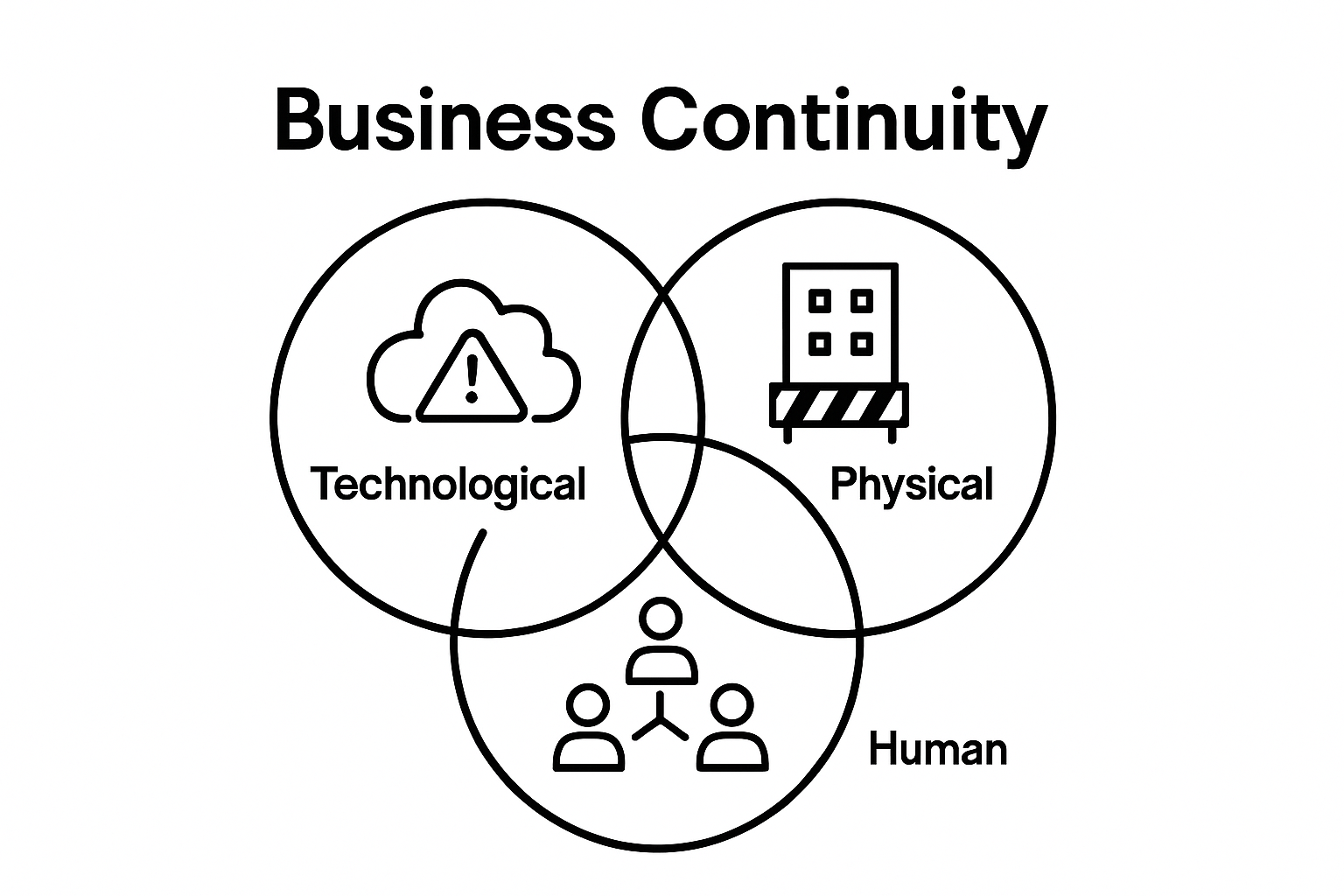 Instead, organisations must develop adaptive, responsive frameworks that can quickly reconfigure and respond to diverse challenges, ensuring operational resilience across multiple potential disruption types.
Business continuity planning represents a sophisticated framework that goes beyond traditional risk management, providing organisations with a strategic approach to maintaining operational integrity during unexpected challenges. Understanding its fundamental concepts is crucial for developing robust resilience strategies.
According to the University of West London, Business Continuity Management (BCM) involves a comprehensive process of identifying and managing potential operational risks. This approach requires a systematic understanding of an organisation’s critical functions and potential vulnerabilities.
Fundamental components include:
This table organises the core components of business continuity planning, summarising the main features of effective plans as outlined in the article.
| Component | Description |
|---|---|
| Risk Identification and Assessment | Evaluating and recognising potential threats and vulnerabilities |
| Critical Function Mapping | Determining essential business operations and processes |
| Vulnerability Analysis | Analysing weak points within the organisation |
| Recovery Strategy Development | Formulating plans for rapid recovery and continuity |
| Ongoing Plan Maintenance | Regularly reviewing and updating the continuity plan |
Business continuity planning operates as a strategic risk management framework that anticipates potential disruptions before they occur. This proactive approach transforms potential vulnerabilities into opportunities for organisational learning and adaptation.
Key strategic elements encompass:
Successful business continuity planning requires more than theoretical understanding. It demands practical implementation strategies that can be rapidly deployed during critical incidents. This involves creating flexible, responsive mechanisms that enable organisations to maintain essential functions under challenging circumstances.
Implementation focuses on:
The most effective business continuity plans are not static documents but dynamic, living strategies that evolve with changing organisational landscapes and emerging technological capabilities. They represent a commitment to organisational resilience, demonstrating an ability to anticipate, respond, and thrive amid uncertainty.
Business continuity is not a theoretical concept but a practical approach that can be observed through strategic implementations across various industries. Understanding how organisations successfully navigate unexpected challenges provides valuable insights into effective resilience strategies.
According to the UK Cabinet Office, businesses face significant disruption risks, with nearly 1 in 5 experiencing major operational challenges annually. Tech companies demonstrate remarkable adaptability in maintaining service continuity.
Notable technology sector examples include:
Robust business continuity planning enables manufacturing organisations to maintain operations during complex disruptions. Successful companies develop sophisticated strategies that anticipate potential supply chain interruptions and create flexible response mechanisms.
Effective manufacturing continuity strategies involve:

Financial institutions demonstrate exceptional business continuity capabilities by creating comprehensive frameworks that protect critical financial services during unexpected events. These organisations invest heavily in technological and human resource resilience strategies.
Key financial services continuity approaches include:
These real-world examples illustrate that effective business continuity transcends mere planning.
It represents a dynamic, proactive approach to organisational resilience that enables businesses to transform potential vulnerabilities into strategic opportunities for growth and adaptation.
Has uncertainty around business continuity left you concerned about the future of your operations? The article highlights real dangers such as system outages, security threats and unexpected disruptions that cause financial and reputational harm. If you have ever struggled with slow systems or unreliable technology, you know how crucial it is to keep your business running smoothly no matter what.

Do not wait until disaster strikes. Take practical steps now to secure your critical data and critical business functions. The local experts at J700 Group specialise in proactive IT support, cybersecurity protection and robust cloud solutions designed specifically for Lancashire SMEs. Let us help you turn business continuity planning into a real advantage for your team. Contact J700 Group today for a tailored consultation and start building more resilience into your technology.
Business continuity refers to the strategic approach organisations use to prepare for, respond to, and recover from disruptions that could compromise their core operations, ensuring they can continue delivering products or services at predefined levels.
Business continuity is essential as it helps companies prevent substantial financial losses, reputational damage, and potential operational collapse during unexpected challenges. It also enhances organisational resilience and competitive advantage.
Key components include risk identification and assessment, critical function mapping, vulnerability analysis, recovery strategy development, and ongoing plan maintenance to ensure effective resilience against potential disruptions.
Businesses prepare for technological disruptions by developing comprehensive plans that address cybersecurity threats, system failures, and infrastructure breakdowns, ensuring rapid response mechanisms and maintaining operational capabilities during such events.

Most businesses don’t lose data because of a dramatic cyberattack. They lose it, or expose…
Read More
For manufacturers, downtime isn’t just frustrating, it’s expensive. When production stops, everything slows down. Orders…
Read More
Artificial Intelligence is no longer something businesses are experimenting with. In 2026, it’s becoming part…
Read More
An email landed in my inbox this week from “Jonathan Cundliffe” — our Managing Director.…
Read More
For years, businesses protected their data like a medieval castle: build a thick wall (a…
Read More
For many small and medium-sized businesses, cybersecurity is still viewed as an IT problem. Firewalls,…
Read More
Cloud technology is no longer a luxury or a cost-saving alternative to on-site servers. For…
Read More
Remember when we jokingly wondered if Apple was borrowing our name? Well, the rumours were…
Read More
AI hasn’t just changed the way we work, it has completely rewritten the rulebook for…
Read More
For many businesses, the office phone is like part of the furniture, it’s always there,…
Read More
We are thrilled to announce a significant milestone in the J700 Group journey. To keep…
Read More
For years, many small and medium-sized business owners in the North West have operated under…
Read More
In a modern healthcare setting, the stethoscope and the blood pressure cuff aren’t the only…
Read More
When people hear the word cybersecurity, they often imagine complex systems, expensive software and specialist…
Read More
As we count down to midnight, most of us are thinking about gym memberships or…
Read More
It’s Christmas Eve in Lancashire. The Preston bypass is a nightmare, the last-minute dash to…
Read More
For many businesses, the Christmas period means quieter offices, reduced staffing and systems left running…
Read More
Or: Why we’d like to have a word with Tim Cook this Christmas. There are…
Read More
Hackers Love Christmas: Learn Why your Business Could be at Risk This Holiday SeasonThe festive…
Read More
In recent months, high-profile companies like Land Rover and Co-op have made headlines due to…
Read More
Explore 7 essential tips for effective cloud solutions comparison to find the best fit for…
Read More
Learn how to secure business data for UK SMEs with this step-by-step guide focused on…
Read More
Cybersecurity basics explained for UK businesses—core concepts, major threats, essential safeguards, and compliance requirements. A…
Read More
Discover the essential role of IT support desks, core functions, key benefits, types of support,…
Read More
Discover 10 microsoft 365 alternatives for UK SMEs, comparing features and benefits to help your…
Read More
Discover the best microsoft 365 alternatives in our comparison of 10 top products to enhance…
Read More
Discover a business connectivity checklist with 7 actionable steps to boost IT reliability, security, and…
Read More
Discover 7 essential business continuity planning steps to protect your SME. Learn practical strategies for…
Read More
Small Business Office 365 comprehensive guide for UK SMEs: core features, setup process, security essentials,…
Read More
Small Business Office 365 guide for UK firms. Learn core features, setup, security, costs, and…
Read More
Small business Office 365 guide covering essential features, security, costs, local support, and practical benefits…
Read More
Follow this cybersecurity checklist for SMEs to secure your business in Lancashire and Manchester. Step-by-step…
Read More
Follow this cybersecurity checklist for SMEs to boost protection, reduce risks, and secure business data…
Read More
Cloud security explained: A comprehensive guide for UK businesses covering threat types, protection strategies, compliance,…
Read More
Data protection strategies for UK SMEs—types, key components, GDPR compliance, business risks, and best practices…
Read More
Why cybersecurity matters for UK businesses: core concepts, main risks, common threats, legal requirements, and…
Read More
Comprehensive guide to IT issues Lancashire businesses face, including security threats, system downtime, cloud solutions,…
Read More
Comprehensive guide on cyber security threats in the UK. Learn common types, key characteristics, real-world…
Read More
Follow this IT security checklist for a step-by-step process to secure your business effectively in…
Read More
Explore the benefits of managed IT services for businesses in Manchester and Lancashire, enhancing efficiency…
Read More