




For years, businesses protected their data like a medieval castle: build a thick wall (a…
Read More
Business continuity planning protects organisations from sudden shocks and unexpected disasters. Many assume it is only about fire drills or IT backups, but the truth is much broader. Organisations with robust continuity plans are actually 2.5 times more likely to survive major disruptions compared to those without any plan at all. This might surprise you, and it proves that the real power lies in preparation that keeps a business running no matter what happens next.
| Takeaway | Explanation |
|---|---|
| Identify critical business functions | Recognising essential operations is vital for minimising disruptions during crises. Prioritisation helps focus recovery efforts effectively. |
| Conduct regular risk assessments | Continuous evaluation of potential threats enables timely identification and mitigation, protecting organisation’s operational integrity. |
| Develop comprehensive recovery strategies | Robust strategies ensure quick restoration of critical functions after disruptions, reducing overall downtime and losses. |
| Establish clear communication protocols | Well-defined communication channels during crises enhance coordination and maintain stakeholder trust and confidence. |
| Test and update your business continuity plan | Regular drills and updates ensure the plan remains effective against evolving risks and changing environments. |
Business continuity planning represents a strategic approach for organisations to prepare, respond, and recover from potential disruptions that could significantly impact their operations. At its core, this comprehensive process helps businesses maintain critical functions during unexpected events, ensuring minimal downtime and protecting organisational resilience.
Business continuity planning is more than a simple emergency response strategy. It involves creating a systematic framework that anticipates potential risks, identifies critical business processes, and develops robust mechanisms to continue essential operations under challenging circumstances. This proactive methodology goes beyond traditional risk management by focusing on comprehensive organisational preparedness.
Key elements of business continuity planning include:
In an increasingly unpredictable business environment, continuity planning has transformed from an optional strategy to a critical necessity. According to Gartner Research, organisations with well-developed continuity plans are 2.5 times more likely to survive major disruptions compared to those without structured approaches.
Effective business continuity planning enables organisations to:
By developing a comprehensive business continuity planning guide, companies can transform potential vulnerabilities into strategic opportunities for resilience and adaptability.
Business continuity planning has become a critical strategy for organisations seeking to protect their operational integrity, financial stability, and long-term sustainability in an increasingly volatile business landscape. By anticipating and preparing for potential disruptions, businesses can significantly reduce the potential negative impacts of unexpected events.
In today’s complex business environment, organisations face numerous potential threats that could interrupt normal operations. These range from technological failures and cyberattacks to natural disasters and global pandemic scenarios. Business continuity planning provides a structured approach to identifying, mitigating, and responding to such challenges.
Key reasons business continuity planning is crucial include:
The financial consequences of inadequate business continuity planning can be devastating. According to UK Government Research, organisations without robust continuity strategies can face significant economic challenges, including potential business closure and substantial revenue losses.
Business continuity planning enables organisations to:
By implementing a comprehensive business continuity plan, organisations transform potential vulnerabilities into opportunities for demonstrating professional resilience and strategic adaptability. This approach not only protects immediate operational capabilities but also builds long-term organisational strength and stakeholder confidence.
A comprehensive business continuity plan comprises several interconnected elements that work together to create a robust framework for organisational resilience. Understanding these key components is crucial for developing an effective strategy that can protect an organisation during unexpected disruptions.
Risk assessment forms the foundation of business continuity planning. This critical process involves systematically identifying potential threats and vulnerabilities that could impact an organisation’s operations. By conducting a thorough business impact analysis, companies can prioritise critical functions and understand the potential consequences of various disruption scenarios.
Key aspects of risk assessment include:
Once risks are identified, organisations must develop comprehensive recovery strategies that outline specific actions to maintain or quickly restore critical business functions. According to Business Continuity Institute Research, effective recovery strategies typically encompass multiple layers of preparedness and response mechanisms.
Critical recovery strategy components include:
A business continuity plan is not a static document but a dynamic strategy that requires regular review and refinement. Organisations must continuously update their plans to reflect changing business environments, technological advancements, and emerging potential risks. Regular testing and simulation exercises help validate the effectiveness of the plan and identify potential improvements.
Key maintenance activities include:
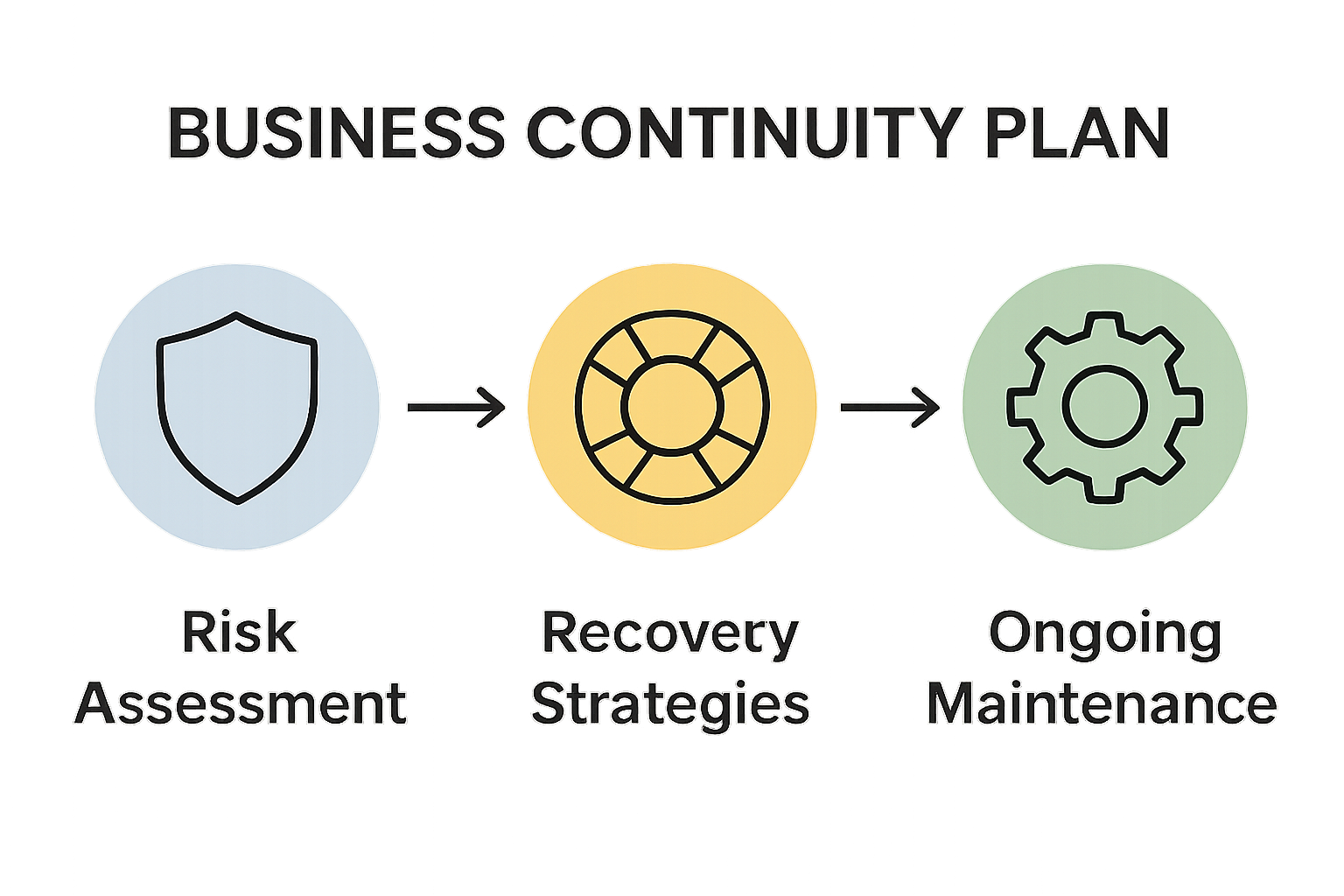
By integrating these key components, organisations can create a comprehensive business continuity planning guide that provides a structured approach to managing potential disruptions and maintaining operational resilience.
The table below summarises the key components of business continuity planning, providing a concise overview of each element and its primary function within the overall strategy.
| Component | Description |
|---|---|
| Risk Assessment and Business Impact Analysis | Identifying potential threats, assessing impacts, and prioritising critical business functions |
| Developing Recovery Strategies | Creating actionable plans to restore essential operations and minimise disruption |
| Ongoing Maintenance and Testing | Regularly updating, testing, and improving the plan to keep it effective and relevant |
| Implementing Operational Frameworks | Establishing structures, roles, and protocols needed to execute continuity strategies in practice |
| Communication Protocols | Defining channels and procedures for coordination and information dissemination during crises |
| Training and Simulation Exercises | Ensuring staff competency and readiness through regular practice and scenario-based drills |
Business continuity planning transforms theoretical strategies into practical, actionable frameworks that organisations can implement to manage potential disruptions effectively. The practical application of these plans involves a systematic approach that integrates risk management, strategic planning, and adaptive response mechanisms.
Practical business continuity planning goes beyond documentation to create living, responsive strategies. This involves developing detailed protocols that can be quickly activated during unexpected events. Organisations must create comprehensive playbooks that outline specific actions, responsibilities, and communication channels to be used during various potential disruption scenarios.
Key practical implementation aspects include:
Effective business continuity planning requires organisations to develop flexible approaches that can adapt to diverse and unpredictable challenges. According to Business Continuity Institute Research, successful implementation involves creating scalable strategies that can be modified based on specific organisational contexts and emerging risks.
Practical scenario management involves:
Practical business continuity planning is an ongoing process of refinement and learning. Organisations must continuously evaluate and update their strategies to reflect changing technological landscapes, emerging risks, and organisational transformations. Learn more about business continuity plan essentials to understand the critical elements of maintaining an effective strategy.
Key continuous improvement practices include:
By approaching business continuity planning as a dynamic, practical process, organisations can develop robust strategies that provide genuine protection and resilience in an increasingly complex business environment.
Real-world case studies demonstrate the critical importance of comprehensive business continuity planning across various industries. These practical examples illustrate how well-prepared organisations can effectively navigate unexpected challenges and maintain operational resilience.
Healthcare organisations represent a prime example of sophisticated business continuity planning. During the COVID-19 pandemic, healthcare systems worldwide demonstrated remarkable adaptability by rapidly restructuring operational protocols, implementing remote consultation mechanisms, and creating flexible treatment strategies.
Key healthcare continuity strategies included:

Financial institutions have long been at the forefront of developing robust business continuity strategies. These organisations must maintain uninterrupted services while protecting sensitive financial data and customer transactions. According to NHS England Business Continuity Research, successful continuity planning involves creating multilayered response mechanisms.
Financial sector continuity approaches feature:
Technology and manufacturing sectors have demonstrated exceptional business continuity capabilities by rapidly pivoting operational strategies during global disruptions. Learn more about creating a comprehensive disaster recovery plan to understand the critical elements of effective organisational resilience.
Technology and manufacturing continuity strategies encompass:
These real-world examples highlight that effective business continuity planning transcends theoretical frameworks, providing organisations with practical, actionable strategies to navigate complex and unpredictable business environments.
Below is a comparison table highlighting business continuity planning approaches across three different sectors, demonstrating how each industry tailors key strategies to their specific needs and challenges.
| Sector | Key Focus Areas | Example Strategies |
|---|---|---|
| Healthcare | Patient care, staff safety, supply chain | Rapid triage, telemedicine, infection control |
| Financial Services | Data protection, service continuity, cybersecurity | Backup systems, remote working, cybersecurity protocols |
| Tech & Manufacturing | Production uptime, resource flexibility, global supply network | Flexible production, supply chain alternatives |
Modern businesses cannot afford the risks of downtime, cyber threats or unreliable IT systems. If your organisation is struggling to keep up with the rapid changes discussed in our business continuity planning guide, you already know how stressful these disruptions can be. Proactive preparation is vital and so is having the right technology partner. Discover how J700 Group’s expertise in managed IT services and robust cybersecurity can safeguard your critical operations and support every aspect outlined in your continuity strategy.

Act now to avoid being caught unprepared. Reach out to our experienced Lancashire-based team for a tailored business continuity assessment. Let us show you how our comprehensive support can help your business stay resilient, secure and ready for anything. Visit our contact page today to start planning for your organisation’s long-term stability and peace of mind.
Business continuity planning is a strategic approach that helps organisations prepare for, respond to, and recover from potential disruptions that could impact their operations. It focuses on maintaining critical functions during unexpected events.
Business continuity planning is essential for protecting organisational resilience, minimising financial losses during disruptions, maintaining customer confidence, and ensuring rapid recovery and operational stability.
Key components of an effective business continuity plan include risk assessment and business impact analysis, developing recovery strategies, ongoing maintenance and testing, and implementing operational frameworks to manage potential disruptions.
A business continuity plan should be reviewed and updated regularly to reflect changing business environments, technological advancements, and emerging risks. Periodic risk reassessments and training sessions are also critical for maintaining effectiveness.
For years, businesses protected their data like a medieval castle: build a thick wall (a…
Read More
For many small and medium-sized businesses, cybersecurity is still viewed as an IT problem. Firewalls,…
Read More
Cloud technology is no longer a luxury or a cost-saving alternative to on-site servers. For…
Read More
Remember when we jokingly wondered if Apple was borrowing our name? Well, the rumours were…
Read More
AI hasn’t just changed the way we work, it has completely rewritten the rulebook for…
Read More
For many businesses, the office phone is like part of the furniture, it’s always there,…
Read More
We are thrilled to announce a significant milestone in the J700 Group journey. To keep…
Read More
For years, many small and medium-sized business owners in the North West have operated under…
Read More
In a modern healthcare setting, the stethoscope and the blood pressure cuff aren’t the only…
Read More
When people hear the word cybersecurity, they often imagine complex systems, expensive software and specialist…
Read More
As we count down to midnight, most of us are thinking about gym memberships or…
Read More
It’s Christmas Eve in Lancashire. The Preston bypass is a nightmare, the last-minute dash to…
Read More
For many businesses, the Christmas period means quieter offices, reduced staffing and systems left running…
Read More
Or: Why we’d like to have a word with Tim Cook this Christmas. There are…
Read More
Hackers Love Christmas: Learn Why your Business Could be at Risk This Holiday SeasonThe festive…
Read More
In recent months, high-profile companies like Land Rover and Co-op have made headlines due to…
Read More
Explore 7 essential tips for effective cloud solutions comparison to find the best fit for…
Read More
Learn how to secure business data for UK SMEs with this step-by-step guide focused on…
Read More
Cybersecurity basics explained for UK businesses—core concepts, major threats, essential safeguards, and compliance requirements. A…
Read More
Discover the essential role of IT support desks, core functions, key benefits, types of support,…
Read More
Discover 10 microsoft 365 alternatives for UK SMEs, comparing features and benefits to help your…
Read More
Discover the best microsoft 365 alternatives in our comparison of 10 top products to enhance…
Read More
Discover a business connectivity checklist with 7 actionable steps to boost IT reliability, security, and…
Read More
Discover 7 essential business continuity planning steps to protect your SME. Learn practical strategies for…
Read More
Small Business Office 365 comprehensive guide for UK SMEs: core features, setup process, security essentials,…
Read More
Small Business Office 365 guide for UK firms. Learn core features, setup, security, costs, and…
Read More
Small business Office 365 guide covering essential features, security, costs, local support, and practical benefits…
Read More
Follow this cybersecurity checklist for SMEs to secure your business in Lancashire and Manchester. Step-by-step…
Read More
Follow this cybersecurity checklist for SMEs to boost protection, reduce risks, and secure business data…
Read More
Cloud security explained: A comprehensive guide for UK businesses covering threat types, protection strategies, compliance,…
Read More
Data protection strategies for UK SMEs—types, key components, GDPR compliance, business risks, and best practices…
Read More
Why cybersecurity matters for UK businesses: core concepts, main risks, common threats, legal requirements, and…
Read More
Comprehensive guide to IT issues Lancashire businesses face, including security threats, system downtime, cloud solutions,…
Read More
Comprehensive guide on cyber security threats in the UK. Learn common types, key characteristics, real-world…
Read More
Follow this IT security checklist for a step-by-step process to secure your business effectively in…
Read More
Explore the benefits of managed IT services for businesses in Manchester and Lancashire, enhancing efficiency…
Read More
Explore the role of cybersecurity in business. Understand its importance, how it works, and key…
Read More
Discover 7 key advantages of Microsoft 365 for SMEs that can enhance productivity, collaboration, and…
Read More
Explore why use managed IT services and how they benefit businesses. Gain comprehensive insights on…
Read More
Comprehensive guide explaining cyber threats, focusing on their importance, how they work, and the key…
Read More