



For years, businesses protected their data like a medieval castle: build a thick wall (a…
Read More
Over half of Lancashire’s small and medium businesses admit to gaps in their internal technology skills, exposing them to rising operational risks. As companies rely on digital tools more than ever, issues like slow internet, cybersecurity threats, and tough compliance rules can cripple growth. Staying informed about common IT challenges gives Lancashire businesses a real edge in building resilience and keeping day-to-day operations on track.
| Point | Details |
|---|---|
| Connectivity Challenges | 33% of SMEs in Lancashire experience slow internet and network issues, impacting daily operations and productivity. |
| Cybersecurity Risks | 17% of SMEs reported cybersecurity incidents, with 58% lacking adequate protection, highlighting the need for improved security measures. |
| Skills Gap | Over 52% of SMEs acknowledge insufficient internal technical expertise, signaling a crucial need for workforce training and upskilling. |
| Compliance Burden | Many businesses perceive GDPR compliance as overwhelming, with 43% reporting operational disruptions, underscoring the need for clear compliance strategies. |
Lancashire businesses are navigating an increasingly complex digital landscape where technology both empowers and challenges small to medium enterprises. Recent research by TalkTalk Business reveals a stark reality for regional companies: technology is simultaneously a critical asset and a potential source of significant operational stress.
The most prevalent IT challenges facing Lancashire businesses include:
According to the 2024 UK Business Data Survey, smaller Lancashire enterprises particularly struggle with data protection knowledge. Many perceive compliance requirements as burdensome rather than beneficial, indicating a broader challenge of technological preparedness.
Understanding these challenges is the first step towards building a resilient, efficient IT strategy that supports sustainable business growth across Lancashire’s dynamic business ecosystem.
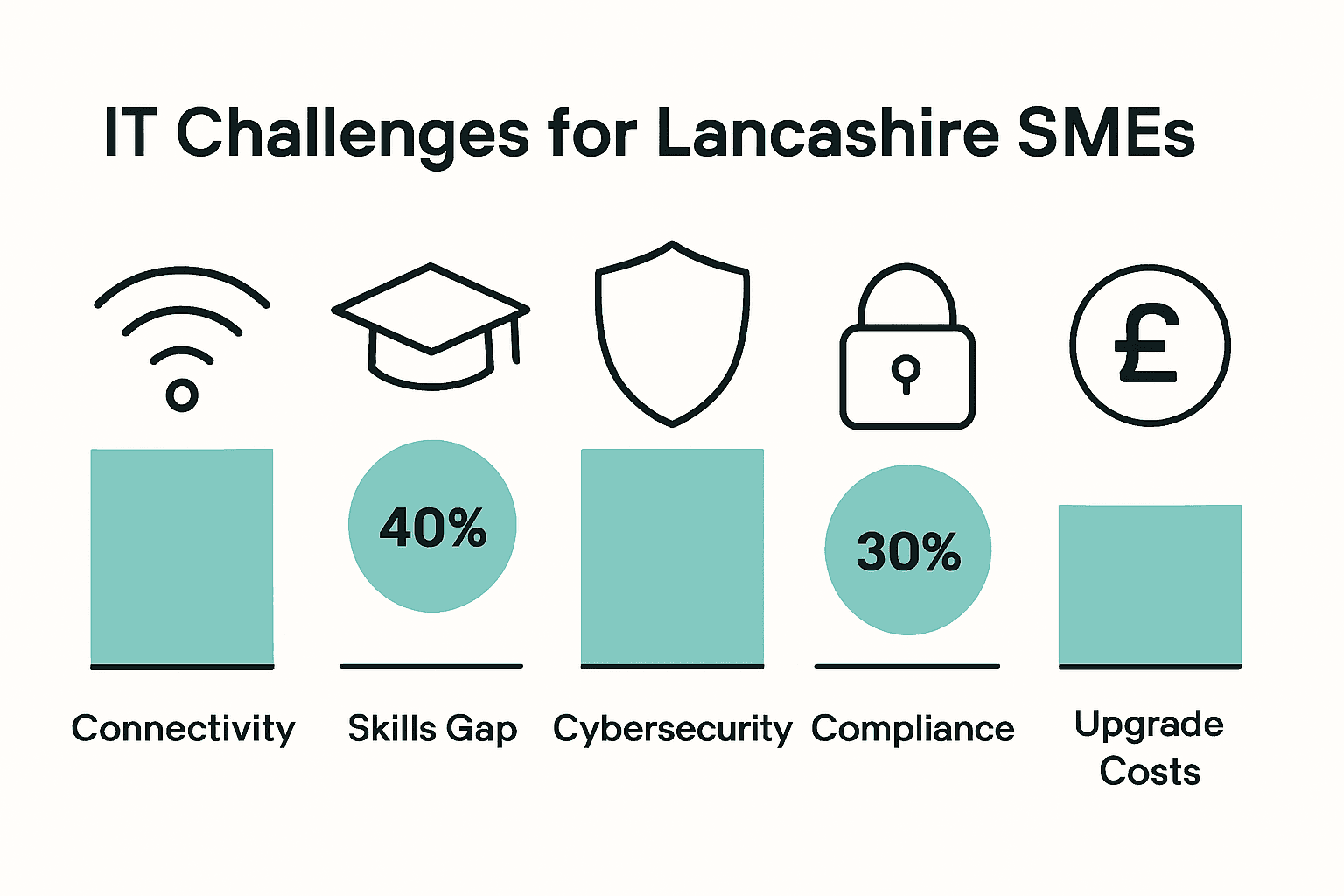
Here’s a comparison of the most common IT challenges faced by Lancashire SMEs:
| Challenge | Description | % of SMEs Affected |
|---|---|---|
| Connectivity Issues | Slow internet, unreliable Wi-Fi | 33% |
| Technology Upgrade Costs | Financial barriers to modernisation | 25% |
| Cybersecurity Vulnerabilities | Exposure to digital threats | 17% (incident) 58% (no protection) |
| Skills Gap | Limited internal technical expertise | 52% |
| Data Protection Compliance | Complexity of GDPR, resource constraints | 43% (marketing impact) |
Small and medium enterprises in Lancashire are experiencing a complex array of technical challenges that go far beyond simple hardware problems. According to the TalkTalk Business survey, these technical issues span multiple dimensions of business technology infrastructure, creating significant operational hurdles.
The primary technical challenges confronting SMEs include:
Research from the Institute of Coding reveals an additional critical dimension: technological skills gaps. Startlingly, only 12% of SMEs have invested in AI training, while 52% acknowledge insufficient internal technological capabilities. This skills deficit represents a significant barrier to technological adoption and innovation.

Moreover, 29% of businesses directly cite lack of training as their primary technological constraint, highlighting the urgent need for comprehensive technological upskilling and strategic IT support across Lancashire’s business landscape.
Lancashire’s business landscape is increasingly vulnerable to sophisticated digital security risks that can devastate unprepared small and medium enterprises. Research from the TalkTalk Business survey reveals a shocking statistic: 17% of SMEs have already experienced a cybersecurity incident, with an alarming 58% operating without any cybersecurity software protection.
The most critical cybersecurity threats facing local businesses include:
According to the UK Business Data Survey, smaller businesses frequently rely on third‑party providers for data protection, which can inadvertently introduce additional cybersecurity vulnerabilities. This outsourcing approach often lacks comprehensive oversight and due diligence.
Learn how to protect your business from these critical cybersecurity threats, understanding that proactive defense is far less costly than recovering from a potential digital catastrophe.
Lancashire businesses are grappling with critical connectivity challenges that directly impact their operational efficiency and digital transformation capabilities. Research from the TalkTalk Business survey reveals a stark reality: 33% of SMEs struggle with slow internet and Wi-Fi problems, while an overwhelming 74% depend on these networks for essential daily business tools.
Key connectivity and cloud adoption challenges include:
According to the same TalkTalk Business research, 11% of SMEs report significant cloud-based service issues, highlighting the complex landscape of digital transformation. These challenges range from unexpected system downtimes to potential security vulnerabilities that can compromise business continuity.
Learn more about optimising your business connectivity, understanding that robust digital infrastructure is no longer a luxury but a fundamental requirement for competitive Lancashire businesses.
Lancashire’s small and medium enterprises are navigating an increasingly complex regulatory landscape that demands sophisticated data management and protection strategies. The 2024 UK Business Data Survey reveals that most small businesses view compliance not as an opportunity, but as an overwhelming administrative burden.
Key compliance challenges for local businesses include:
Research from the Data Marketing Association highlights the profound impact of these regulations: 43% of UK SMEs report that GDPR has significantly disrupted their marketing operations, with 31% deleting substantial portions of their customer databases. Moreover, 48% perceive data protection regulations as introducing unnecessary bureaucratic complexity.
Discover strategies for navigating regulatory challenges, recognising that effective compliance is not just about avoiding penalties, but about building trust and demonstrating professionalism in an increasingly data-sensitive business environment.
Lancashire businesses must adopt strategic approaches to mitigate technological vulnerabilities and protect their digital infrastructure. The UK Business Data Survey emphasises the critical role of structured guidance from trade bodies and certification schemes in strengthening organisational cybersecurity practices.
Key risk reduction strategies include:
The Institute of Coding is responding to skills gaps by offering free AI training courses, highlighting the importance of ongoing technological education as a fundamental risk mitigation strategy. These initiatives demonstrate that investing in workforce capability is crucial for reducing technical vulnerabilities.
Explore our comprehensive guide to endpoint protection, understanding that effective risk management is a continuous journey of learning, adaptation, and strategic investment in your technological ecosystem.
If the common IT issues across Lancashire—such as sluggish connectivity, cybersecurity vulnerabilities, and confusing compliance—sound familiar, you are not alone. These challenges can drain your time, cause unnecessary stress, and put your business at risk. Your team deserves technology that works for you, not against you. Discover how local experts at J700 Group deliver practical solutions to the real technical problems holding Lancashire businesses back.

Make today the turning point for your IT challenges. Speak with Lancashire’s trusted team for managed IT support, secure cloud computing, and robust business connectivity. Get in touch now and let our specialists resolve your IT issues before they impact your growth. Visit our Connectivity solutions for more ways we can keep your business running smoothly.
The most common IT challenges include connectivity issues, technology upgrade costs, system reliability problems, cybersecurity vulnerabilities, and a technology skills gap.
Connectivity issues, such as slow internet and unreliable Wi-Fi, can significantly hamper productivity, disrupt critical operations, and hinder the adoption of cloud services.
To improve cybersecurity, businesses should implement regular staff training, comprehensive virus protection, robust data protection frameworks, continuous technology assessments, and proactive threat monitoring.
Small businesses can manage data protection compliance by developing clear data management policies, understanding GDPR requirements, allocating resources for compliance infrastructure, and adopting proactive compliance strategies rather than reactive ones.
For years, businesses protected their data like a medieval castle: build a thick wall (a…
Read More
For many small and medium-sized businesses, cybersecurity is still viewed as an IT problem. Firewalls,…
Read More
Cloud technology is no longer a luxury or a cost-saving alternative to on-site servers. For…
Read More
Remember when we jokingly wondered if Apple was borrowing our name? Well, the rumours were…
Read More
AI hasn’t just changed the way we work, it has completely rewritten the rulebook for…
Read More
For many businesses, the office phone is like part of the furniture, it’s always there,…
Read More
We are thrilled to announce a significant milestone in the J700 Group journey. To keep…
Read More
For years, many small and medium-sized business owners in the North West have operated under…
Read More
In a modern healthcare setting, the stethoscope and the blood pressure cuff aren’t the only…
Read More
When people hear the word cybersecurity, they often imagine complex systems, expensive software and specialist…
Read More
As we count down to midnight, most of us are thinking about gym memberships or…
Read More
It’s Christmas Eve in Lancashire. The Preston bypass is a nightmare, the last-minute dash to…
Read More
For many businesses, the Christmas period means quieter offices, reduced staffing and systems left running…
Read More
Or: Why we’d like to have a word with Tim Cook this Christmas. There are…
Read More
Hackers Love Christmas: Learn Why your Business Could be at Risk This Holiday SeasonThe festive…
Read More
In recent months, high-profile companies like Land Rover and Co-op have made headlines due to…
Read More
Explore 7 essential tips for effective cloud solutions comparison to find the best fit for…
Read More
Learn how to secure business data for UK SMEs with this step-by-step guide focused on…
Read More
Cybersecurity basics explained for UK businesses—core concepts, major threats, essential safeguards, and compliance requirements. A…
Read More
Discover the essential role of IT support desks, core functions, key benefits, types of support,…
Read More
Discover 10 microsoft 365 alternatives for UK SMEs, comparing features and benefits to help your…
Read More
Discover the best microsoft 365 alternatives in our comparison of 10 top products to enhance…
Read More
Discover a business connectivity checklist with 7 actionable steps to boost IT reliability, security, and…
Read More
Discover 7 essential business continuity planning steps to protect your SME. Learn practical strategies for…
Read More
Small Business Office 365 comprehensive guide for UK SMEs: core features, setup process, security essentials,…
Read More
Small Business Office 365 guide for UK firms. Learn core features, setup, security, costs, and…
Read More
Small business Office 365 guide covering essential features, security, costs, local support, and practical benefits…
Read More
Follow this cybersecurity checklist for SMEs to secure your business in Lancashire and Manchester. Step-by-step…
Read More
Follow this cybersecurity checklist for SMEs to boost protection, reduce risks, and secure business data…
Read More
Cloud security explained: A comprehensive guide for UK businesses covering threat types, protection strategies, compliance,…
Read More
Data protection strategies for UK SMEs—types, key components, GDPR compliance, business risks, and best practices…
Read More
Why cybersecurity matters for UK businesses: core concepts, main risks, common threats, legal requirements, and…
Read More
Comprehensive guide to IT issues Lancashire businesses face, including security threats, system downtime, cloud solutions,…
Read More
Comprehensive guide on cyber security threats in the UK. Learn common types, key characteristics, real-world…
Read More
Follow this IT security checklist for a step-by-step process to secure your business effectively in…
Read More
Explore the benefits of managed IT services for businesses in Manchester and Lancashire, enhancing efficiency…
Read More
Explore the role of cybersecurity in business. Understand its importance, how it works, and key…
Read More
Discover 7 key advantages of Microsoft 365 for SMEs that can enhance productivity, collaboration, and…
Read More
Explore why use managed IT services and how they benefit businesses. Gain comprehensive insights on…
Read More
Comprehensive guide explaining cyber threats, focusing on their importance, how they work, and the key…
Read More