




Why Zero Trust Security Is No Longer Optional for Lancashire and Manchester SMEs Most small…
Read More
Cloud computing is everywhere now. It has completely changed how businesses access technology, and companies using cloud solutions can scale resources up or down in minutes. That alone sounds remarkable. Yet, a surprising 90 percent of UK enterprises are now adopting at least one form of cloud service. Think cloud is just for tech giants or complex operations? Actually, even small local businesses are tapping into these powerful options every day. The real surprise is just how much cloud computing is levelling the playing field for anyone ready to make the switch.
| Takeaway | Explanation |
|---|---|
| Embrace cloud computing for flexibility. | Cloud computing offers scalable solutions, helping businesses adapt swiftly to changing needs and reduce maintenance costs. |
| Choose the right cloud model. | Evaluate public, private, and hybrid clouds to find the best fit for your organisational security and budget requirements. |
| Utilise IaaS for cost efficiency. | Infrastructure as a Service allows renting resources without upfront hardware costs, enhancing operational flexibility and scalability. |
| Leverage PaaS for rapid development. | Platform as a Service simplifies application development, enabling teams to focus on software innovation without infrastructure concerns. |
| Explore SaaS for streamlined software access. | Software as a Service offers immediate access to applications via the internet, reducing complexity and improving collaboration across teams. |
Cloud computing represents a fundamental shift in how businesses manage and deploy technological resources. At its core, cloud computing allows organisations to access computing services over the internet, transforming traditional infrastructure models by providing flexible, scalable solutions that adapt to changing business needs.
Understanding cloud computing requires recognising its primary characteristics. According to University of Oxford, cloud services are defined by several key attributes:
Cloud computing fundamentally changes how businesses approach technology infrastructure. Instead of maintaining expensive physical servers and complex IT systems, organisations can now access powerful computational resources through remote servers. This approach offers significant advantages: reduced upfront capital expenditure, increased operational flexibility, enhanced collaboration capabilities, and improved disaster recovery mechanisms.
Businesses implementing cloud services can select from three primary deployment models: public cloud, private cloud, and hybrid cloud. Public clouds provide services accessible to multiple organisations, private clouds offer dedicated infrastructure for a single entity, while hybrid clouds combine both approaches, allowing seamless integration and enhanced security.
By understanding these foundational principles, businesses can make informed decisions about leveraging cloud technologies to drive innovation, efficiency, and competitive advantage in an increasingly digital marketplace.
Infrastructure as a Service (IaaS) represents a transformative cloud computing model that delivers fundamental computational resources to businesses through internet-based platforms. IaaS enables organisations to access virtualized computing infrastructure without substantial upfront hardware investments.
According to UK Government Cloud First Policy, IaaS provides businesses with critical technological capabilities that can be rapidly deployed and scaled. The core components of IaaS typically include:
Businesses adopting IaaS gain significant advantages over traditional infrastructure management. Key benefits include reduced capital expenditure, increased operational flexibility, and enhanced scalability. Rather than purchasing and maintaining physical servers, organisations can rent virtualized infrastructure from cloud providers, paying only for the resources they consume.
The technical architecture of IaaS involves complex virtualization technologies that abstract physical hardware into flexible, programmable resources. Cloud providers maintain extensive data centres with powerful servers, which are partitioned into virtual machines that customers can configure and manage remotely.
Businesses can select from multiple IaaS deployment configurations to match their specific operational requirements:
When implementing IaaS, organisations must carefully evaluate their technological needs, security requirements, and budget constraints. Considerations include network performance, data protection mechanisms, compliance standards, and integration capabilities with existing technological ecosystems.
Modern IaaS platforms offer advanced features such as automated scaling, comprehensive monitoring tools, and seamless resource allocation. These capabilities enable businesses to respond dynamically to changing computational demands, optimising both performance and cost-efficiency.
Platform as a Service (PaaS) emerges as a sophisticated cloud computing model that empowers businesses to develop, run, and manage applications without the complexity of maintaining traditional infrastructure. PaaS provides a comprehensive development and deployment environment accessible through the internet.
Businesses leveraging PaaS gain significant advantages in application development and technological innovation. The platform abstracts underlying infrastructure complexities, allowing developers to focus exclusively on creating and enhancing software solutions.
Key characteristics of PaaS include:
According to University of Kent’s Computing Module, PaaS enables organisations to streamline their software development processes by providing pre-configured technological environments. Developers can rapidly prototype, test, and launch applications without managing underlying hardware or networking infrastructure.
The architectural framework of PaaS supports multiple programming languages and development tools, offering unprecedented flexibility for technological teams. Businesses can select from various PaaS models tailored to specific operational requirements:
Implementing PaaS requires careful evaluation of organisational technological needs, existing infrastructure, and potential integration challenges. Businesses must consider factors such as data security, compliance requirements, scalability, and compatibility with existing systems.
Modern PaaS platforms offer advanced features like automatic scaling, comprehensive monitoring tools, and seamless integration capabilities. These functionalities enable businesses to accelerate innovation, reduce development costs, and respond dynamically to changing market demands.
By abstracting complex technological infrastructure, PaaS empowers organisations to concentrate on core business objectives, driving digital transformation and technological innovation with unprecedented efficiency.
Software as a Service (SaaS) represents a revolutionary cloud computing model that delivers software applications directly over the internet, transforming how businesses access and utilize technological solutions. SaaS eliminates the need for complex local software installations, providing instant access to powerful applications through web browsers.
According to the UK Government’s Cloud First Policy, SaaS offers organisations unprecedented flexibility and efficiency in managing digital resources. The model fundamentally changes software consumption by providing:
SaaS platforms dramatically reduce technological barriers by removing traditional software implementation challenges. Instead of purchasing expensive software licenses and managing complex installation processes, businesses can access sophisticated applications through simple internet connections.
The architectural approach of SaaS involves hosting software applications on remote cloud servers, enabling multiple users to access identical software versions simultaneously. This centralized deployment model offers significant advantages:
Businesses can select from diverse SaaS solutions spanning multiple operational domains, including:
Implementing SaaS requires careful consideration of organizational requirements, data security protocols, and integration capabilities. Businesses must evaluate factors such as data privacy, compliance standards, network reliability, and potential vendor lock-in risks.
Modern SaaS platforms provide advanced features like real-time data synchronization, customizable dashboards, and seamless third-party integrations. These capabilities enable organisations to adapt quickly to changing technological landscapes, driving innovation and operational efficiency.
By embracing SaaS, businesses can transform their technological infrastructure, reducing complexity while simultaneously enhancing productivity and strategic agility.
Function as a Service (FaaS) emerges as an innovative serverless computing model that represents the next evolution in cloud technology. FaaS enables developers to execute specific code segments without managing underlying infrastructure, providing unprecedented flexibility and efficiency in application development.
According to Research from University College London, FaaS represents a transformative approach to computational resource management. The model allows organisations to deploy individual functions that execute specific tasks, paying only for actual computational time consumed.
Key characteristics of FaaS include:
FaaS fundamentally changes how businesses approach software development, breaking complex applications into smaller, independently deployable functions. This architectural approach offers significant advantages over traditional monolithic application designs.
The technical implementation of FaaS involves several critical components:
Businesses can leverage FaaS across multiple scenarios, including:
Implementing FaaS requires careful consideration of application architecture, performance requirements, and potential limitations. Developers must design functions to be lightweight, stateless, and capable of rapid initialization to maximize the benefits of serverless computing.
Modern FaaS platforms provide advanced features such as integrated debugging tools, comprehensive monitoring dashboards, and seamless integration with existing cloud infrastructures. These capabilities enable organisations to build more resilient, scalable, and cost-effective technological solutions.
By embracing FaaS, businesses can transform their approach to software development, reducing operational complexity while maintaining exceptional computational flexibility and efficiency.
Storage as a Service (StaaS) represents a sophisticated cloud computing model that transforms how businesses manage, store, and access digital data. StaaS enables organisations to outsource data storage infrastructure, eliminating the need for expensive on-premises hardware and complex maintenance processes.
According to University College London’s Research Data Storage Service, cloud storage solutions provide comprehensive data management capabilities that extend far beyond traditional storage methodologies.
Key features of StaaS include:
Modern StaaS platforms revolutionize data management by offering unprecedented flexibility and reliability. Businesses can dynamically adjust storage requirements, paying only for the resources they consume while maintaining high levels of data protection and accessibility.
The architectural framework of StaaS encompasses multiple storage models:
Businesses implementing StaaS must consider several critical factors:
Advanced StaaS solutions provide additional sophisticated features such as:
By leveraging StaaS, organisations can transform their data management strategies, reducing infrastructure costs while simultaneously enhancing data accessibility, security, and operational efficiency. The model enables businesses to focus on core operational objectives rather than managing complex storage infrastructure.
StaaS represents a strategic approach to data management, offering businesses a flexible, scalable, and cost-effective solution for handling increasingly complex digital information landscapes.
Cloud deployment models represent strategic technological frameworks that enable businesses to optimise their computational resources and infrastructure management. Each cloud model offers unique advantages tailored to specific organisational requirements.
According to UK Government’s Cloud Strategy, organisations must carefully evaluate their technological needs when selecting cloud deployment approaches.
Public Cloud Characteristics:
Private Cloud Characteristics:
Hybrid Cloud Strategy:
Public Cloud Advantages:
Private Cloud Benefits:
Businesses must consider multiple factors when selecting cloud deployment models, including:
Hybrid cloud strategies offer the most flexible approach, allowing organisations to distribute workloads across different cloud environments. This model enables businesses to leverage public cloud’s cost-effectiveness while maintaining sensitive operations within private infrastructure.
Successful cloud deployment requires comprehensive planning, continuous evaluation, and a strategic approach to technological integration. By understanding the strengths and limitations of each cloud model, businesses can design robust, adaptable technological infrastructures that support their long-term operational objectives.
Below is a comprehensive table summarising the seven essential types of cloud services for businesses, highlighting their core features, main benefits, and key organisational considerations.
| Cloud Service Type | Core Features & Description | Main Benefits | Organisational Considerations |
|---|---|---|---|
| Infrastructure as a Service (IaaS) | Virtualised computing (VMs, storage, networking) delivered via web | Scalable resources, reduced capital expenditure | Assess technological needs, security, compliance |
| Platform as a Service (PaaS) | Hosted app development and deployment environment, integrated dev tools, automated deployment | Rapid development, innovation acceleration | Software compatibility, data security, integration |
| Software as a Service (SaaS) | Subscription-based software accessed online, automatic updates, centralised data | Reduced IT complexity, enhanced collaboration | Data privacy, vendor lock-in, integration |
| Function as a Service (FaaS) | Event-driven serverless execution, automatic scaling, pay per use | Granular billing, operational agility | Stateless app structure, rapid function triggering |
| Storage as a Service (StaaS) | Cloud-based scalable data storage, backup, redundancy, and encryption | Flexible capacity, improved data security | Regulatory compliance, integration, cost |
| Public Cloud | Shared multi-tenant infrastructure, managed by third party, pay-as-you-go | Cost-effective, rapid deployment | Security, compliance, workload suitability |
| Private/Hybrid Cloud | Dedicated or mixed infrastructure for one/more organisations, customisable control | Enhanced security, workload flexibility | Higher costs, complex integration, management |
Exploring the seven essential types of cloud services can be overwhelming for many businesses. If your team is struggling with slow infrastructure, confused by the difference between IaaS, SaaS, and FaaS, or worried about managing data security and scalability, you are not alone. Many local businesses in Lancashire face similar concerns when moving to the cloud, especially when every pound and minute counts. Your goals of achieving flexibility, reducing costs, and keeping your data protected demand more than generic advice—they require practical solutions built for your industry and region. For expert guidance in integrating robust cloud platforms, discover our Cloud Solutions designed for businesses like yours.
Ready to experience stress-free cloud adoption? Connect with the Lancashire-based experts at J700 Group. We will guide you from confusion to confidence, helping your business benefit from streamlined communication and powerful Microsoft 365 integrations as found in our Microsoft services. Get ahead of IT headaches and secure your operations with trusted local support. Act now to simplify your journey to the cloud and keep your business moving forward.
Cloud services for businesses primarily fall into seven categories: Infrastructure as a Service (IaaS), Platform as a Service (PaaS), Software as a Service (SaaS), Function as a Service (FaaS), Storage as a Service (StaaS), and different deployment models including public, private, and hybrid clouds.
IaaS allows organisations to access virtualised computing infrastructure over the internet, significantly reducing capital expenditure on physical hardware. It offers enhanced scalability, operational flexibility, and the ability to quickly adapt to changing business needs.
SaaS provides subscription-based access to software applications, eliminating the need for complex local installations. Key benefits include automatic updates, centralised data management, and enhanced collaboration across platforms, making it easier for teams to work together efficiently.
Public clouds offer shared infrastructure, are cost-effective, and are managed by third-party providers. Private clouds provide dedicated resources with enhanced security and control for one organisation. Hybrid clouds offer a combination of both, allowing businesses to optimise workloads across different environments according to their operational needs.

Why Zero Trust Security Is No Longer Optional for Lancashire and Manchester SMEs Most small…
Read More
A practical guide for SMEs across Lancashire and the North West If you’ve been hearing…
Read More
Running a business in Lancashire is hard enough without your IT company adding to your…
Read More
Most businesses don’t lose data because of a dramatic cyberattack. They lose it, or expose…
Read More
For manufacturers, downtime isn’t just frustrating, it’s expensive. When production stops, everything slows down. Orders…
Read More
Artificial Intelligence is no longer something businesses are experimenting with. In 2026, it’s becoming part…
Read More
An email landed in my inbox this week from “Jonathan Cundliffe” — our Managing Director.…
Read More
For years, businesses protected their data like a medieval castle: build a thick wall (a…
Read More
For many small and medium-sized businesses, cybersecurity is still viewed as an IT problem. Firewalls,…
Read More
Cloud technology is no longer a luxury or a cost-saving alternative to on-site servers. For…
Read More
Remember when we jokingly wondered if Apple was borrowing our name? Well, the rumours were…
Read More
AI hasn’t just changed the way we work, it has completely rewritten the rulebook for…
Read More
For many businesses, the office phone is like part of the furniture, it’s always there,…
Read More
We are thrilled to announce a significant milestone in the J700 Group journey. To keep…
Read More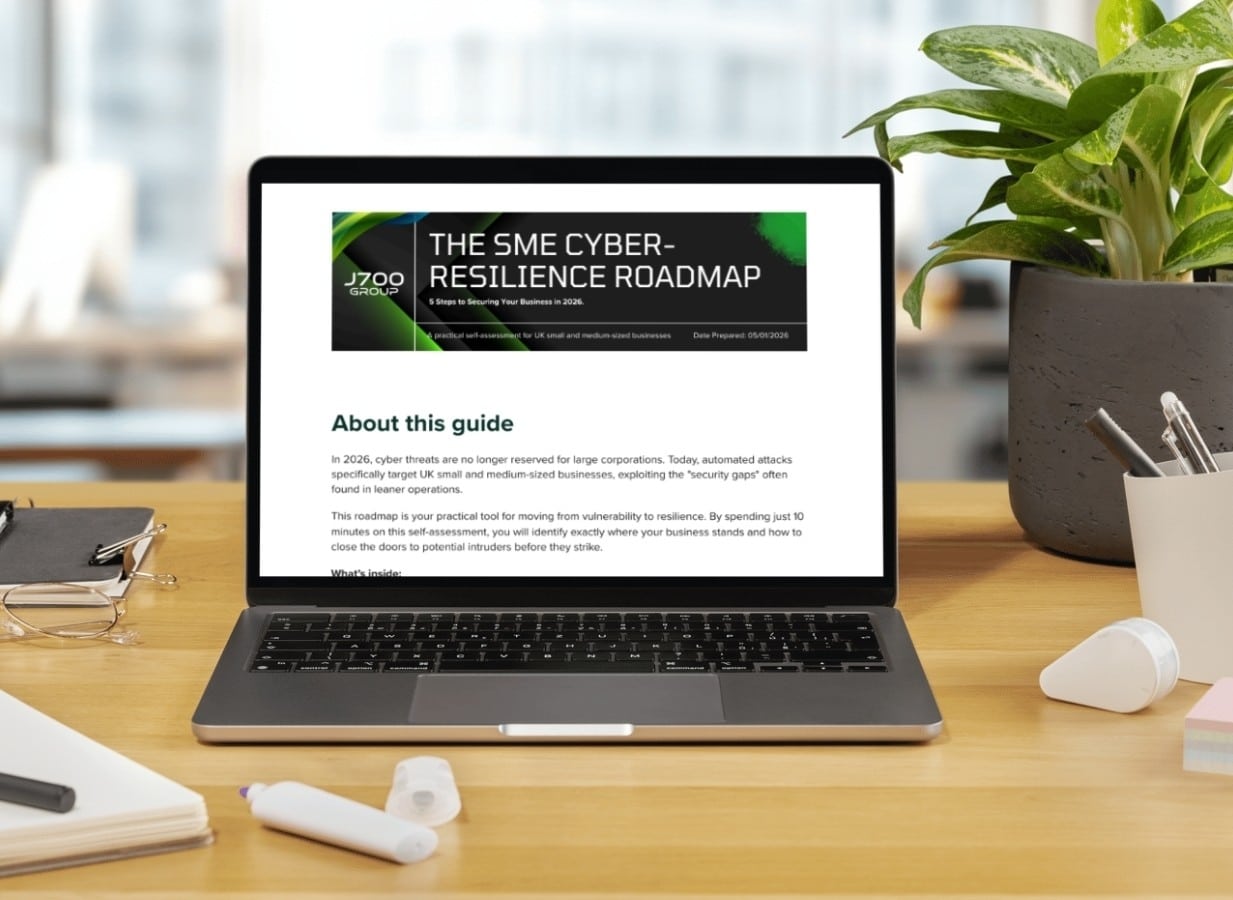
For years, many small and medium-sized business owners in the North West have operated under…
Read More
In a modern healthcare setting, the stethoscope and the blood pressure cuff aren’t the only…
Read More
When people hear the word cybersecurity, they often imagine complex systems, expensive software and specialist…
Read More
As we count down to midnight, most of us are thinking about gym memberships or…
Read More
It’s Christmas Eve in Lancashire. The Preston bypass is a nightmare, the last-minute dash to…
Read More
For many businesses, the Christmas period means quieter offices, reduced staffing and systems left running…
Read More
Or: Why we’d like to have a word with Tim Cook this Christmas. There are…
Read More
Hackers Love Christmas: Learn Why your Business Could be at Risk This Holiday SeasonThe festive…
Read More
In recent months, high-profile companies like Land Rover and Co-op have made headlines due to…
Read More
Explore 7 essential tips for effective cloud solutions comparison to find the best fit for…
Read More
Learn how to secure business data for UK SMEs with this step-by-step guide focused on…
Read More
Cybersecurity basics explained for UK businesses—core concepts, major threats, essential safeguards, and compliance requirements. A…
Read More
Discover the essential role of IT support desks, core functions, key benefits, types of support,…
Read More
Discover 10 microsoft 365 alternatives for UK SMEs, comparing features and benefits to help your…
Read More
Discover the best microsoft 365 alternatives in our comparison of 10 top products to enhance…
Read More
Discover the best microsoft 365 alternatives in our comparison of 10 top products to enhance…
Read More
Discover a business connectivity checklist with 7 actionable steps to boost IT reliability, security, and…
Read More
Discover 7 essential business continuity planning steps to protect your SME. Learn practical strategies for…
Read More
Small Business Office 365 comprehensive guide for UK SMEs: core features, setup process, security essentials,…
Read More
Small Business Office 365 guide for UK firms. Learn core features, setup, security, costs, and…
Read More
Small business Office 365 guide covering essential features, security, costs, local support, and practical benefits…
Read More
Follow this cybersecurity checklist for SMEs to secure your business in Lancashire and Manchester. Step-by-step…
Read More
Follow this cybersecurity checklist for SMEs to boost protection, reduce risks, and secure business data…
Read More
Cloud security explained: A comprehensive guide for UK businesses covering threat types, protection strategies, compliance,…
Read More
Data protection strategies for UK SMEs—types, key components, GDPR compliance, business risks, and best practices…
Read More
Why cybersecurity matters for UK businesses: core concepts, main risks, common threats, legal requirements, and…
Read More