



Why Zero Trust Security Is No Longer Optional for Lancashire and Manchester SMEs Most small…
Read More
Every small and medium business runs on technology these days, relying on everything from email to cloud storage to keep things moving. Yet even a minor technical hiccup can cost more than you might imagine. A single system failure can bring operations to a standstill, draining money fast and damaging reputation. Most people think IT support is just about fixing things when they break, but that barely scratches the surface. The real power comes from having a structured IT support workflow that quietly shields your business from chaos and turns everyday tech problems into manageable steps.
| Takeaway | Explanation |
|---|---|
| Implement Structured IT Support Workflows | A solid IT support workflow minimises downtime and enhances operational efficiency for SMEs. |
| Proactive Issue Detection is Crucial | Utilise monitoring systems and user reporting to quickly identify and log technical issues before they escalate. |
| Standardise Response Protocols | Develop clear and scalable procedures for resolving technical problems to streamline incident management. |
| Integrate Communication Channels | Establish effective communication paths within the IT support team to ensure swift resolution of issues. |
| Focus on Continuous Performance Monitoring | Regularly assess system health to anticipate potential failures and maintain optimal technology performance. |
IT support workflow represents a structured methodology for managing technology resources and resolving technical challenges within small and medium enterprises. This strategic approach encompasses systematic processes designed to maintain, monitor, and optimize an organisation’s technological infrastructure.
At its fundamental level, an IT support workflow involves several critical elements that ensure seamless technological operations. Our guide on outsourcing IT support provides deeper insights into these processes. The workflow typically includes:
The following table breaks down the main components of a typical IT support workflow for SMEs, providing concise definitions to clarify their role within the overall process.
| Component | Description |
|---|---|
| Initial Problem Identification | Detecting technology issues through monitoring, reports, or alerts |
| Ticket Creation and Prioritisation | Logging and ranking incidents based on severity and impact |
| Diagnostic Assessment | Analysing technical issues to determine root causes |
| Structured Problem Resolution | Employing systematic processes to resolve technical challenges |
| Proactive Maintenance Strategies | Anticipating and preventing issues before they occur |
| Continuous Performance Monitoring | Regularly tracking system health and performance |
| Communication Channels | Ensuring clear pathways for reporting and resolving issues |
For small businesses, an effective IT support workflow must balance efficiency with cost-effectiveness. According to research from the UK Government’s digital adoption taskforce, successful workflows integrate proactive management strategies that anticipate potential technological challenges.
The primary goal of an IT support workflow is to minimise downtime, protect critical business data, and ensure continuous technological performance. This involves creating standardised procedures for issue resolution, establishing clear communication channels, and developing robust response protocols that address technical problems swiftly and comprehensively.
By implementing a well-structured IT support workflow, SMEs can transform technical challenges from potential business disruptions into manageable, systematic processes that support ongoing operational excellence.
IT support workflow is critical for small and medium enterprises as it provides a strategic framework for managing technological resources effectively, minimising operational risks, and ensuring business continuity. These structured processes are not merely technical protocols but fundamental business survival mechanisms in an increasingly digital landscape.
This table compares the potential consequences of inadequate IT support with the strategic benefits of adopting a structured IT support workflow for SMEs, helping to highlight why a formal process is essential.
| Aspect | Without Structured Workflow | With Structured Workflow |
|---|---|---|
| Operational Continuity | High risk of prolonged downtime | Minimised downtime and disruption |
| Data Security | Increased vulnerability to breaches | Enhanced data protection |
| Financial Stability | Unpredictable, often elevated IT costs | Predictable budgeting, reduced losses |
| Staff Productivity | Frequent frustration and lost time | Efficient, focused workforce |
| Customer Confidence | Reputation damage due to recurring issues | Improved trust and satisfaction |
| Risk Management | Reactive, crisis-driven approach | Proactive, planned management |
For SMEs, technological disruptions can be catastrophically expensive. Learn more about cybersecurity threats facing small businesses to understand the critical nature of robust IT support. The potential consequences of inadequate technological management include:
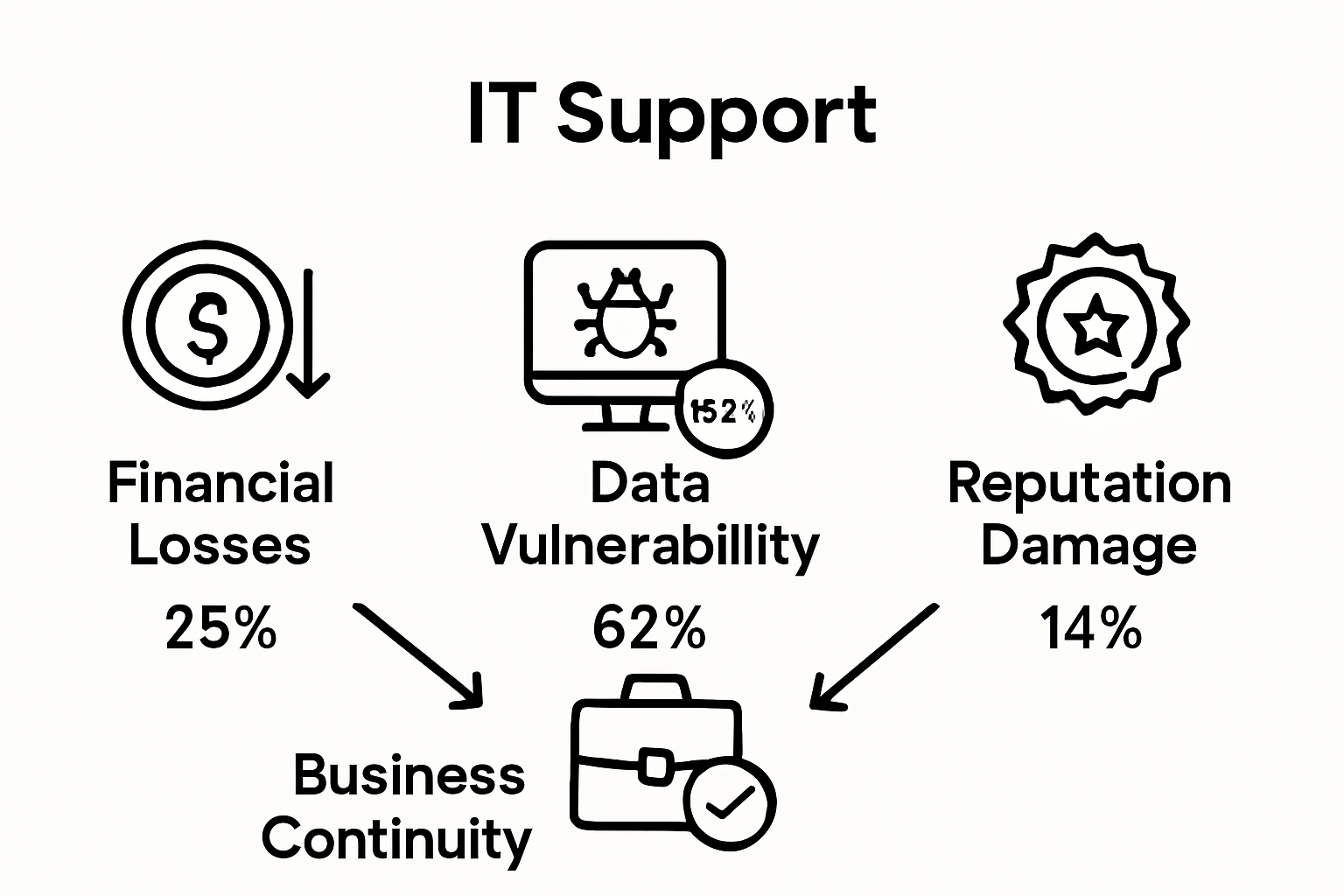
According to research from the UK Government’s digital adoption taskforce, effective IT support workflows enable SMEs to transform technological challenges into strategic opportunities. By implementing comprehensive support processes, businesses can:
Moreover, a well-designed IT support workflow provides SMEs with a competitive advantage. It allows businesses to respond quickly to technological challenges, maintain operational efficiency, and allocate resources strategically. The workflow becomes a critical tool for managing technological complexity, ensuring that limited resources are used effectively and technological investments deliver maximum value.
IT support workflow in small and medium enterprises operates as a comprehensive system designed to manage technological resources systematically, ensuring seamless operational efficiency and minimising potential disruptions. This intricate process involves multiple interconnected stages that transform technical challenges into strategic opportunities.
The initial phase of IT support workflow focuses on robust monitoring and immediate problem identification. Explore emerging tech trends that can enhance business growth to understand the technological landscape. The detection mechanisms typically include:
According to research from the UK Government’s digital adoption taskforce, effective workflows integrate systematic problem-solving protocols. This involves categorising issues based on complexity, urgency, and potential business impact.
The resolution process follows a hierarchical approach:
By implementing a structured workflow, SMEs can transform unpredictable technological challenges into manageable, systematic processes. This approach not only addresses immediate technical concerns but also builds a proactive framework for long-term technological resilience and strategic digital management.

IT support workflow represents a sophisticated ecosystem of technological management strategies specifically tailored to address the unique challenges faced by small and medium enterprises. Understanding the fundamental concepts driving these workflows is crucial for businesses seeking technological resilience and operational efficiency.
Explore the top cybersecurity risks in modern work environments to understand the complexity of technological management. The foundational principles guiding IT support workflows include:
According to research from the UK Government’s digital adoption taskforce, effective IT support workflows are built upon several critical strategic components:
These components form an interconnected framework that transforms technological management from a reactive function into a strategic business asset. By embedding these concepts into their operational DNA, SMEs can create robust, adaptable IT support systems that not only address immediate technical challenges but also contribute to long-term business growth and technological resilience.
If your business is feeling the strain of slow systems, constant technical hiccups, or growing cyber threats, you are not alone. Many SMEs discover that ineffective IT support workflows lead directly to wasted time, frustrated staff, and potential security breaches. The good news is that these pain points are completely avoidable. By adopting a structured IT support workflow, as explored in our Business Archives, you can transform chaos into clarity and gain back valuable peace of mind.
Ready to experience smoother operations and stronger IT protection? Partner with J700 Group for expert IT support and tailored solutions built for your unique challenges. Our Lancashire-based team specialises in proactive monitoring, fast response, and seamless management of your technology. Take action today and future-proof your business—visit J700 Group to learn how we can help or explore more tips in our Business Archives.
IT support workflow for SMEs is a structured methodology designed to manage technology resources and resolve technical challenges effectively. It involves systematic processes for maintaining, monitoring, and optimising an organisation’s technological infrastructure.
An IT support workflow is crucial for SMEs as it minimises operational risks, ensures business continuity, and provides a framework for effectively managing technological resources, which is essential in a digital landscape.
The IT support workflow in SMEs consists of several interconnected stages, including incident detection and logging, structured problem resolution, and continuous performance monitoring, transforming technical challenges into manageable processes.
Core components of an effective IT support workflow include initial problem identification, ticket creation and prioritisation, diagnostic assessment, and structured problem resolution processes that integrate proactive management strategies.

Why Zero Trust Security Is No Longer Optional for Lancashire and Manchester SMEs Most small…
Read More
A practical guide for SMEs across Lancashire and the North West If you’ve been hearing…
Read More
Running a business in Lancashire is hard enough without your IT company adding to your…
Read More
Most businesses don’t lose data because of a dramatic cyberattack. They lose it, or expose…
Read More
For manufacturers, downtime isn’t just frustrating, it’s expensive. When production stops, everything slows down. Orders…
Read More
Artificial Intelligence is no longer something businesses are experimenting with. In 2026, it’s becoming part…
Read More
An email landed in my inbox this week from “Jonathan Cundliffe” — our Managing Director.…
Read More
For years, businesses protected their data like a medieval castle: build a thick wall (a…
Read More
For many small and medium-sized businesses, cybersecurity is still viewed as an IT problem. Firewalls,…
Read More
Cloud technology is no longer a luxury or a cost-saving alternative to on-site servers. For…
Read More
Remember when we jokingly wondered if Apple was borrowing our name? Well, the rumours were…
Read More
AI hasn’t just changed the way we work, it has completely rewritten the rulebook for…
Read More
For many businesses, the office phone is like part of the furniture, it’s always there,…
Read More
We are thrilled to announce a significant milestone in the J700 Group journey. To keep…
Read More
For years, many small and medium-sized business owners in the North West have operated under…
Read More
In a modern healthcare setting, the stethoscope and the blood pressure cuff aren’t the only…
Read More
When people hear the word cybersecurity, they often imagine complex systems, expensive software and specialist…
Read More
As we count down to midnight, most of us are thinking about gym memberships or…
Read More
It’s Christmas Eve in Lancashire. The Preston bypass is a nightmare, the last-minute dash to…
Read More
For many businesses, the Christmas period means quieter offices, reduced staffing and systems left running…
Read More
Or: Why we’d like to have a word with Tim Cook this Christmas. There are…
Read More
Hackers Love Christmas: Learn Why your Business Could be at Risk This Holiday SeasonThe festive…
Read More
In recent months, high-profile companies like Land Rover and Co-op have made headlines due to…
Read More
Explore 7 essential tips for effective cloud solutions comparison to find the best fit for…
Read More
Learn how to secure business data for UK SMEs with this step-by-step guide focused on…
Read More
Cybersecurity basics explained for UK businesses—core concepts, major threats, essential safeguards, and compliance requirements. A…
Read More
Discover the essential role of IT support desks, core functions, key benefits, types of support,…
Read More
Discover 10 microsoft 365 alternatives for UK SMEs, comparing features and benefits to help your…
Read More
Discover the best microsoft 365 alternatives in our comparison of 10 top products to enhance…
Read More
Discover a business connectivity checklist with 7 actionable steps to boost IT reliability, security, and…
Read More
Discover 7 essential business continuity planning steps to protect your SME. Learn practical strategies for…
Read More
Small Business Office 365 comprehensive guide for UK SMEs: core features, setup process, security essentials,…
Read More
Small Business Office 365 guide for UK firms. Learn core features, setup, security, costs, and…
Read More
Small business Office 365 guide covering essential features, security, costs, local support, and practical benefits…
Read More
Follow this cybersecurity checklist for SMEs to secure your business in Lancashire and Manchester. Step-by-step…
Read More
Follow this cybersecurity checklist for SMEs to boost protection, reduce risks, and secure business data…
Read More
Cloud security explained: A comprehensive guide for UK businesses covering threat types, protection strategies, compliance,…
Read More
Data protection strategies for UK SMEs—types, key components, GDPR compliance, business risks, and best practices…
Read More
Why cybersecurity matters for UK businesses: core concepts, main risks, common threats, legal requirements, and…
Read More
Comprehensive guide to IT issues Lancashire businesses face, including security threats, system downtime, cloud solutions,…
Read More