



Why Zero Trust Security Is No Longer Optional for Lancashire and Manchester SMEs Most small…
Read More
Every business leader talks about staying ahead with the right technology and focusing on digital tools to drive growth. Yet many are surprised to learn that companies which strategically prioritise technology can see up to 30 percent higher productivity than those who do not. The real shock is that it is not just about having the latest gadgets or software. It is about choosing technology that fits your actual business goals, which is where most organisations get it wrong—and where the hidden competitive edge lies.
| Takeaway | Explanation |
|---|---|
| Strategic alignment is crucial | Ensure technology investments align with overarching business goals for maximum impact. |
| Continuous evaluation is essential | Regular assessments help adapt technology strategies to evolving market needs and innovations. |
| Focus on operational efficiency gains | Prioritise technologies that enhance productivity and reduce costs within the organisation. |
| Adaptability drives competitive advantage | Develop a culture that embraces technological adaptation to maintain market relevance. |
| Implement tailored technology roadmaps | Create specific plans addressing unique organisational needs and strategic objectives effectively. |
Business technology priorities represent strategic technological investments and focus areas that organisations undertake to drive operational efficiency, competitive advantage, and sustainable growth. These priorities fundamentally shape how businesses leverage digital tools and technological solutions to address complex challenges and unlock new opportunities.
At the heart of business technology priorities are several key dimensions that organisations must carefully consider. Technological alignment with business objectives becomes paramount, ensuring that every technological investment directly contributes to overarching organisational goals. This means moving beyond simply adopting new technologies and instead strategically selecting solutions that enhance productivity, reduce operational friction, and create measurable value.
The fundamental priorities typically encompass critical areas such as:
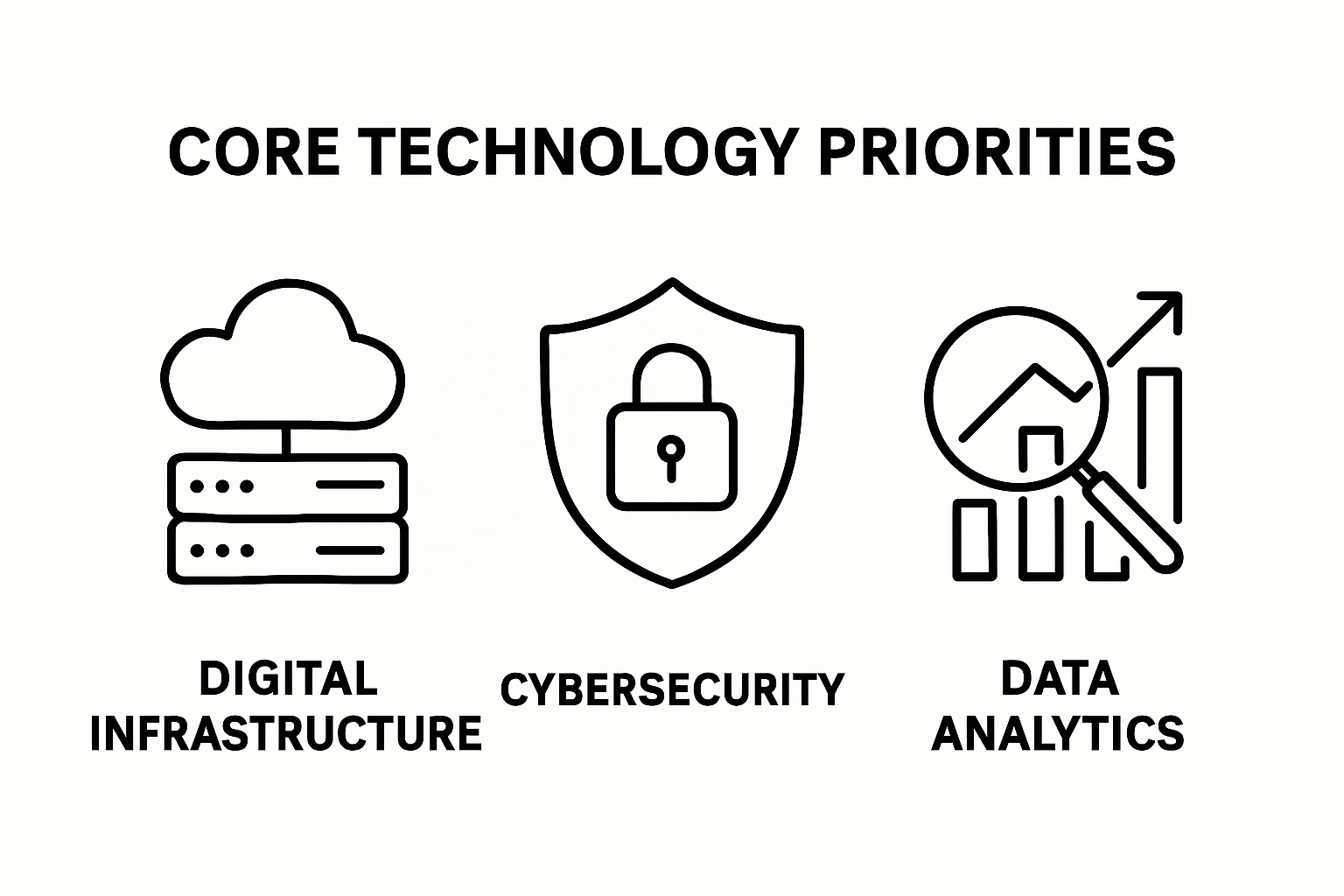
These priorities are not uniform across industries but vary based on specific organisational needs, market dynamics, and competitive landscapes. Learn more about our technology strategy consulting to understand how businesses can develop tailored technological roadmaps.
Successful technology prioritisation requires a systematic approach that balances immediate operational requirements with long-term strategic vision. According to research from the UK Innovation Strategy, businesses must adopt a holistic view that considers technological capabilities, workforce readiness, and potential return on investment.
Effective technology priorities demand continuous assessment, involving regular technological audits, performance monitoring, and adaptive strategy refinement. Business leaders must remain agile, recognising that technological landscapes evolve rapidly and priorities must remain flexible to accommodate emerging innovations and shifting market demands.
Business technology priorities are not merely optional strategies but critical determinants of organisational performance and competitive positioning. They represent the fundamental mechanism through which businesses transform technological capabilities into tangible strategic advantages.

Technological readiness has become a primary differentiator in modern business landscapes. Companies that systematically prioritise and implement strategic technology initiatives gain significant competitive edges. This involves creating robust technological ecosystems that enable faster decision making, enhanced operational efficiency, and superior customer experiences.
The critical dimensions of technological competitive advantage include:
Discover how our technology consulting supports business growth and helps organisations develop strategic technological roadmaps.
According to research from the UK Innovation Strategy, businesses that strategically prioritise technological investments consistently demonstrate superior economic performance. Technology priorities directly translate into improved productivity metrics, reduced operational costs, and enhanced workforce capabilities.
By systematically identifying and addressing technological needs, organisations can create more agile, responsive, and efficient operational models. This approach enables businesses to not just survive but thrive in increasingly complex and digitally transformed market environments, transforming technological investments into sustainable competitive advantages.
Business technology priorities serve as powerful strategic frameworks that fundamentally transform how organisations design, implement, and execute their core business strategies. These priorities act as strategic blueprints that guide technological investments, operational approaches, and long-term organisational development.
Technology priorities function as strategic connective tissue between an organisation’s vision and its operational capabilities. By establishing clear technological objectives, businesses can create comprehensive strategies that integrate digital capabilities directly into their core business models. This approach enables companies to move beyond traditional operational constraints and develop more responsive, adaptive organisational structures.
The key strategic transformation mechanisms include:
Explore our strategic technology consulting services to understand how technology can reshape your business strategy.
According to research from the UK Digital Strategy, technology priorities are crucial in developing organisational adaptability. By creating strategic technology roadmaps, businesses can anticipate market shifts, proactively develop new capabilities, and maintain competitive relevance.
Technology priorities transform strategic planning from a static, periodic exercise into a dynamic, continuous process of organisational evolution. This approach ensures that technological capabilities are not merely supportive tools but fundamental drivers of business strategy, enabling companies to navigate complex market landscapes with greater precision and confidence.
Business technology prioritisation represents a sophisticated strategic approach that enables organisations to systematically evaluate, select, and implement technological investments. This process transforms technological potential into strategic organizational capabilities by creating structured frameworks for decision making and resource allocation.
Effective technology prioritisation transcends simple selection processes and encompasses comprehensive evaluation methodologies. Organizations must develop robust frameworks that assess technological investments across multiple critical dimensions, considering not just immediate operational needs but long-term strategic potential.
The fundamental evaluation criteria typically include:
Explore our technology assessment methodologies to understand how businesses can develop sophisticated prioritisation strategies.
According to guidance from the UK Government’s Service Manual, successful technology prioritisation requires a structured, data-driven approach. This involves creating transparent evaluation processes that balance quantitative metrics with qualitative strategic considerations.
The prioritisation process is not a one-time event but a continuous organizational practice. By developing iterative assessment frameworks, businesses can create dynamic technological roadmaps that remain responsive to changing market conditions, emerging technologies, and evolving organizational strategies. This approach ensures that technological investments remain strategically relevant and operationally impactful.
Business technology priorities transform from abstract strategic concepts into tangible organisational capabilities through practical implementation. These real-world applications demonstrate how technological investments drive substantial operational improvements and competitive advantages across diverse industry sectors.
To clarify how various business technology priorities are implemented across different industries, the following table summarises real-world examples mentioned in the article.
| Industry | Technology Priority Example | Strategic Objective |
|---|---|---|
| Healthcare | Digitisation of patient records | Improve operational efficiency and accuracy |
| Financial Services | Blockchain transaction systems | Enhance security and transparency |
| Manufacturing | Predictive maintenance technologies | Reduce downtime and costs |
| Retail | Personalised customer experience platforms | Boost customer engagement and loyalty |
| Logistics | Real-time tracking and inventory management | Streamline operations and responsiveness |
Technological priorities manifest differently across various business contexts, reflecting unique organisational needs and strategic objectives. By examining concrete implementation strategies, businesses can gain valuable insights into effective technological integration approaches.
Significant technology priority implementation examples include:
Explore our comprehensive tech insight archives to understand diverse technological implementation strategies.
According to research from the UK International Technology Strategy, successful technology priorities require comprehensive, context-specific approaches. These implementation narratives demonstrate how businesses translate strategic technological objectives into operational realities.
Effective technology priority implementation involves more than technological adoption. It demands holistic organisational transformation, where technological capabilities are seamlessly integrated into existing workflows, creating synergistic ecosystems that enhance overall business performance and adaptability.
Is your business struggling to translate technology priorities into real growth? If you find it challenging to align IT investments with business goals or to keep pace with the evolving digital landscape, you are not alone. Many organisations face slow systems, rising security risks, and inefficient processes. These are pain points highlighted in our article on business technology priorities, and tackling them is essential for gaining a real competitive advantage. For deeper insight into the latest industry strategies, explore our Tech Insight Archives.

Take action now to ensure your organisation is one step ahead. The J700 Group specialises in helping SMEs across Lancashire and the North West set and achieve clear technology priorities. Our local experts provide managed IT services, cybersecurity, cloud solutions and ongoing support tailored to your needs. Let us help you reduce IT stress and drive sustainable business growth. Start your journey to better technology outcomes today by contacting our team via this page, or browse our Business resources for more guidance.
Business technology priorities are strategic investments and focus areas that organisations adopt to enhance operational efficiency, competitiveness, and sustainable growth through digital tools and technological solutions.
Technology priorities are crucial as they directly contribute to organisational performance, enabling businesses to transform their technological capabilities into strategic advantages and maintaining competitive positioning in the market.
Organisations can evaluate their technology priorities by developing comprehensive decision-making frameworks that consider strategic alignment, potential return on investment, implementation complexity, and scalability of technological investments.
Continuous assessment is vital for technology prioritisation as it allows businesses to adapt to changing market conditions and emerging technologies, ensuring that technological investments remain relevant and impactful over time.

Why Zero Trust Security Is No Longer Optional for Lancashire and Manchester SMEs Most small…
Read More
A practical guide for SMEs across Lancashire and the North West If you’ve been hearing…
Read More
Running a business in Lancashire is hard enough without your IT company adding to your…
Read More
Most businesses don’t lose data because of a dramatic cyberattack. They lose it, or expose…
Read More
For manufacturers, downtime isn’t just frustrating, it’s expensive. When production stops, everything slows down. Orders…
Read More
Artificial Intelligence is no longer something businesses are experimenting with. In 2026, it’s becoming part…
Read More
An email landed in my inbox this week from “Jonathan Cundliffe” — our Managing Director.…
Read More
For years, businesses protected their data like a medieval castle: build a thick wall (a…
Read More
For many small and medium-sized businesses, cybersecurity is still viewed as an IT problem. Firewalls,…
Read More
Cloud technology is no longer a luxury or a cost-saving alternative to on-site servers. For…
Read More
Remember when we jokingly wondered if Apple was borrowing our name? Well, the rumours were…
Read More
AI hasn’t just changed the way we work, it has completely rewritten the rulebook for…
Read More
For many businesses, the office phone is like part of the furniture, it’s always there,…
Read More
We are thrilled to announce a significant milestone in the J700 Group journey. To keep…
Read More
For years, many small and medium-sized business owners in the North West have operated under…
Read More
In a modern healthcare setting, the stethoscope and the blood pressure cuff aren’t the only…
Read More
When people hear the word cybersecurity, they often imagine complex systems, expensive software and specialist…
Read More
As we count down to midnight, most of us are thinking about gym memberships or…
Read More
It’s Christmas Eve in Lancashire. The Preston bypass is a nightmare, the last-minute dash to…
Read More
For many businesses, the Christmas period means quieter offices, reduced staffing and systems left running…
Read More
Or: Why we’d like to have a word with Tim Cook this Christmas. There are…
Read More
Hackers Love Christmas: Learn Why your Business Could be at Risk This Holiday SeasonThe festive…
Read More
In recent months, high-profile companies like Land Rover and Co-op have made headlines due to…
Read More
Explore 7 essential tips for effective cloud solutions comparison to find the best fit for…
Read More
Learn how to secure business data for UK SMEs with this step-by-step guide focused on…
Read More
Cybersecurity basics explained for UK businesses—core concepts, major threats, essential safeguards, and compliance requirements. A…
Read More
Discover the essential role of IT support desks, core functions, key benefits, types of support,…
Read More
Discover 10 microsoft 365 alternatives for UK SMEs, comparing features and benefits to help your…
Read More
Discover the best microsoft 365 alternatives in our comparison of 10 top products to enhance…
Read More
Discover the best microsoft 365 alternatives in our comparison of 10 top products to enhance…
Read More
Discover a business connectivity checklist with 7 actionable steps to boost IT reliability, security, and…
Read More
Discover 7 essential business continuity planning steps to protect your SME. Learn practical strategies for…
Read More
Small Business Office 365 comprehensive guide for UK SMEs: core features, setup process, security essentials,…
Read More
Small Business Office 365 guide for UK firms. Learn core features, setup, security, costs, and…
Read More
Small business Office 365 guide covering essential features, security, costs, local support, and practical benefits…
Read More
Follow this cybersecurity checklist for SMEs to secure your business in Lancashire and Manchester. Step-by-step…
Read More
Follow this cybersecurity checklist for SMEs to boost protection, reduce risks, and secure business data…
Read More
Cloud security explained: A comprehensive guide for UK businesses covering threat types, protection strategies, compliance,…
Read More
Data protection strategies for UK SMEs—types, key components, GDPR compliance, business risks, and best practices…
Read More
Why cybersecurity matters for UK businesses: core concepts, main risks, common threats, legal requirements, and…
Read More