



For years, businesses protected their data like a medieval castle: build a thick wall (a…
Read More
Over 80 percent of UK businesses report a targeted cyber incident every year, putting sensitive customer and company information at risk. For organisations in Lancashire and Manchester, safeguarding data is more than a box to tick. Reliable data protection strategies protect trust, help meet strict legal rules, and keep your business strong against growing digital threats. Understanding how to set up effective data protection makes a direct difference to your company’s future security and reputation.
| Point | Details |
|---|---|
| Comprehensive Approach | Data protection strategies must encompass legal compliance and proactive risk management to protect sensitive information. |
| Implementation of Key Measures | Employing measures like encryption, access controls, and incident response planning is essential for robust cybersecurity. |
| Continuous Improvement | Data protection should be treated as an ongoing process, adapting to evolving regulations and technological landscapes. |
| Building Trust | Proactively adopting GDPR standards enhances customer trust and strengthens competitive positioning in the marketplace. |
Data protection isn’t just another checkbox for Lancashire and Manchester businesses—it’s a critical shield safeguarding your organisation’s most valuable asset: information. Data protection strategies represent a comprehensive approach to securing sensitive data, ensuring your business remains compliant, trustworthy, and resilient against potential cyber threats.
According to the UK Information Commissioner’s Office, SMEs need a structured framework to manage data responsibly. Key principles include:
The emerging landscape of digital security is complex, particularly for small businesses across Lancashire and Manchester. Research from the academic paper “GDPRShield” suggests that embedding a privacy-first culture from the early stages of software development can significantly enhance an organisation’s data protection capabilities. This means thinking about data protection not as an afterthought, but as a fundamental design principle in your technological infrastructure.
Implementing robust data protection isn’t about creating complicated systems—it’s about understanding your specific business needs, identifying potential vulnerabilities, and developing tailored strategies that protect both your organisation and your customers. By prioritising data protection, you’re not just meeting legal requirements; you’re building trust, demonstrating professionalism, and securing your business’s most critical digital assets.
For businesses across Lancashire and Manchester, data protection isn’t a one-size-fits-all approach but a nuanced strategy tailored to specific organisational needs. Understanding the various types of data protection measures is crucial for maintaining robust cybersecurity and regulatory compliance. Explore our guide on data protection strategies to comprehensively secure your digital assets.
According to practical guidance for SMEs, businesses can implement several key technical and organisational data protection measures:
The UK government’s Cyber Essentials certification scheme provides a robust baseline for cybersecurity controls. These include fundamental protections such as:
Beyond technical solutions, effective data protection requires a holistic approach. This means continuous staff training, regular security assessments, and creating a culture of privacy awareness. By integrating these multifaceted strategies, Lancashire and Manchester businesses can build resilient defences against evolving digital threats, protecting their most valuable asset—information.

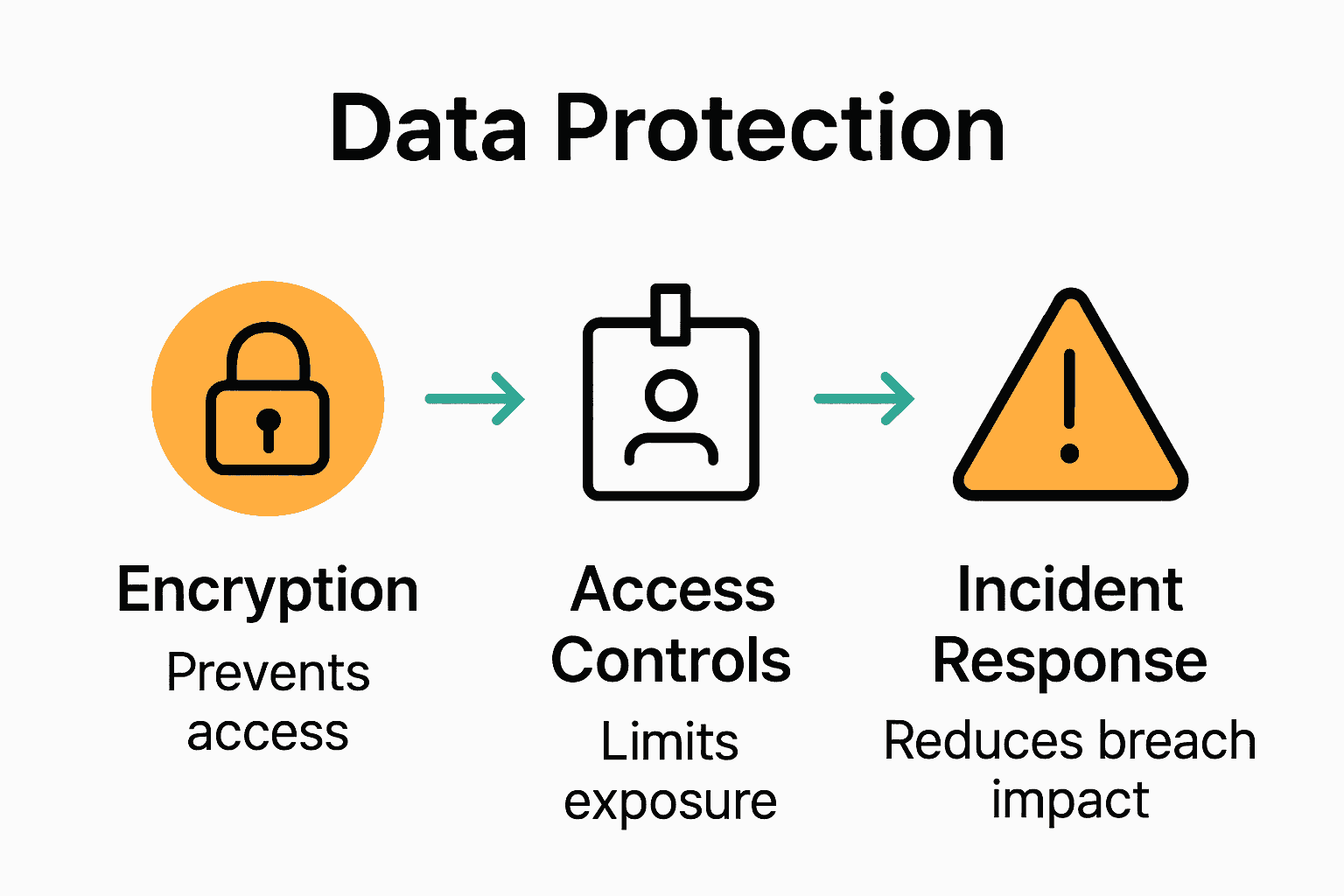
Here’s a summary of common data protection measures and their main purposes:
| Measure | Description | Primary Benefit |
|---|---|---|
| Encryption | Converts data into code | Prevents unauthorised access |
| Access Controls | Restricts data access to approved users | Limits data exposure |
| Data Loss Prevention | Stops data leaving the organisation | Minimises data leakage |
| Anonymisation | Removes personally identifiable information | Protects individual privacy |
| Incident Response | Prepares for and manages data breaches | Reduces impact of incidents |
Data protection strategies for Lancashire and Manchester businesses must go beyond basic compliance—they need a comprehensive, proactive approach that anticipates potential risks.
Learn more about our comprehensive data protection approach to understand how to build a robust defence.
According to research from legal foundations, an effective data protection strategy incorporates several critical elements. The seven core GDPR principles provide a fundamental framework:
Practical implementation involves developing GDPR-friendly policies that cover privacy notices, breach response protocols, and clear data retention guidelines. Key strategic components include:
For SMEs across Lancashire, a successful data protection strategy is not about perfection, but continuous improvement.
By treating data protection as an ongoing process rather than a one-time achievement, businesses can create resilient systems that adapt to changing technological landscapes and regulatory environments.
Navigating the complex landscape of data protection laws can be challenging for SMEs across Lancashire and Manchester. Check out our comprehensive privacy policy guidelines to understand the nuanced legal requirements that impact your business.
According to the Data Protection Act 2018, the UK has established a robust legal framework that implements rigorous data protection standards. Post-Brexit, this legislation ensures businesses maintain high levels of data security and individual privacy protection. Key aspects of compliance include:
The Information Commissioner’s Office (ICO) provides critical guidance for small and medium enterprises. Their recommendations focus on several crucial compliance areas:
For businesses in the North West, compliance isn’t just about avoiding penalties—it’s about building trust. By proactively adopting UK GDPR standards, organisations demonstrate their commitment to protecting customer and employee data, ultimately strengthening their reputation and competitive positioning in an increasingly data-sensitive marketplace.
Data protection isn’t just a technical challenge—it’s a critical business risk management strategy for SMEs across Lancashire and Manchester. Learn more about managing data protection risks to safeguard your business’s reputation and financial stability.
According to research from SME Today, UK small businesses frequently encounter several dangerous pitfalls that can result in substantial financial penalties and significant reputational damage. Common mistakes include:
The Information Commissioner’s Office (ICO) emphasises that data protection is a continuous journey, not a one-time task. Key financial and operational risks businesses must navigate include:
For SMEs in the North West, understanding these risks isn’t about generating fear—it’s about creating a proactive, resilient approach to data management. By recognising potential pitfalls early and investing in robust protection strategies, businesses can transform data protection from a compliance burden into a competitive advantage.
Navigating UK data protection requirements can be overwhelming, especially with threats and regulations constantly changing. If you are a Lancashire or Manchester SME worried about GDPR compliance, security breaches, and staying ahead in data protection as outlined in our comprehensive guide, you are not alone. Many local businesses struggle with keeping sensitive information secure, managing risk, and building customer trust.
For practical guidance tailored to your sector, visit our GDPR resource hub for insights and updates.

Do not let uncertainty put your business at risk. Take action today and discover how J700 Group can reinforce your defences with proactive IT support, managed services, and expert advice. Connect with our Lancashire-based team to discuss your needs. Your first step towards peace of mind starts with a simple enquiry at Contact J700 Group. Already tackling technical issues? Explore our Cyber Security solutions to see how you can safeguard your reputation and operations right now.
The key principles of data protection for SMEs include collecting only necessary personal information, keeping data accurate and up to date, storing data securely, protecting individual privacy rights, and maintaining transparent data handling practices.
Businesses can implement effective data protection strategies by using measures such as encryption to secure data, access controls to limit visibility to authorized personnel, data loss prevention plans, anonymisation techniques, and incident response planning to manage data breaches.
The main components of a successful data protection strategy include appointing a dedicated data protection lead, conducting regular internal security audits, providing comprehensive staff training, maintaining flexible policies, and securing legal support for compliance issues.
Potential risks of non-compliance include mandatory registration fees, substantial fines for breaches, erosion of customer trust, legal liabilities in case of data breaches, and operational disruptions from security incidents.
For years, businesses protected their data like a medieval castle: build a thick wall (a…
Read More
For many small and medium-sized businesses, cybersecurity is still viewed as an IT problem. Firewalls,…
Read More
Cloud technology is no longer a luxury or a cost-saving alternative to on-site servers. For…
Read More
Remember when we jokingly wondered if Apple was borrowing our name? Well, the rumours were…
Read More
AI hasn’t just changed the way we work, it has completely rewritten the rulebook for…
Read More
For many businesses, the office phone is like part of the furniture, it’s always there,…
Read More
We are thrilled to announce a significant milestone in the J700 Group journey. To keep…
Read More
For years, many small and medium-sized business owners in the North West have operated under…
Read More
In a modern healthcare setting, the stethoscope and the blood pressure cuff aren’t the only…
Read More
When people hear the word cybersecurity, they often imagine complex systems, expensive software and specialist…
Read More
As we count down to midnight, most of us are thinking about gym memberships or…
Read More
It’s Christmas Eve in Lancashire. The Preston bypass is a nightmare, the last-minute dash to…
Read More
For many businesses, the Christmas period means quieter offices, reduced staffing and systems left running…
Read More
Or: Why we’d like to have a word with Tim Cook this Christmas. There are…
Read More
Hackers Love Christmas: Learn Why your Business Could be at Risk This Holiday SeasonThe festive…
Read More
In recent months, high-profile companies like Land Rover and Co-op have made headlines due to…
Read More
Explore 7 essential tips for effective cloud solutions comparison to find the best fit for…
Read More
Learn how to secure business data for UK SMEs with this step-by-step guide focused on…
Read More
Cybersecurity basics explained for UK businesses—core concepts, major threats, essential safeguards, and compliance requirements. A…
Read More
Discover the essential role of IT support desks, core functions, key benefits, types of support,…
Read More
Discover 10 microsoft 365 alternatives for UK SMEs, comparing features and benefits to help your…
Read More
Discover the best microsoft 365 alternatives in our comparison of 10 top products to enhance…
Read More
Discover a business connectivity checklist with 7 actionable steps to boost IT reliability, security, and…
Read More
Discover 7 essential business continuity planning steps to protect your SME. Learn practical strategies for…
Read More
Small Business Office 365 comprehensive guide for UK SMEs: core features, setup process, security essentials,…
Read More
Small Business Office 365 guide for UK firms. Learn core features, setup, security, costs, and…
Read More
Small business Office 365 guide covering essential features, security, costs, local support, and practical benefits…
Read More
Follow this cybersecurity checklist for SMEs to secure your business in Lancashire and Manchester. Step-by-step…
Read More
Follow this cybersecurity checklist for SMEs to boost protection, reduce risks, and secure business data…
Read More
Cloud security explained: A comprehensive guide for UK businesses covering threat types, protection strategies, compliance,…
Read More
Data protection strategies for UK SMEs—types, key components, GDPR compliance, business risks, and best practices…
Read More
Why cybersecurity matters for UK businesses: core concepts, main risks, common threats, legal requirements, and…
Read More
Comprehensive guide to IT issues Lancashire businesses face, including security threats, system downtime, cloud solutions,…
Read More
Comprehensive guide on cyber security threats in the UK. Learn common types, key characteristics, real-world…
Read More
Follow this IT security checklist for a step-by-step process to secure your business effectively in…
Read More
Explore the benefits of managed IT services for businesses in Manchester and Lancashire, enhancing efficiency…
Read More
Explore the role of cybersecurity in business. Understand its importance, how it works, and key…
Read More
Discover 7 key advantages of Microsoft 365 for SMEs that can enhance productivity, collaboration, and…
Read More
Explore why use managed IT services and how they benefit businesses. Gain comprehensive insights on…
Read More
Comprehensive guide explaining cyber threats, focusing on their importance, how they work, and the key…
Read More