



For years, businesses protected their data like a medieval castle: build a thick wall (a…
Read More
Over half of UK businesses make critical mistakes with cloud security, often misjudging how much protection their providers actually offer. Rapid growth in cyberattacks means companies in Lancashire and Manchester face serious risks if gaps go unchecked. Strong cloud security is not just a technical detail. It shapes your daily business safety, client trust, and legal standing. Understanding key threats and protective strategies can help you stay one step ahead.
| Point | Details |
|---|---|
| Understanding Shared Responsibility | Cloud security involves a shared responsibility between providers and businesses; companies must secure their data and access controls. |
| Recognizing Threats | Phishing, AI-powered threats, and ransomware attacks highlight the critical need for proactive cybersecurity measures. |
| Implementing Technologies | Utilising technologies like Multi-Factor Authentication and encryption tools is essential for protecting cloud assets. |
| Prioritizing Compliance | Compliance with regulations like Cyber Essentials and GDPR is necessary for lawful cloud operations and data protection. |
Cloud security is more complex than most Lancashire and Manchester businesses realise. It’s not just about storing data online—it’s about protecting your digital assets in an increasingly interconnected environment.
According to Data Buzz Ltd, many UK businesses fundamentally misunderstand the shared responsibility model in cloud security. Most assume their cloud provider handles all security aspects, when in reality, the responsibility is split:
Research from Gradeon highlights that cloud security complexity is driving its importance for businesses across Lancashire and the North West. The increasing risks of misconfiguration and the shortage of specialist talent make securing hybrid and multi-cloud environments particularly challenging.
At its core, cloud security involves protecting data, applications, and infrastructure associated with cloud computing. This means implementing robust strategies to prevent unauthorized access, data breaches, and ensure regulatory compliance—critical considerations for businesses in Preston, Blackburn, and beyond.
For businesses across Lancashire and Manchester, understanding cloud security threats is no longer optional—it’s a critical survival strategy. These digital dangers can strike quickly, causing significant operational and financial damage.
According to SIIT Research, phishing and social engineering remain the most prevalent cloud-related threats for UK businesses. These sophisticated attacks are becoming increasingly dangerous, particularly with AI technology enhancing their deceptiveness:
Prestige Cyber Guard highlights an emerging trend of AI-powered threats, including deepfake impersonations that can trick even experienced professionals. These attacks are especially dangerous for SMEs in Preston, Blackburn, and across the North West, who often lack extensive cybersecurity resources.
Beyond traditional phishing, businesses must also guard against data breaches, ransomware attacks, and insider threats. Each presents unique challenges requiring comprehensive security strategies that combine technological solutions with robust employee training and awareness programmes.

For businesses across Lancashire and Manchester, navigating cloud security requires a robust toolkit of technologies designed to protect digital assets and mitigate emerging cyber risks. Cloud security technologies are no longer optional—they’re fundamental to maintaining operational integrity and protecting sensitive information.
Key cloud security technologies every business should consider include:
Network segmentation and zero trust architecture represent advanced strategies for businesses in Preston, Blackburn, and across the North West. These approaches assume no inherent trust in any network connection, requiring continuous verification for every access request.
Read more about preventing cloud breaches by implementing these cutting-edge technologies. Remember, cloud security is not a one-time setup but an ongoing process of monitoring, updating, and adapting to the evolving digital threat landscape.
Here’s a summary of key cloud security technologies and their primary functions:
| Technology | Purpose | Example Benefit |
|---|---|---|
| Multi-Factor Authentication (MFA) | Extra verification for user logins | Reduces unauthorised access |
| Encryption Tools | Protects data in transit and at rest | Secures sensitive information |
| CASB | Monitors and manages cloud use | Detects risky behaviour |
| SIEM Systems | Analyses security alerts in real time | Enables rapid threat response |
| Network Segmentation | Separates critical IT resources | Limits breach impact |
| Zero Trust Architecture | Requires verification for all access | Prevents lateral attacks |
For businesses across Lancashire and Manchester, cloud security compliance is not just a best practice—it’s a legal necessity. Navigating the complex landscape of regulatory requirements demands careful attention and strategic planning.
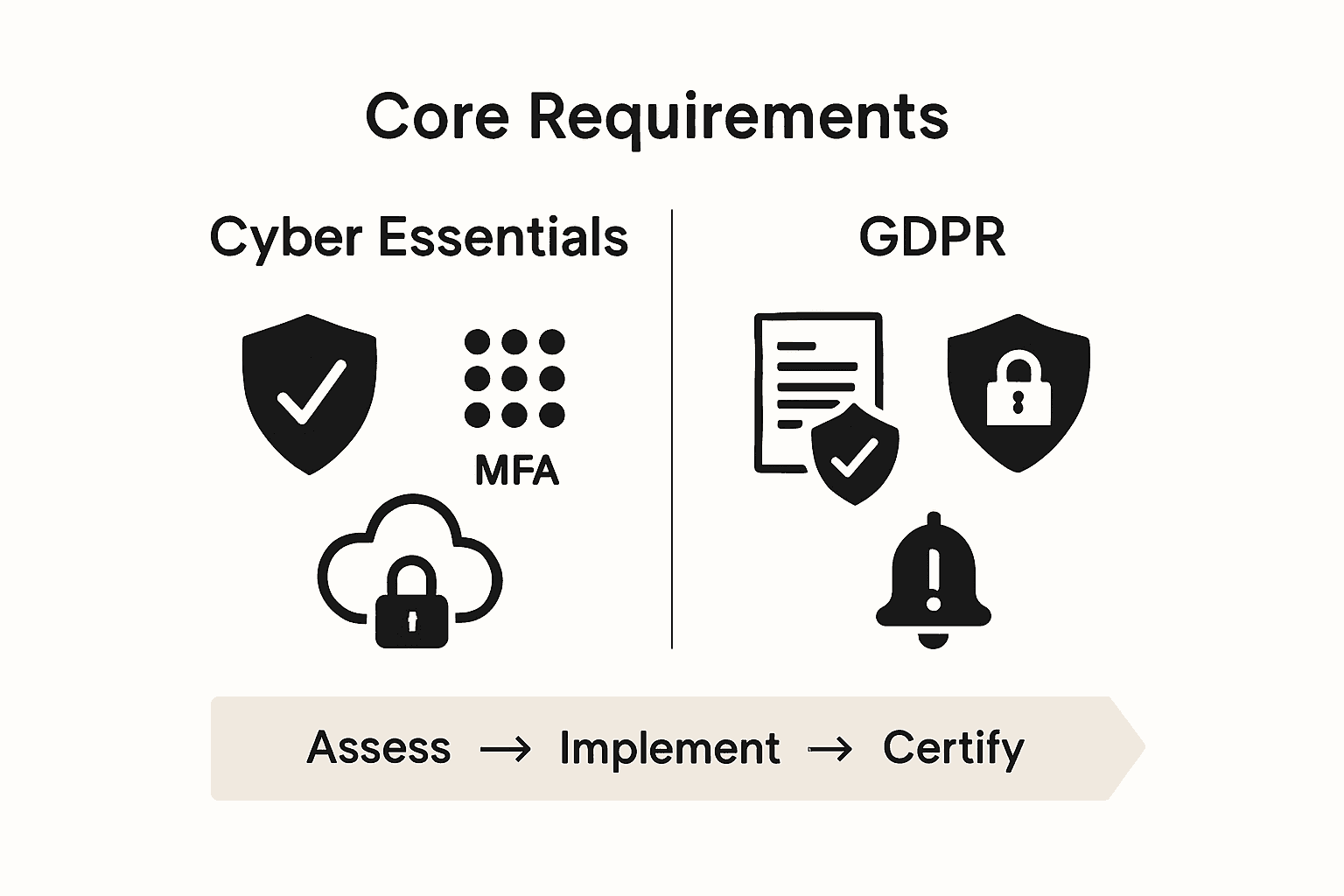
According to Wikipedia’s Cyber Essentials documentation, the UK government has established clear guidelines through the Cyber Essentials certification scheme. Since January 2022, this scheme has significantly expanded its scope to comprehensively cover cloud services:
Businesses in Preston, Blackburn, and across the North West must also consider additional regulatory frameworks like GDPR, which impose strict data protection requirements. This means implementing robust mechanisms for:
Learn more about preventing cloud breaches to ensure your cloud strategy remains compliant and secure. Compliance is an ongoing journey, not a destination—staying informed and proactive is key to protecting your digital assets.
For businesses across Lancashire and Manchester, cloud security management requires a proactive and comprehensive approach. Protecting your digital infrastructure isn’t about implementing a single solution, but creating a robust, multi-layered strategy that adapts to evolving threats.
Key best practices for effective cloud security management include:
Businesses in Preston, Blackburn, and across the North West should prioritize employee awareness as a critical component of cloud security. This means creating a culture of security consciousness where every team member understands their role in protecting sensitive information.
Explore our guide on preventing cloud breaches to develop a comprehensive security strategy. Remember, cloud security is not a one-time implementation but an ongoing process of monitoring, learning, and adapting to protect your most valuable digital assets.
Are you worried about misconfigurations, compliance risks or sophisticated cloud threats? If your business in Lancashire or Manchester faces uncertainty about cloud security responsibilities, you are not alone. Many UK companies struggle to keep data safe and meet regulations while lacking the in-house expertise or tools mentioned in this guide. Visit our Cloud Solutions page to see how we help local businesses secure every aspect of their cloud infrastructure and protect sensitive information.
Take real action to futureproof your business today. The risk of cyber attacks and compliance failures is growing rapidly, so do not wait for a breach before acting. Speak to our Lancashire-based specialists for tailored cloud security solutions that include managed support, advanced technology, and ongoing compliance. Make contact quickly at J700 Group or explore how we strengthen digital protection by visiting our Cyber Security resource hub. Your peace of mind starts now.
Cloud security involves protecting data, applications, and infrastructure associated with cloud computing through various strategies to prevent unauthorized access, data breaches, and ensure compliance with regulations.
Common cloud security threats include phishing, social engineering, data breaches, ransomware attacks, and insider threats. It’s essential to implement comprehensive security strategies to mitigate these risks.
Key technologies include Multi-Factor Authentication (MFA), encryption tools, Cloud Access Security Brokers (CASB), Security Information and Event Management (SIEM) systems, network segmentation, and zero trust architecture.
Businesses can ensure compliance by following guidelines such as the Cyber Essentials certification, implementing multi-factor authentication, controlling access, encrypting data, conducting regular audits, and establishing breach notification protocols.
For years, businesses protected their data like a medieval castle: build a thick wall (a…
Read More
For many small and medium-sized businesses, cybersecurity is still viewed as an IT problem. Firewalls,…
Read More
Cloud technology is no longer a luxury or a cost-saving alternative to on-site servers. For…
Read More
Remember when we jokingly wondered if Apple was borrowing our name? Well, the rumours were…
Read More
AI hasn’t just changed the way we work, it has completely rewritten the rulebook for…
Read More
For many businesses, the office phone is like part of the furniture, it’s always there,…
Read More
We are thrilled to announce a significant milestone in the J700 Group journey. To keep…
Read More
For years, many small and medium-sized business owners in the North West have operated under…
Read More
In a modern healthcare setting, the stethoscope and the blood pressure cuff aren’t the only…
Read More
When people hear the word cybersecurity, they often imagine complex systems, expensive software and specialist…
Read More
As we count down to midnight, most of us are thinking about gym memberships or…
Read More
It’s Christmas Eve in Lancashire. The Preston bypass is a nightmare, the last-minute dash to…
Read More
For many businesses, the Christmas period means quieter offices, reduced staffing and systems left running…
Read More
Or: Why we’d like to have a word with Tim Cook this Christmas. There are…
Read More
Hackers Love Christmas: Learn Why your Business Could be at Risk This Holiday SeasonThe festive…
Read More
In recent months, high-profile companies like Land Rover and Co-op have made headlines due to…
Read More
Explore 7 essential tips for effective cloud solutions comparison to find the best fit for…
Read More
Learn how to secure business data for UK SMEs with this step-by-step guide focused on…
Read More
Cybersecurity basics explained for UK businesses—core concepts, major threats, essential safeguards, and compliance requirements. A…
Read More
Discover the essential role of IT support desks, core functions, key benefits, types of support,…
Read More
Discover 10 microsoft 365 alternatives for UK SMEs, comparing features and benefits to help your…
Read More
Discover the best microsoft 365 alternatives in our comparison of 10 top products to enhance…
Read More
Discover a business connectivity checklist with 7 actionable steps to boost IT reliability, security, and…
Read More
Discover 7 essential business continuity planning steps to protect your SME. Learn practical strategies for…
Read More
Small Business Office 365 comprehensive guide for UK SMEs: core features, setup process, security essentials,…
Read More
Small Business Office 365 guide for UK firms. Learn core features, setup, security, costs, and…
Read More
Small business Office 365 guide covering essential features, security, costs, local support, and practical benefits…
Read More
Follow this cybersecurity checklist for SMEs to secure your business in Lancashire and Manchester. Step-by-step…
Read More
Follow this cybersecurity checklist for SMEs to boost protection, reduce risks, and secure business data…
Read More
Cloud security explained: A comprehensive guide for UK businesses covering threat types, protection strategies, compliance,…
Read More
Data protection strategies for UK SMEs—types, key components, GDPR compliance, business risks, and best practices…
Read More
Why cybersecurity matters for UK businesses: core concepts, main risks, common threats, legal requirements, and…
Read More
Comprehensive guide to IT issues Lancashire businesses face, including security threats, system downtime, cloud solutions,…
Read More
Comprehensive guide on cyber security threats in the UK. Learn common types, key characteristics, real-world…
Read More
Follow this IT security checklist for a step-by-step process to secure your business effectively in…
Read More
Explore the benefits of managed IT services for businesses in Manchester and Lancashire, enhancing efficiency…
Read More
Explore the role of cybersecurity in business. Understand its importance, how it works, and key…
Read More
Discover 7 key advantages of Microsoft 365 for SMEs that can enhance productivity, collaboration, and…
Read More
Explore why use managed IT services and how they benefit businesses. Gain comprehensive insights on…
Read More
Comprehensive guide explaining cyber threats, focusing on their importance, how they work, and the key…
Read More