



For years, businesses protected their data like a medieval castle: build a thick wall (a…
Read More
Managed IT services are rapidly shifting how companies manage their technology. Businesses that adopt this strategy enjoy predictable monthly IT costs and access to expertise that would be costly to build in-house. Most expect outsourcing tech support means less control or lower quality. Instead, managed IT services actually give organisations a competitive edge by keeping their systems secure, smooth, and always ready for what’s next.
| Takeaway | Explanation |
|---|---|
| Outsource IT for strategic focus | Managed IT services allow businesses to outsource IT management, enabling a concentration on core objectives and innovation. |
| Proactive management reduces downtime | Continuous monitoring and preventive strategies help identify and resolve issues before they escalate, minimising disruptions. |
| Access specialised expertise | Partnering with managed IT service providers offers businesses access to advanced technology skills without the need for large internal teams. |
| Predictable technology costs | Engaging managed IT services provides consistent monthly costs for IT expenses, aiding in budget management and planning. |
| Transform IT into a strategic asset | By utilising managed IT services, businesses can shift their IT from a cost centre to a key driver of competitive advantage and growth. |
Managed IT services represent a strategic approach for businesses to outsource their technology infrastructure management to specialised external providers. Instead of maintaining an in-house IT department, organisations can leverage expert teams who proactively monitor, maintain, and support their entire technological ecosystem.
At its fundamental level, managed IT services encompass comprehensive technology support designed to optimise a company’s digital operations. These services typically include network monitoring, cybersecurity protection, technical support, cloud infrastructure management, and strategic technology consulting.
According to Gartner Research, businesses increasingly adopt managed IT services to reduce operational complexity and focus on core business objectives. The primary goal is transforming technology from a potential burden into a strategic asset that drives organisational performance.
Managed IT services provide multiple strategic advantages for organisations of all sizes. Key benefits include:
These services function as a comprehensive solution that allows businesses to leverage professional technological management without substantial internal investment. By partnering with experienced managed IT service providers, organisations can ensure their technological infrastructure remains robust, secure, and aligned with their strategic goals.
The following table summarises the core components of managed IT services and highlights the strategic business benefits associated with each feature, allowing readers to quickly scan how each element adds value.
| Managed IT Component | Description | Key Benefit |
|---|---|---|
| Network Monitoring | Continuous surveillance of digital networks | Early issue detection; less downtime |
| Cybersecurity Protection | Proactive safeguarding against threats | Enhanced data security |
| Technical Support | Expert helpdesk and troubleshooting | Fast issue resolution |
| Cloud Infrastructure Management | Management of cloud platforms and services | Scalable, flexible resources |
| Strategic Technology Consulting | Guidance on IT strategy and planning | Improved alignment with goals |
Unlike traditional break-fix IT support models, managed IT services operate on a proactive model.
To clarify the operational distinctions between managed IT services and traditional IT support, the following table compares their primary approaches, methodologies, and outcomes.
| Aspect | Managed IT Services | Traditional IT Support |
|---|---|---|
| Approach | Proactive | Reactive (break-fix) |
| System Monitoring | Continuous, real-time | Typically none until failure |
| Issue Resolution | Preventative, before problems occur | After issues are reported |
| Cost Structure | Predictable monthly fees | Unpredictable, pay-as-you-go |
| Impact on Downtime | Minimised through prevention | Downtime likely during fixes |
| Strategic Alignment | Integrated with business objectives | Siloed, tactical responses |
| Access to Expertise | Comprehensive, cutting-edge | Variable, often basic |
In today’s rapidly evolving digital landscape, businesses must prioritise technological resilience and strategic IT management. Managed IT services have emerged as a critical solution for organisations seeking comprehensive technological support and strategic advantage.
Managed IT services represent more than simple technical support. They function as a transformative approach that enables businesses to reimagine their technological infrastructure. Learn more about how IT can better serve your business by understanding the profound impact of professional technology management.
According to McKinsey Digital, businesses that effectively leverage managed IT services can achieve significant competitive advantages. These advantages extend beyond traditional technological support and include strategic insights, risk management, and operational efficiency.
The importance of managed IT services becomes evident through their multifaceted benefits. Businesses gain substantial advantages that directly impact their operational effectiveness:
Moreover, managed IT services enable businesses to shift their focus from reactive problem-solving to proactive strategic planning. By outsourcing technological management, organisations can allocate internal resources more effectively, concentrating on core business objectives and innovation.
Professional IT service providers bring comprehensive expertise that individual businesses might struggle to develop internally. They offer continuous monitoring, rapid problem resolution, and strategic technological guidance. This approach ensures that businesses remain technologically competitive, secure, and adaptable in an increasingly complex digital environment.
Managed IT services function as a comprehensive technological partnership where external experts assume responsibility for an organisation’s entire technological infrastructure. This approach transforms traditional IT support from a reactive to a proactive management model.
The operational approach of managed IT services involves continuous monitoring, strategic planning, and integrated technological support. Discover our detailed guide to managed IT services to understand the intricate mechanisms behind this sophisticated service model.
According to Deloitte Technology Insights, successful managed IT services integrate multiple technological domains to create a holistic support ecosystem. This integration typically encompasses:
Professional managed IT service providers employ advanced monitoring tools and sophisticated diagnostic technologies to ensure optimal technological performance. They establish predefined service level agreements (SLAs) that outline specific performance metrics, response times, and resolution protocols.
Unlike traditional IT support models, managed services operate on a predictive and preventative basis.
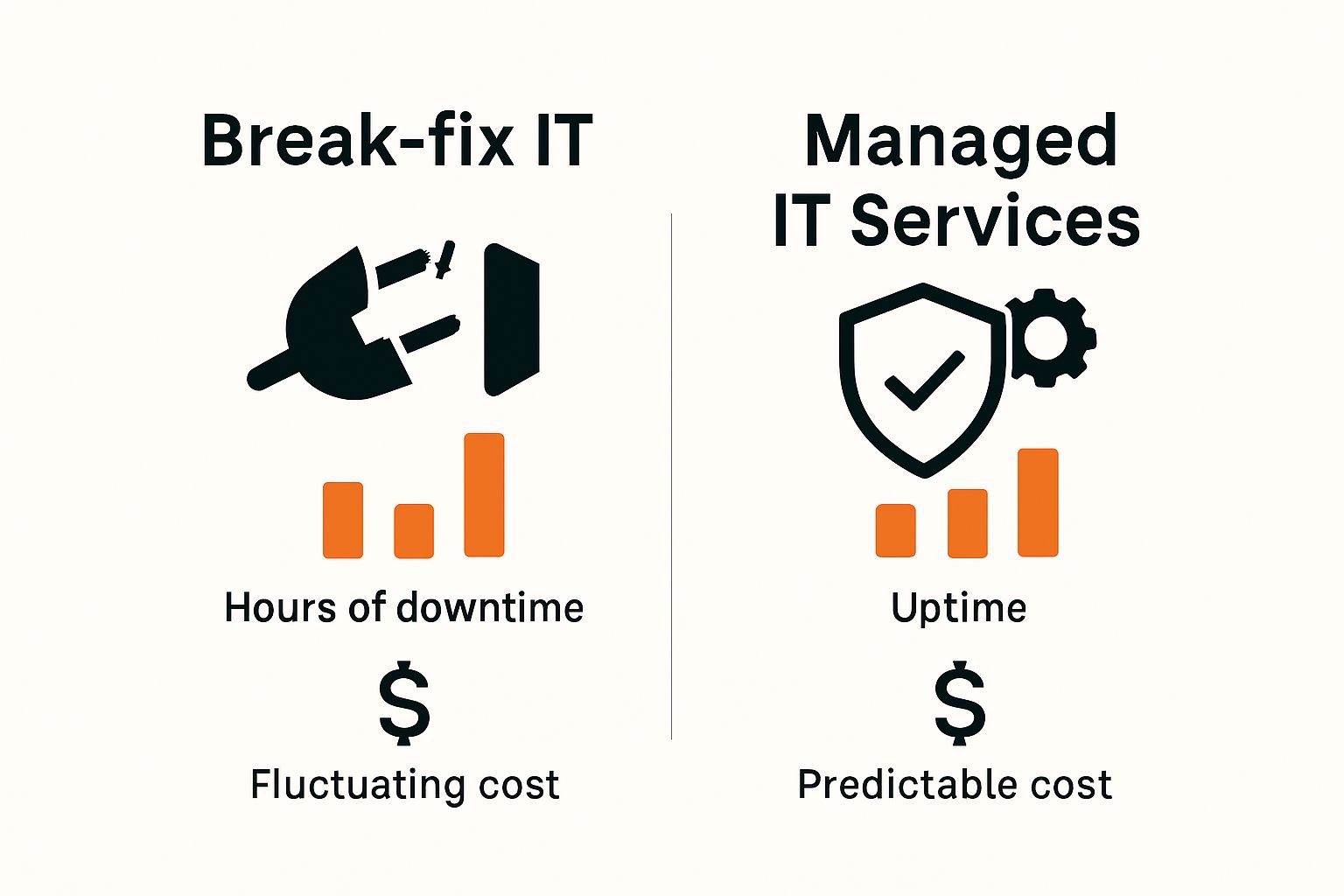
Technological experts continuously analyse system performance, identify potential vulnerabilities, and implement proactive solutions before issues can escalate. This approach minimises downtime, reduces technological risks, and enables businesses to maintain uninterrupted operational efficiency.
Managed IT services represent a sophisticated approach to technological management that goes beyond traditional technical support. By understanding their fundamental concepts, businesses can unlock significant strategic advantages in their digital infrastructure.
The fundamental philosophy of managed IT services centres on proactive technological governance. Rather than waiting for systems to fail, these services anticipate potential challenges and implement preventative strategies. Learn more about technology trends changing business operations to understand how modern IT management has evolved.
According to Forrester Research, modern managed IT services operate on several critical principles:
Managed IT services transcend traditional technical support by offering holistic technological solutions. They transform IT from a cost centre into a strategic business asset. Professional providers bring specialised expertise that enables businesses to leverage cutting-edge technologies without maintaining extensive internal technological teams.
By outsourcing technological management, organisations gain access to advanced technological capabilities, reduce operational risks, and create more flexible, responsive digital infrastructures. This approach allows businesses to concentrate on core competencies while ensuring their technological foundations remain robust, secure, and strategically aligned with organisational objectives.

If you are struggling with unreliable systems or are tired of constant IT issues slowing down your business, there is a better way. The article has shown how managed IT services provide proactive support, tight cybersecurity, and stable technology budgets. Now is the time to move beyond patching problems when they appear and secure the expert partnership that helps your business thrive. If you use Microsoft 365 or depend on cloud services, explore our Microsoft solutions designed for seamless productivity.
J700 Group offers managed IT services tailored for SMEs across Lancashire and the North West. We understand that business owners need technology to simply work without hassle. Let us manage your IT needs so you can focus on growth and peace of mind. Make the change today and get in touch with our Lancashire-based team to see how simple effective IT support can be. Your business deserves it.
Managed IT services are a strategic approach where businesses outsource their technology infrastructure management to specialised external providers, who monitor, maintain, and support the technology ecosystem.
Managed IT services provide predictable monthly technology expenses, access to specialised expertise, proactive system maintenance, enhanced cybersecurity protection, and scalable technology infrastructure.
Unlike traditional break-fix IT support, managed IT services are proactive; they continuously monitor systems to identify and resolve potential issues before they escalate, ensuring minimal downtime and operational efficiency.
Outsourcing IT management allows businesses to focus on their core objectives and innovation. It provides access to comprehensive expertise and advanced technological capabilities without substantial internal investment.
For years, businesses protected their data like a medieval castle: build a thick wall (a…
Read More
For many small and medium-sized businesses, cybersecurity is still viewed as an IT problem. Firewalls,…
Read More
Cloud technology is no longer a luxury or a cost-saving alternative to on-site servers. For…
Read More
Remember when we jokingly wondered if Apple was borrowing our name? Well, the rumours were…
Read More
AI hasn’t just changed the way we work, it has completely rewritten the rulebook for…
Read More
For many businesses, the office phone is like part of the furniture, it’s always there,…
Read More
We are thrilled to announce a significant milestone in the J700 Group journey. To keep…
Read More
For years, many small and medium-sized business owners in the North West have operated under…
Read More
In a modern healthcare setting, the stethoscope and the blood pressure cuff aren’t the only…
Read More
When people hear the word cybersecurity, they often imagine complex systems, expensive software and specialist…
Read More
As we count down to midnight, most of us are thinking about gym memberships or…
Read More
It’s Christmas Eve in Lancashire. The Preston bypass is a nightmare, the last-minute dash to…
Read More
For many businesses, the Christmas period means quieter offices, reduced staffing and systems left running…
Read More
Or: Why we’d like to have a word with Tim Cook this Christmas. There are…
Read More
Hackers Love Christmas: Learn Why your Business Could be at Risk This Holiday SeasonThe festive…
Read More
In recent months, high-profile companies like Land Rover and Co-op have made headlines due to…
Read More
Explore 7 essential tips for effective cloud solutions comparison to find the best fit for…
Read More
Learn how to secure business data for UK SMEs with this step-by-step guide focused on…
Read More
Cybersecurity basics explained for UK businesses—core concepts, major threats, essential safeguards, and compliance requirements. A…
Read More
Discover the essential role of IT support desks, core functions, key benefits, types of support,…
Read More
Discover 10 microsoft 365 alternatives for UK SMEs, comparing features and benefits to help your…
Read More
Discover the best microsoft 365 alternatives in our comparison of 10 top products to enhance…
Read More
Discover a business connectivity checklist with 7 actionable steps to boost IT reliability, security, and…
Read More
Discover 7 essential business continuity planning steps to protect your SME. Learn practical strategies for…
Read More
Small Business Office 365 comprehensive guide for UK SMEs: core features, setup process, security essentials,…
Read More
Small Business Office 365 guide for UK firms. Learn core features, setup, security, costs, and…
Read More
Small business Office 365 guide covering essential features, security, costs, local support, and practical benefits…
Read More
Follow this cybersecurity checklist for SMEs to secure your business in Lancashire and Manchester. Step-by-step…
Read More
Follow this cybersecurity checklist for SMEs to boost protection, reduce risks, and secure business data…
Read More
Cloud security explained: A comprehensive guide for UK businesses covering threat types, protection strategies, compliance,…
Read More
Data protection strategies for UK SMEs—types, key components, GDPR compliance, business risks, and best practices…
Read More
Why cybersecurity matters for UK businesses: core concepts, main risks, common threats, legal requirements, and…
Read More
Comprehensive guide to IT issues Lancashire businesses face, including security threats, system downtime, cloud solutions,…
Read More
Comprehensive guide on cyber security threats in the UK. Learn common types, key characteristics, real-world…
Read More
Follow this IT security checklist for a step-by-step process to secure your business effectively in…
Read More
Explore the benefits of managed IT services for businesses in Manchester and Lancashire, enhancing efficiency…
Read More
Explore the role of cybersecurity in business. Understand its importance, how it works, and key…
Read More
Discover 7 key advantages of Microsoft 365 for SMEs that can enhance productivity, collaboration, and…
Read More
Explore why use managed IT services and how they benefit businesses. Gain comprehensive insights on…
Read More
Comprehensive guide explaining cyber threats, focusing on their importance, how they work, and the key…
Read More