



For years, businesses protected their data like a medieval castle: build a thick wall (a…
Read More
Data protection is shaping how every company and consumer operate online. The stakes have never been higher, with potential fines reaching up to £17.5 million or 4 percent of global annual turnover for a single breach. Many think data protection is just a legal headache for big corporations. In reality, it is the invisible shield that keeps your personal life private and can decide whether a business thrives or disappears overnight.
| Takeaway | Explanation |
|---|---|
| Data protection is essential for privacy | Safeguarding personal information prevents misuse and builds trust between individuals and organisations. |
| Compliance with data laws is mandatory | UK GDPR and Data Protection Act 2018 outline strict requirements for handling personal information. |
| Organisations face severe penalties for breaches | Violating data protection regulations can lead to fines of up to 4% of global turnover or £17.5 million. |
| Robust data management is crucial for businesses | Establishing strong protocols protects personal information and supports operational efficiency. |
| Consent is fundamental in data processing | Individuals must give informed permission for their data usage, ensuring transparency and individual rights. |
Data protection represents a critical framework for safeguarding personal and organisational information in our increasingly digital world. At its core, data protection involves establishing comprehensive strategies and legal mechanisms to prevent unauthorised access, misuse, or theft of sensitive information.
Data protection fundamentally centres on preserving individuals’ privacy rights and ensuring organisations handle personal data responsibly. The primary objective is creating a secure environment where personal information remains confidential, accurate, and used only for intended purposes. This approach protects individuals from potential misuse of their data while providing organisations clear guidelines for responsible information management.
The UK has robust regulations governing data protection. According to Information Commissioner’s Office, organisations must adhere to key principles that ensure data is:
Data protection extends beyond technical safeguards into legal and ethical domains. Breaching data protection regulations can result in significant financial penalties and reputational damage. Businesses must implement comprehensive strategies that not only comply with legal requirements but also demonstrate a commitment to protecting individual privacy.
Companies handling personal data must develop robust protocols that include secure storage systems, restricted access controls, regular security audits, and clear consent mechanisms. This approach ensures that personal information remains protected from potential cyber threats, accidental exposure, or inappropriate use.
The legal framework for data protection represents a complex and evolving system designed to protect individuals’ personal information in an increasingly digital world. These regulations establish clear guidelines for how organisations must collect, process, store, and manage personal data while ensuring fundamental privacy rights.
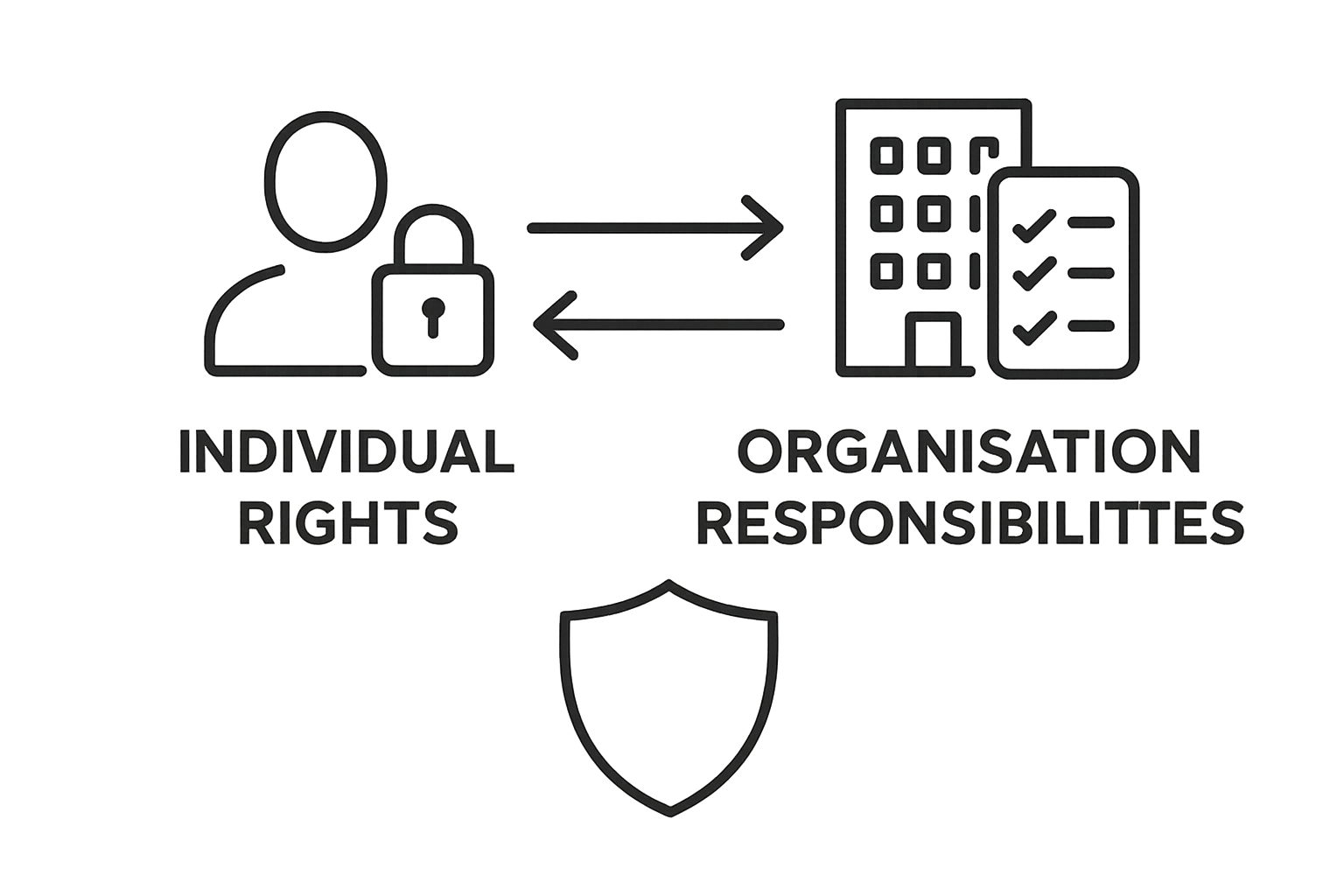
In the United Kingdom, the primary legislative instruments governing data protection are the UK General Data Protection Regulation (UK GDPR) and the Data Protection Act 2018. According to UK Government Legal Guidance, these laws create a comprehensive framework that defines the rights of individuals and the responsibilities of organisations handling personal information.
The legal framework encompasses several critical elements
 :
:
The legal framework is not merely a set of guidelines but includes robust enforcement mechanisms. The Information Commissioner’s Office (ICO) serves as the primary regulatory body responsible for monitoring compliance and enforcing data protection regulations. Organisations found in violation can face significant financial penalties, with potential fines reaching up to 4% of global annual turnover or £17.5 million, whichever is higher.
These substantial penalties underscore the critical importance of understanding and implementing comprehensive data protection strategies.
Businesses must proactively develop comprehensive compliance programmes that address not just legal requirements, but also establish a culture of responsible data management and individual privacy protection.
Data protection is not merely a technical exercise but a comprehensive approach to managing personal information with respect, integrity, and strategic consideration. It encompasses a set of fundamental principles designed to balance individual privacy rights with organisational information needs.
The foundation of data protection rests on several critical principles that guide how personal information should be handled. According to Information Commissioner’s Office, these principles ensure that data processing remains fair, transparent, and accountable.
Key principles include:
Consent forms the cornerstone of ethical data protection. Individuals must provide explicit, informed permission for their data to be collected and processed. This means organisations must clearly explain:
Moreover, individuals retain fundamental rights including the ability to access their personal data, request corrections, and demand deletion under specific circumstances. These rights empower individuals to maintain control over their personal information in an increasingly digital landscape.
The following table summarises the core data protection principles explained in the article, offering a concise reference for understanding each principle’s distinct purpose and importance.
| Principle | Explanation |
|---|---|
| Lawfulness | Processing personal data must have a legitimate legal basis. |
| Fairness | Data handling should not adversely impact individuals. |
| Transparency | Clear communication about how data will be used. |
| Purpose Limitation | Data collected only for specific, explicit purposes. |
| Data Minimisation | Collecting only necessary information. |
| Accuracy | Ensuring data remains current and correct. |

Data protection is no longer an optional consideration but a critical business imperative that impacts every organisational operation. For modern businesses, understanding and implementing robust data protection strategies represents both a legal obligation and a strategic competitive advantage.
Businesses face significant challenges in navigating data protection requirements. According to UK Government Guidelines, organisations must develop comprehensive approaches that protect personal information while maintaining operational efficiency. These requirements extend across multiple business domains, including customer relationship management, human resources, and digital marketing.
This table presents the main financial and operational consequences highlighted in the article for businesses that fail to comply with data protection regulations.
| Consequence | Description |
|---|---|
| Substantial Fines | Up to £17.5 million or 4% of global annual turnover, whichever is higher. |
| Loss of Customer Trust | Erosion of confidence in the organisation, affecting long-term relationships and reputation. |
| Regulatory Investigations & Legal Action | Potential for legal proceedings and increased scrutiny from regulatory authorities. |
| Business Operation Disruption | Disruption to normal business processes during compliance reviews or incident management. |
The financial risks of non-compliance are substantial:
Effective data protection demands more than mere regulatory compliance. Businesses must proactively develop strategic data management frameworks that balance legal requirements with operational needs. This involves implementing robust technical and organisational measures, including secure data storage systems, restricted access protocols, and comprehensive staff training programmes.
For businesses seeking deeper insights, read more about data protection strategies beyond basic backup that can transform how organisations approach information security. By treating data protection as a strategic asset rather than a compliance burden, businesses can build stronger, more resilient operational models that protect both their interests and their customers’ privacy.
Data protection is not an abstract concept but a practical approach implemented across various sectors to safeguard personal information. Understanding how different organisations apply data protection principles helps demystify these critical practices and illustrates their real-world significance.
Healthcare represents a sector with particularly sensitive data protection requirements. According to NHS Digital Guidelines, medical institutions must implement rigorous protocols to protect patient records. Anonymisation techniques are frequently used to enable research while preserving individual privacy.
Key strategies in healthcare data protection include:
Technology companies are pioneering innovative approaches to data protection. These organisations develop sophisticated mechanisms that balance user privacy with functional requirements. For instance, some platforms use federated learning techniques that allow machine learning model training without directly accessing individual user data.
Learn more about emerging privacy technologies in smart systems that demonstrate how cutting-edge solutions can protect personal information. These approaches showcase how businesses can leverage technology to create robust, privacy-preserving systems that maintain both security and functionality.
Struggling with the challenges of data protection and compliance is more common than you think. This guide makes it clear how complex managing privacy regulations, securing personal data, and keeping up with ever-changing laws can be. If you feel unsure about your company’s responsibilities under GDPR or worry about the risk of data breaches, you are certainly not alone. Many businesses simply do not have the time or specialised knowledge to put all the right controls in place. See what other businesses are solving right now in our GDPR resource hub.

Let J700 Group show you how stress-free data protection should feel. Our Lancashire-based experts design robust strategies, strengthen cybersecurity, and guide you through technical and legal requirements—so you can focus on running your business, not worrying about compliance. Discover how we can solve your IT headaches and protect your reputation. Visit our contact page and take control of your data protection today. Explore more ways to boost your security on our Cyber Security page. Act now to protect your business before the next regulation changes.
Data protection is a framework that encompasses strategies and legal mechanisms designed to secure personal and organisational information from unauthorised access, misuse, or theft.
Data protection is crucial for preserving individuals’ privacy rights and ensuring that organisations manage personal data responsibly, preventing misuse and maintaining trust.
The main principles include lawfulness, fairness, transparency, purpose limitation, data minimisation, and accuracy, ensuring that personal information is handled properly.
Consequences include significant financial penalties, reputational damage, potential legal action, and disruption to business operations, which emphasise the need for compliance and robust data protection strategies.
For years, businesses protected their data like a medieval castle: build a thick wall (a…
Read More
For many small and medium-sized businesses, cybersecurity is still viewed as an IT problem. Firewalls,…
Read More
Cloud technology is no longer a luxury or a cost-saving alternative to on-site servers. For…
Read More
Remember when we jokingly wondered if Apple was borrowing our name? Well, the rumours were…
Read More
AI hasn’t just changed the way we work, it has completely rewritten the rulebook for…
Read More
For many businesses, the office phone is like part of the furniture, it’s always there,…
Read More
We are thrilled to announce a significant milestone in the J700 Group journey. To keep…
Read More
For years, many small and medium-sized business owners in the North West have operated under…
Read More
In a modern healthcare setting, the stethoscope and the blood pressure cuff aren’t the only…
Read More
When people hear the word cybersecurity, they often imagine complex systems, expensive software and specialist…
Read More
As we count down to midnight, most of us are thinking about gym memberships or…
Read More
It’s Christmas Eve in Lancashire. The Preston bypass is a nightmare, the last-minute dash to…
Read More
For many businesses, the Christmas period means quieter offices, reduced staffing and systems left running…
Read More
Or: Why we’d like to have a word with Tim Cook this Christmas. There are…
Read More
Hackers Love Christmas: Learn Why your Business Could be at Risk This Holiday SeasonThe festive…
Read More
In recent months, high-profile companies like Land Rover and Co-op have made headlines due to…
Read More
Explore 7 essential tips for effective cloud solutions comparison to find the best fit for…
Read More
Learn how to secure business data for UK SMEs with this step-by-step guide focused on…
Read More
Cybersecurity basics explained for UK businesses—core concepts, major threats, essential safeguards, and compliance requirements. A…
Read More
Discover the essential role of IT support desks, core functions, key benefits, types of support,…
Read More
Discover 10 microsoft 365 alternatives for UK SMEs, comparing features and benefits to help your…
Read More
Discover the best microsoft 365 alternatives in our comparison of 10 top products to enhance…
Read More
Discover a business connectivity checklist with 7 actionable steps to boost IT reliability, security, and…
Read More
Discover 7 essential business continuity planning steps to protect your SME. Learn practical strategies for…
Read More
Small Business Office 365 comprehensive guide for UK SMEs: core features, setup process, security essentials,…
Read More
Small Business Office 365 guide for UK firms. Learn core features, setup, security, costs, and…
Read More
Small business Office 365 guide covering essential features, security, costs, local support, and practical benefits…
Read More
Follow this cybersecurity checklist for SMEs to secure your business in Lancashire and Manchester. Step-by-step…
Read More
Follow this cybersecurity checklist for SMEs to boost protection, reduce risks, and secure business data…
Read More
Cloud security explained: A comprehensive guide for UK businesses covering threat types, protection strategies, compliance,…
Read More
Data protection strategies for UK SMEs—types, key components, GDPR compliance, business risks, and best practices…
Read More
Why cybersecurity matters for UK businesses: core concepts, main risks, common threats, legal requirements, and…
Read More
Comprehensive guide to IT issues Lancashire businesses face, including security threats, system downtime, cloud solutions,…
Read More
Comprehensive guide on cyber security threats in the UK. Learn common types, key characteristics, real-world…
Read More
Follow this IT security checklist for a step-by-step process to secure your business effectively in…
Read More
Explore the benefits of managed IT services for businesses in Manchester and Lancashire, enhancing efficiency…
Read More
Explore the role of cybersecurity in business. Understand its importance, how it works, and key…
Read More
Discover 7 key advantages of Microsoft 365 for SMEs that can enhance productivity, collaboration, and…
Read More
Explore why use managed IT services and how they benefit businesses. Gain comprehensive insights on…
Read More
Comprehensive guide explaining cyber threats, focusing on their importance, how they work, and the key…
Read More