



For years, businesses protected their data like a medieval castle: build a thick wall (a…
Read More
Cloud application hosting is changing how businesses run software and manage technology. Many firms still picture racks of local servers and endless hardware upgrades, but everything shifts with cloud platforms. UK organisations can now cut IT costs by up to 40 percent and run powerful applications anywhere with nothing but an internet connection. This is not just about saving money on servers. It is about unlocking a whole new way to work that is faster, safer, and more resilient than ever before.
| Takeaway | Explanation |
|---|---|
| Cloud hosting enhances operational efficiency | Businesses can significantly reduce IT costs and complexity by transitioning to cloud-based solutions. |
| Scalability is a key advantage of cloud hosting | Organisations can instantly allocate resources as per demand without upfront investment in hardware. |
| Cloud providers ensure robust security measures | Advanced security frameworks protect sensitive data while maintaining compliance with industry regulations. |
| Global accessibility supports workforce mobility | Employees can access applications from anywhere with an internet connection, increasing productivity. |
| Focus on core business over tech management | Outsourcing technical maintenance allows businesses to concentrate on innovation and strategic growth. |
Cloud application hosting represents a transformative approach to deploying, managing, and accessing software applications through remote internet-based servers. Instead of maintaining complex on-premise infrastructure, businesses can leverage cloud platforms to run their critical software applications with greater flexibility and efficiency.
At its fundamental level, cloud application hosting involves running software applications on virtual servers managed by third-party cloud service providers. These providers maintain extensive data centres with powerful computing resources, allowing organisations to access sophisticated technological infrastructure without significant upfront capital investment. Cloud solutions for Lancashire businesses offer scalable and secure options for companies seeking modern technological capabilities.
The mechanism works by hosting an application’s entire ecosystem remotely, including its computing power, storage, and networking requirements. Businesses can access these applications through web browsers or dedicated client software, eliminating the need for local hardware maintenance and complex software installations.
Cloud application hosting encompasses several critical architectural components that distinguish it from traditional software deployment models:
According to the UK National Cyber Security Centre, cloud hosting models provide enhanced security protocols and standardised compliance frameworks that significantly reduce operational risks for businesses.
By leveraging cloud application hosting, organisations can achieve unprecedented operational agility, reduce infrastructure complexity, and focus more resources on core business objectives rather than technological maintenance.
Below is a table summarising core architectural components of cloud application hosting, helping to clarify their distinct roles and benefits for organisations.
| Component | Description | Organisational Benefit |
|---|---|---|
| Scalability | Instant resource allocation as demand changes | Reduces need for overprovisioning, improves cost-efficiency |
| Multi-tenancy | Shared infrastructure among multiple users | Lowers costs, maximises resource utilisation |
| Automated Management | Automatic updates, patching, and maintenance | Minimises IT workloads, ensures up-to-date security |
| Global Accessibility | Applications accessed from any internet-enabled location | Enhances remote work and workforce flexibility |
| Business Continuity | Built-in disaster recovery and backup systems | Increases operational resilience |
Cloud application hosting has emerged as a game-changing technological strategy that fundamentally transforms how businesses approach their digital infrastructure, offering unprecedented operational advantages and strategic flexibility.
For modern businesses, cloud application hosting represents more than just a technological solution – it is a strategic approach to resource management. By transitioning from traditional on-premise infrastructure to cloud-based platforms, organisations can significantly reduce capital expenditure.
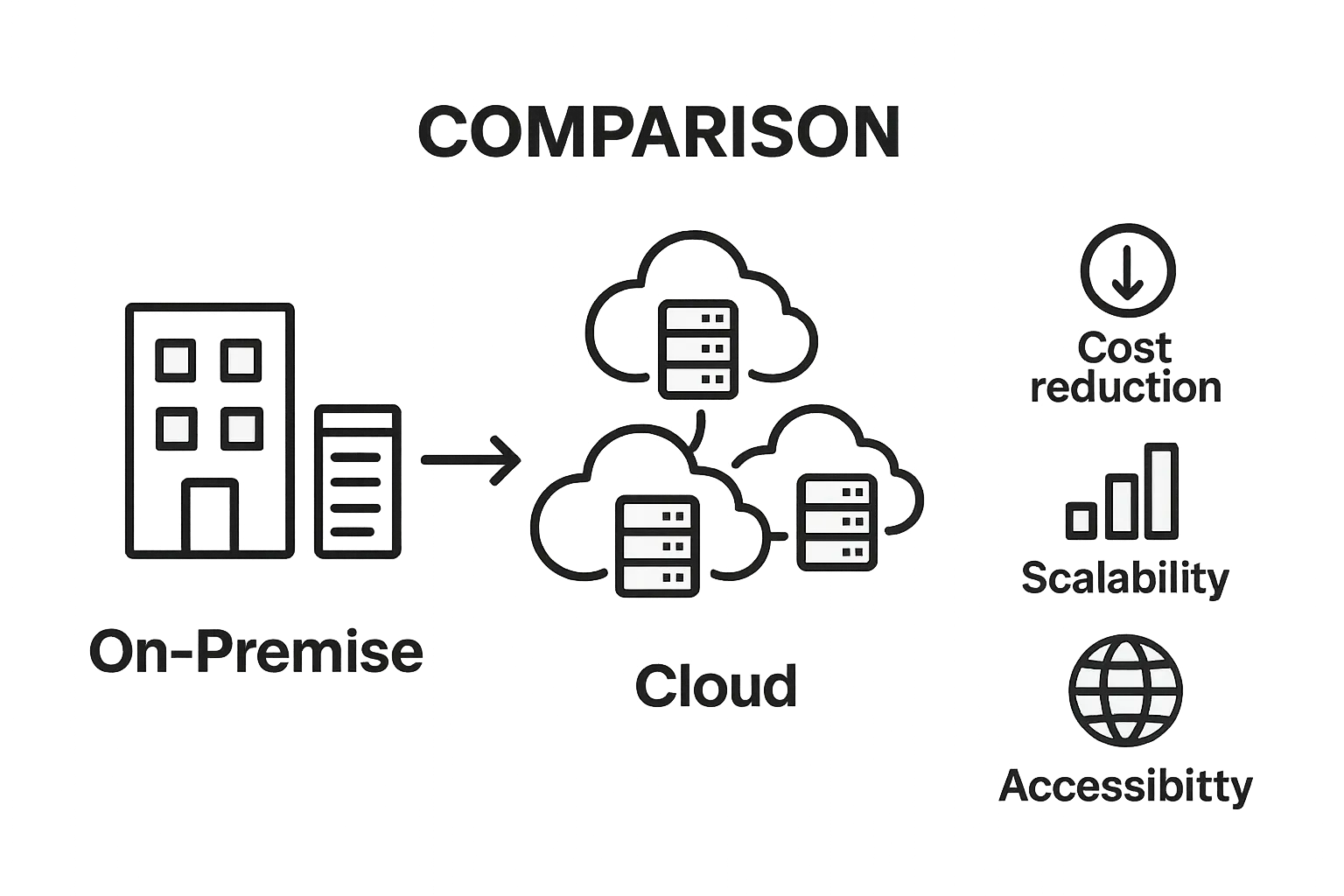
Instead of investing substantial funds in physical servers, maintenance, and ongoing hardware upgrades, businesses can leverage pay-as-you-go models that align technology costs directly with actual usage requirements.
Learn more about small business cloud migration strategies to understand how cloud technologies can transform your operational efficiency.
Cloud application hosting provides businesses with remarkable operational resilience and adaptability. Key advantages include:
According to Gartner Research, organisations using cloud application hosting can reduce IT operational costs by up to 40% while simultaneously improving technological responsiveness.
Moreover, cloud hosting allows businesses to focus on core competencies rather than managing complex technological infrastructures.
 By outsourcing technical maintenance to specialized providers, companies can redirect valuable resources towards innovation, customer experience, and strategic growth initiatives.
Cloud application hosting operates through a sophisticated network of interconnected technologies that enable seamless software deployment, management, and accessibility across distributed computing environments.
At the core of cloud application hosting lies virtualization technology, which allows multiple virtual servers to run simultaneously on a single physical server. This approach enables cloud providers to maximise hardware utilisation, creating flexible and efficient computing environments. Virtualization transforms physical hardware into logical resources that can be dynamically allocated, scaled, and managed according to specific application requirements.
Explore emerging technology trends changing business infrastructure, which highlights the transformative potential of modern cloud technologies.
Cloud application hosting relies on several critical technological components that work harmoniously to deliver robust software solutions:
According to IEEE Computer Society, containerisation and microservices architectures have revolutionised how applications are developed, deployed, and managed in cloud environments.
The underlying infrastructure typically involves massive data centres with redundant power systems, advanced cooling mechanisms, and high-speed network connectivity. These data centres are designed to provide continuous availability, ensuring that hosted applications remain accessible and performant even during individual server failures.
By leveraging these sophisticated technological frameworks, cloud application hosting transforms traditional software delivery models, offering businesses unprecedented flexibility, scalability, and operational efficiency.
Cloud hosting has transformed how businesses approach technological infrastructure, offering versatile solutions across multiple industries and operational contexts. From small startups to large enterprises, organisations are leveraging cloud technologies to drive innovation, efficiency, and strategic growth.
Enterprise-level cloud hosting provides robust platforms for complex business applications. Companies can now deploy sophisticated customer relationship management (CRM) systems, enterprise resource planning (ERP) software, and collaborative productivity tools without massive upfront hardware investments. These cloud-based applications enable real-time data synchronisation, seamless remote access, and enhanced scalability.
Explore our comprehensive cloud solutions for Lancashire businesses, which demonstrate practical implementation strategies for modern organisations.
Different sectors utilise cloud hosting in unique and transformative ways:
According to Gartner Research, over 85% of organisations will embrace a cloud-first principle by 2025, indicating the profound impact of cloud technologies across industries.
Cloud hosting enables businesses to implement complex technological solutions with minimal infrastructure complexity.
This table presents examples of industry-specific cloud application use cases, showing how different sectors benefit from tailored cloud hosting solutions.
| Industry | Cloud Application Example | Purpose/Benefit |
|---|---|---|
| Healthcare | Patient records management, telemedicine | Secure data access, remote care delivery |
| Financial Services | Risk management, transaction processing | Enhanced security, compliance, improved efficiency |
| Education | Remote learning, research collaboration | Flexible access to resources, greater collaboration |
| Manufacturing | Supply chain, real-time production | Improved process monitoring, more agile operations |
Cloud application hosting introduces complex security and compliance challenges that require sophisticated technological frameworks and strategic risk management approaches. Organisations must navigate intricate digital landscapes while protecting sensitive data and maintaining regulatory standards.
Cloud hosting security encompasses comprehensive protection strategies that extend beyond traditional network defence mechanisms. Advanced security frameworks integrate multiple protective layers, including encryption protocols, access management systems, and continuous threat monitoring. These integrated approaches ensure that data remains protected across transmission, storage, and processing stages.
Learn more about our cybersecurity protection strategies, which demonstrate our commitment to robust digital defence mechanisms.
Different industries face unique compliance requirements that cloud hosting must meticulously address:
According to the UK National Cyber Security Centre, comprehensive cloud security strategies must incorporate:
By implementing sophisticated security frameworks, cloud application hosting providers can create resilient environments that protect organisational assets while enabling technological innovation and operational flexibility.
Many businesses struggle with unreliable systems, mounting security concerns and the constant challenge of scaling IT resources. If you have recognised these pain points while exploring the benefits and technology behind cloud application hosting, you are not alone. At J700 Group, we understand that shifting to cloud-based solutions can feel overwhelming, especially when uptime, seamless access, and regulatory compliance are at stake. Our expertise in cloud infrastructure, security, and tailored support means we help local businesses across Lancashire adopt cloud application hosting with confidence and ease. Discover how our solutions can address your specific challenges in our Cloud Solutions resource hub.
Why risk falling behind when a more secure, agile, and cost-effective cloud hosting setup is within easy reach? Speak to the trusted Lancashire IT experts who keep your systems running smoothly and your data protected. Find peace of mind and start your cloud transformation today by contacting J700 Group or exploring real-world results in our J700 Case Studies. Make the move now and let your business thrive with managed cloud solutions built around you.
Cloud application hosting involves running software applications on virtual servers managed by third-party cloud service providers, allowing businesses to access critical applications via the internet without the need for complex on-premise infrastructure.
Cloud application hosting offers several benefits, including reduced capital expenditure, improved operational resilience, instant scalability, global accessibility, and enhanced business continuity through robust disaster recovery mechanisms.
Cloud application hosting enhances security through multi-layered security architecture that includes encryption protocols, access management systems, and continuous threat monitoring, protecting sensitive data throughout transmission, storage, and processing stages.
Common use cases for cloud application hosting include enterprise application deployment for CRM and ERP systems, industry-specific applications in healthcare and finance, and enabling remote learning solutions in education.
For years, businesses protected their data like a medieval castle: build a thick wall (a…
Read More
For many small and medium-sized businesses, cybersecurity is still viewed as an IT problem. Firewalls,…
Read More
Cloud technology is no longer a luxury or a cost-saving alternative to on-site servers. For…
Read More
Remember when we jokingly wondered if Apple was borrowing our name? Well, the rumours were…
Read More
AI hasn’t just changed the way we work, it has completely rewritten the rulebook for…
Read More
For many businesses, the office phone is like part of the furniture, it’s always there,…
Read More
We are thrilled to announce a significant milestone in the J700 Group journey. To keep…
Read More
For years, many small and medium-sized business owners in the North West have operated under…
Read More
In a modern healthcare setting, the stethoscope and the blood pressure cuff aren’t the only…
Read More
When people hear the word cybersecurity, they often imagine complex systems, expensive software and specialist…
Read More
As we count down to midnight, most of us are thinking about gym memberships or…
Read More
It’s Christmas Eve in Lancashire. The Preston bypass is a nightmare, the last-minute dash to…
Read More
For many businesses, the Christmas period means quieter offices, reduced staffing and systems left running…
Read More
Or: Why we’d like to have a word with Tim Cook this Christmas. There are…
Read More
Hackers Love Christmas: Learn Why your Business Could be at Risk This Holiday SeasonThe festive…
Read More
In recent months, high-profile companies like Land Rover and Co-op have made headlines due to…
Read More
Explore 7 essential tips for effective cloud solutions comparison to find the best fit for…
Read More
Learn how to secure business data for UK SMEs with this step-by-step guide focused on…
Read More
Cybersecurity basics explained for UK businesses—core concepts, major threats, essential safeguards, and compliance requirements. A…
Read More
Discover the essential role of IT support desks, core functions, key benefits, types of support,…
Read More
Discover 10 microsoft 365 alternatives for UK SMEs, comparing features and benefits to help your…
Read More
Discover the best microsoft 365 alternatives in our comparison of 10 top products to enhance…
Read More
Discover a business connectivity checklist with 7 actionable steps to boost IT reliability, security, and…
Read More
Discover 7 essential business continuity planning steps to protect your SME. Learn practical strategies for…
Read More
Small Business Office 365 comprehensive guide for UK SMEs: core features, setup process, security essentials,…
Read More
Small Business Office 365 guide for UK firms. Learn core features, setup, security, costs, and…
Read More
Small business Office 365 guide covering essential features, security, costs, local support, and practical benefits…
Read More
Follow this cybersecurity checklist for SMEs to secure your business in Lancashire and Manchester. Step-by-step…
Read More
Follow this cybersecurity checklist for SMEs to boost protection, reduce risks, and secure business data…
Read More
Cloud security explained: A comprehensive guide for UK businesses covering threat types, protection strategies, compliance,…
Read More
Data protection strategies for UK SMEs—types, key components, GDPR compliance, business risks, and best practices…
Read More
Why cybersecurity matters for UK businesses: core concepts, main risks, common threats, legal requirements, and…
Read More
Comprehensive guide to IT issues Lancashire businesses face, including security threats, system downtime, cloud solutions,…
Read More
Comprehensive guide on cyber security threats in the UK. Learn common types, key characteristics, real-world…
Read More
Follow this IT security checklist for a step-by-step process to secure your business effectively in…
Read More
Explore the benefits of managed IT services for businesses in Manchester and Lancashire, enhancing efficiency…
Read More
Explore the role of cybersecurity in business. Understand its importance, how it works, and key…
Read More
Discover 7 key advantages of Microsoft 365 for SMEs that can enhance productivity, collaboration, and…
Read More
Explore why use managed IT services and how they benefit businesses. Gain comprehensive insights on…
Read More
Comprehensive guide explaining cyber threats, focusing on their importance, how they work, and the key…
Read More