



Artificial Intelligence is no longer something businesses are experimenting with. In 2026, it’s becoming part…
Read More
Cloud storage has changed the rules for how businesses handle data. The old way involved bulky servers and endless upgrades, but now, data can live anywhere and be accessed from any device. It sounds technical, yet businesses using cloud storage often cut infrastructure costs by up to 50 percent. The real surprise is that security in the cloud often outpaces anything you can achieve on your own server racks. That means the shift to cloud is not just about storage, but about unlocking a safer, more accessible future for your business.
| Takeaway | Explanation |
|---|---|
| Cloud storage offers scalable solutions. | Businesses can easily adjust their storage capacity without significant investments in infrastructure. |
| Improves collaboration and access. | Teams can work simultaneously on documents from various locations, enhancing productivity and flexibility. |
| Advanced security mechanisms protect data. | Cloud storage uses encryption and multi-factor authentication, providing higher security than traditional storage methods. |
| Cost-effective management reduces expenses. | Transitioning to cloud storage minimizes hardware costs and allows for predictable budgeting through a pay-as-you-go model. |
| Automatic backup ensures data safety. | Data is replicated across multiple servers, guaranteeing continuous access and protection against loss from disasters. |
Cloud storage represents a revolutionary approach to data management that allows businesses to store, access, and protect digital information using remote servers accessed via the internet. Unlike traditional on-premise storage systems that require physical hardware and infrastructure, cloud storage offers unprecedented flexibility and scalability for modern organisations.
At its core, cloud storage works by storing data across multiple interconnected servers located in data centres worldwide. These servers are managed by cloud service providers who ensure data redundancy, security, and continuous accessibility. When you upload files to cloud storage, they are not stored on your local device but distributed across secure, geographically dispersed server networks.
The key advantages of cloud storage for businesses include:
Cloud storage solutions offer robust security mechanisms that often surpass traditional storage methods. According to the UK Government’s Cloud First policy, cloud services provide enhanced data protection through advanced encryption, multi-factor authentication, and continuous monitoring. Businesses can implement comprehensive backup strategies, ensuring critical data remains safe and recoverable in case of unexpected incidents.
By leveraging cloud storage, organisations can transform their data management approach, moving from reactive to proactive information strategies that support growth, collaboration, and operational efficiency.
Cloud storage has emerged as a transformative technology that offers businesses substantial advantages in managing their digital assets. By shifting from traditional on-premise storage solutions to cloud-based systems, organisations can unlock unprecedented operational efficiencies and strategic capabilities.
One of the most compelling benefits of cloud storage is its significant impact on financial and operational resources. Businesses can dramatically reduce capital expenditure by eliminating the need for expensive physical server infrastructure, hardware maintenance, and ongoing upgrade costs. Cloud solutions in Lancashire enable companies to adopt a more flexible, pay-as-you-go model that scales precisely with their current requirements.
Key financial advantages include:
Cloud storage fundamentally transforms how teams interact with digital information. Employees can securely access, share, and collaborate on documents from any location, using any internet-connected device. According to the UK Government’s Use Cloud First policy, this approach supports more dynamic and flexible working environments, enabling businesses to remain competitive in an increasingly digital marketplace.
The collaborative potential of cloud storage extends beyond simple file sharing, providing real-time editing capabilities, version control, and seamless synchronisation across multiple users and devices.
Contrary to initial concerns, cloud storage often provides superior security compared to traditional storage methods. Professional cloud service providers implement robust security protocols, including end-to-end encryption, multi-factor authentication, and continuous monitoring. These advanced safeguards protect sensitive business data more comprehensively than most organisations could achieve with internal resources.
By leveraging cloud storage, businesses gain not just a storage solution, but a strategic tool that enhances operational agility, reduces technological complexity, and supports sustainable growth.
Cloud storage represents a sophisticated technological ecosystem that fundamentally transforms how businesses manage and interact with digital information. By leveraging complex distributed computing frameworks, cloud storage enables seamless data management across multiple remote servers and geographic locations.
The core mechanism of cloud storage involves breaking digital files into smaller, encrypted data fragments that are strategically distributed across multiple servers. This process, known as data fragmentation, ensures that no single server contains complete file information, dramatically enhancing security and resilience.
When a user requests a file, the cloud system rapidly reassembles these fragments from different servers, creating a seamless retrieval experience.
Key technological components include:
Cloud storage infrastructure relies on extensive networks of powerful servers housed in secure data centres. According to research from the Open University, these servers utilize virtualization technology, which allows multiple virtual servers to operate on a single physical machine. This approach maximises computational efficiency, reduces hardware costs, and enables rapid scaling of storage resources.
Virtualization enables cloud providers to dynamically allocate computing resources, ensuring optimal performance and flexibility for businesses with fluctuating storage requirements.
One of the most critical aspects of cloud storage technology is its robust synchronisation and redundancy mechanisms. Files are automatically replicated across multiple servers in different geographic locations, creating multiple backup copies. This approach guarantees data availability and protection against potential hardware failures, natural disasters, or localised technical incidents.
By implementing sophisticated data management technologies, cloud storage transforms traditional storage paradigms, offering businesses unprecedented reliability, security, and operational flexibility.
Cloud storage is a sophisticated technology with multiple deployment models and service approaches designed to meet diverse business requirements. Understanding these variations helps organisations select the most appropriate solution for their specific operational needs and technological infrastructure.
Cloud storage is typically categorised into three primary service models that offer different levels of management and control.
Below is a comparison of the three primary cloud service models to help businesses understand their key characteristics and managerial implications.
| Service Model | Description | Business Control Level |
|---|---|---|
| Infrastructure-as-a-Service (IaaS) | Provides virtualised computing resources over the internet | High (control over infrastructure) |
| Platform-as-a-Service (PaaS) | Offers development and deployment environments | Medium (control over applications and data) |
| Software-as-a-Service (SaaS) | Delivers complete software applications via the cloud | Low (minimal infrastructure management) |
The three primary cloud service models are:
Businesses can choose from multiple cloud deployment strategies, each offering unique advantages. Public cloud solutions provide cost-effective, scalable storage managed by third-party providers. Private cloud environments offer enhanced security and customisation for organisations with strict data protection requirements. Hybrid cloud models combine public and private infrastructure, allowing businesses to optimise performance and maintain compliance.
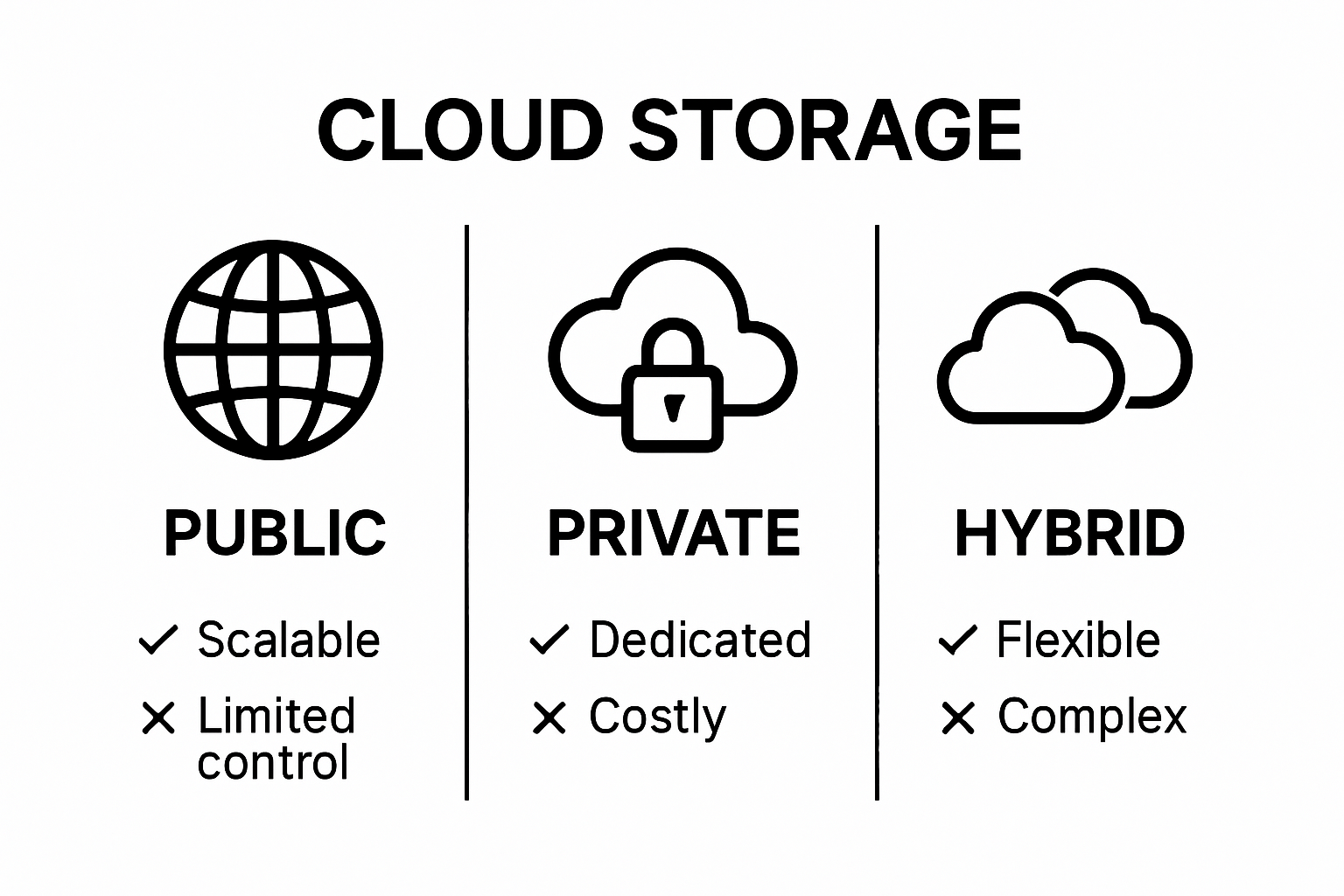
Key deployment considerations include:
Modern cloud storage solutions incorporate advanced security mechanisms to protect organisational data. Multi-factor authentication, end-to-end encryption, and continuous monitoring represent standard protective measures. Businesses can implement granular access controls, ensuring that sensitive information remains accessible only to authorised personnel.
The following table summarises common cloud storage security features and how they safeguard business data.
| Security Feature | Description |
|---|---|
| End-to-end encryption | Encrypts data during transfer and storage, preventing unauthorised access |
| Multi-factor authentication | Requires multiple verification methods for enhanced login security |
| Continuous monitoring | Constant surveillance for threats, anomalies, or breaches |
| Granular access controls | Limits data access to approved users or roles |
| Automatic data replication | Duplicates data across locations, aiding backup and recovery |
By understanding these cloud storage concepts, organisations can make informed decisions that align technological capabilities with strategic business objectives, transforming data management from a technical challenge into a competitive advantage.
Cloud storage has transitioned from an emerging technology to a critical business infrastructure, enabling organisations to transform their operational capabilities and strategic approaches to data management. By integrating cloud storage solutions, businesses can unlock unprecedented efficiency, collaboration, and innovation across multiple domains.
Modern businesses leverage cloud storage as a powerful platform for document management and team collaboration. Employees can simultaneously access, edit, and share files from different locations, breaking down traditional geographic and organisational barriers.

Tips for keeping shared cloud storage organised become crucial for maintaining productivity and preventing information chaos.
Key collaborative advantages include:
Cloud storage provides robust backup and disaster recovery solutions that protect businesses from potential data loss scenarios. By automatically replicating data across multiple geographic locations, organisations can ensure business continuity even during unexpected technical failures or physical infrastructure disruptions. According to the UK Government’s Cloud First policy, cloud solutions offer superior resilience compared to traditional storage methods.
Comprehensive backup strategies typically encompass:
Different industries leverage cloud storage uniquely to address sector-specific challenges. Healthcare organisations use secure cloud platforms to manage patient records, ensuring compliance and data protection. Financial services implement cloud storage for secure transaction logging and regulatory reporting. Creative industries utilise cloud solutions for collaborative multimedia project management, enabling seamless content sharing and version control.
By embracing cloud storage technologies, businesses can transcend traditional technological limitations, creating more agile, responsive, and innovative operational environments.
Struggling to keep your business data safe, accessible, and truly protected? If downtime, security risks, or unpredictable technology costs are holding your business back, now is the perfect time to rethink how you use cloud storage. As discussed in our article, cloud storage not only brings advanced security and scalability, it can also transform how your team collaborates and protects critical files. Do not let outdated systems or fragmented backup solutions slow you down. Our team at J700 Group specialises in guiding SMEs towards secure, reliable, and compliant cloud solutions, ensuring your business stays resilient and competitive.

Let us help you unlock the full potential of cloud technology. Reach out today through our contact page for a free consultation. Discover how J700 Group can deliver managed IT support, affordable cloud solutions, and practical cloud storage tips for your business. Take action now and protect your digital future with expert support from Lancashire’s local IT specialists.
Cloud storage is a method of storing and managing data on remote servers accessed via the internet, rather than on local hardware. It allows businesses to store, access, and protect digital information flexibly and securely.
Cloud storage facilitates collaboration by enabling employees to access, edit, and share documents in real time from any location using internet-connected devices. This capability enhances teamwork and productivity across different geographical locations.
Common security features of cloud storage include end-to-end encryption, multi-factor authentication, and continuous monitoring. These measures help protect sensitive data and ensure only authorised personnel can access it.
Yes, cloud storage provides robust backup and disaster recovery solutions by automatically replicating data across multiple geographic locations, ensuring business continuity during unexpected technical failures or disasters.
Artificial Intelligence is no longer something businesses are experimenting with. In 2026, it’s becoming part…
Read More
An email landed in my inbox this week from “Jonathan Cundliffe” — our Managing Director.…
Read More
For years, businesses protected their data like a medieval castle: build a thick wall (a…
Read More
For many small and medium-sized businesses, cybersecurity is still viewed as an IT problem. Firewalls,…
Read More
Cloud technology is no longer a luxury or a cost-saving alternative to on-site servers. For…
Read More
Remember when we jokingly wondered if Apple was borrowing our name? Well, the rumours were…
Read More
AI hasn’t just changed the way we work, it has completely rewritten the rulebook for…
Read More
For many businesses, the office phone is like part of the furniture, it’s always there,…
Read More
We are thrilled to announce a significant milestone in the J700 Group journey. To keep…
Read More
For years, many small and medium-sized business owners in the North West have operated under…
Read More
In a modern healthcare setting, the stethoscope and the blood pressure cuff aren’t the only…
Read More
When people hear the word cybersecurity, they often imagine complex systems, expensive software and specialist…
Read More
As we count down to midnight, most of us are thinking about gym memberships or…
Read More
It’s Christmas Eve in Lancashire. The Preston bypass is a nightmare, the last-minute dash to…
Read More
For many businesses, the Christmas period means quieter offices, reduced staffing and systems left running…
Read More
Or: Why we’d like to have a word with Tim Cook this Christmas. There are…
Read More
Hackers Love Christmas: Learn Why your Business Could be at Risk This Holiday SeasonThe festive…
Read More
In recent months, high-profile companies like Land Rover and Co-op have made headlines due to…
Read More
Explore 7 essential tips for effective cloud solutions comparison to find the best fit for…
Read More
Learn how to secure business data for UK SMEs with this step-by-step guide focused on…
Read More
Cybersecurity basics explained for UK businesses—core concepts, major threats, essential safeguards, and compliance requirements. A…
Read More
Discover the essential role of IT support desks, core functions, key benefits, types of support,…
Read More
Discover 10 microsoft 365 alternatives for UK SMEs, comparing features and benefits to help your…
Read More
Discover the best microsoft 365 alternatives in our comparison of 10 top products to enhance…
Read More
Discover a business connectivity checklist with 7 actionable steps to boost IT reliability, security, and…
Read More
Discover 7 essential business continuity planning steps to protect your SME. Learn practical strategies for…
Read More
Small Business Office 365 comprehensive guide for UK SMEs: core features, setup process, security essentials,…
Read More
Small Business Office 365 guide for UK firms. Learn core features, setup, security, costs, and…
Read More
Small business Office 365 guide covering essential features, security, costs, local support, and practical benefits…
Read More
Follow this cybersecurity checklist for SMEs to secure your business in Lancashire and Manchester. Step-by-step…
Read More
Follow this cybersecurity checklist for SMEs to boost protection, reduce risks, and secure business data…
Read More
Cloud security explained: A comprehensive guide for UK businesses covering threat types, protection strategies, compliance,…
Read More
Data protection strategies for UK SMEs—types, key components, GDPR compliance, business risks, and best practices…
Read More
Why cybersecurity matters for UK businesses: core concepts, main risks, common threats, legal requirements, and…
Read More
Comprehensive guide to IT issues Lancashire businesses face, including security threats, system downtime, cloud solutions,…
Read More
Comprehensive guide on cyber security threats in the UK. Learn common types, key characteristics, real-world…
Read More
Follow this IT security checklist for a step-by-step process to secure your business effectively in…
Read More
Explore the benefits of managed IT services for businesses in Manchester and Lancashire, enhancing efficiency…
Read More
Explore the role of cybersecurity in business. Understand its importance, how it works, and key…
Read More
Discover 7 key advantages of Microsoft 365 for SMEs that can enhance productivity, collaboration, and…
Read More