



For years, businesses protected their data like a medieval castle: build a thick wall (a…
Read More
Every office relies on technology to keep things running smoothly, and when something goes wrong, panic can spread fast. Most would assume the real problem is the complexity of the software or hardware. But nearly 60% of tech issues in organisations are resolved instantly by the IT service desk at the first contact. This hidden backbone of support not only keeps your team working but also transforms the way businesses handle challenges behind the scenes.
| Takeaway | Explanation |
|---|---|
| IT service desks centralise tech support | They manage and resolve technology-related issues efficiently across an organisation. |
| Proactive monitoring prevents costly disruptions | By identifying recurring issues, service desks help mitigate potential technology failures early. |
| User satisfaction is a key performance metric | Effective service desks track user satisfaction to enhance overall support quality and responsiveness. |
| Structured workflows improve problem resolution | A defined process ensures all issues are categorised, diagnosed, and resolved systematically. |
| Data-driven insights drive strategic improvements | Continuous analysis of support metrics leads to enhanced technological capabilities and innovation. |
An IT service desk represents a centralised support function within an organisation responsible for managing and resolving technology-related issues, requests, and service interactions. According to the NHS Business Services Authority, this critical department serves as the primary point of contact for all digital and technology support needs.
The role of IT service desk extends far beyond simple technical troubleshooting. These specialised teams provide comprehensive technology support that ensures business continuity and operational efficiency. Their primary responsibilities include:
In practical terms, an IT service desk acts like a central nervous system for an organisation’s technological infrastructure. When employees encounter technical problems, they contact this team to obtain swift resolution and guidance.
Beyond immediate problem-solving, IT service desks play a strategic role in organisational technology management. They transform technological challenges into opportunities for improving system performance and user experience. By systematically tracking recurring issues, service desk teams can identify broader technological trends, recommend system improvements, and help prevent future technical disruptions.
The Health Informatics Service demonstrates this approach effectively, resolving approximately 60% of reported incidents at the first point of contact. This approach minimises downtime, increases productivity, and ensures employees can maintain workflow continuity.
Moreover, modern IT service desks leverage advanced technologies like remote access tools, comprehensive ticketing systems, and analytics platforms to deliver efficient, data-driven support. Their work directly contributes to maintaining technological resilience and supporting overall business objectives.
Businesses today operate in an increasingly complex technological landscape where smooth digital operations are critical for success. An IT service desk becomes a fundamental component in maintaining technological resilience and ensuring uninterrupted business performance. Technological disruptions can cost organisations significant financial resources and productivity.
The financial implications of efficient IT service management are substantial. Research from ResearchGate highlights that organisations with robust IT service desks experience reduced operational downtime and enhanced user satisfaction. The key economic benefits include:
Moreover, by learning more about outsourcing IT support, businesses can strategically manage their technological resources and focus on core operational objectives.
Beyond immediate technical support, IT service desks play a pivotal role in strategic technology management. They function as a critical intelligence hub, collecting and analyzing technological performance data. This approach allows businesses to:
The University of Nottingham’s IT Service Desk implementation demonstrates this strategic approach, where systematic improvements led to significant reductions in support calls and enhanced service quality. By treating technology support as a strategic function, businesses can transform potential disruptions into opportunities for innovation and efficiency.
The IT service desk operates as a sophisticated, multi-layered support ecosystem designed to address technological challenges efficiently and systematically. These teams leverage advanced technologies and structured workflows to deliver comprehensive user support.
According to the UK Government’s Service Manual, effective user support requires a strategic approach to handling technological queries. The typical service desk workflow involves several critical stages:
This structured methodology ensures that each technological issue receives appropriate attention, categorisation, and resolution.
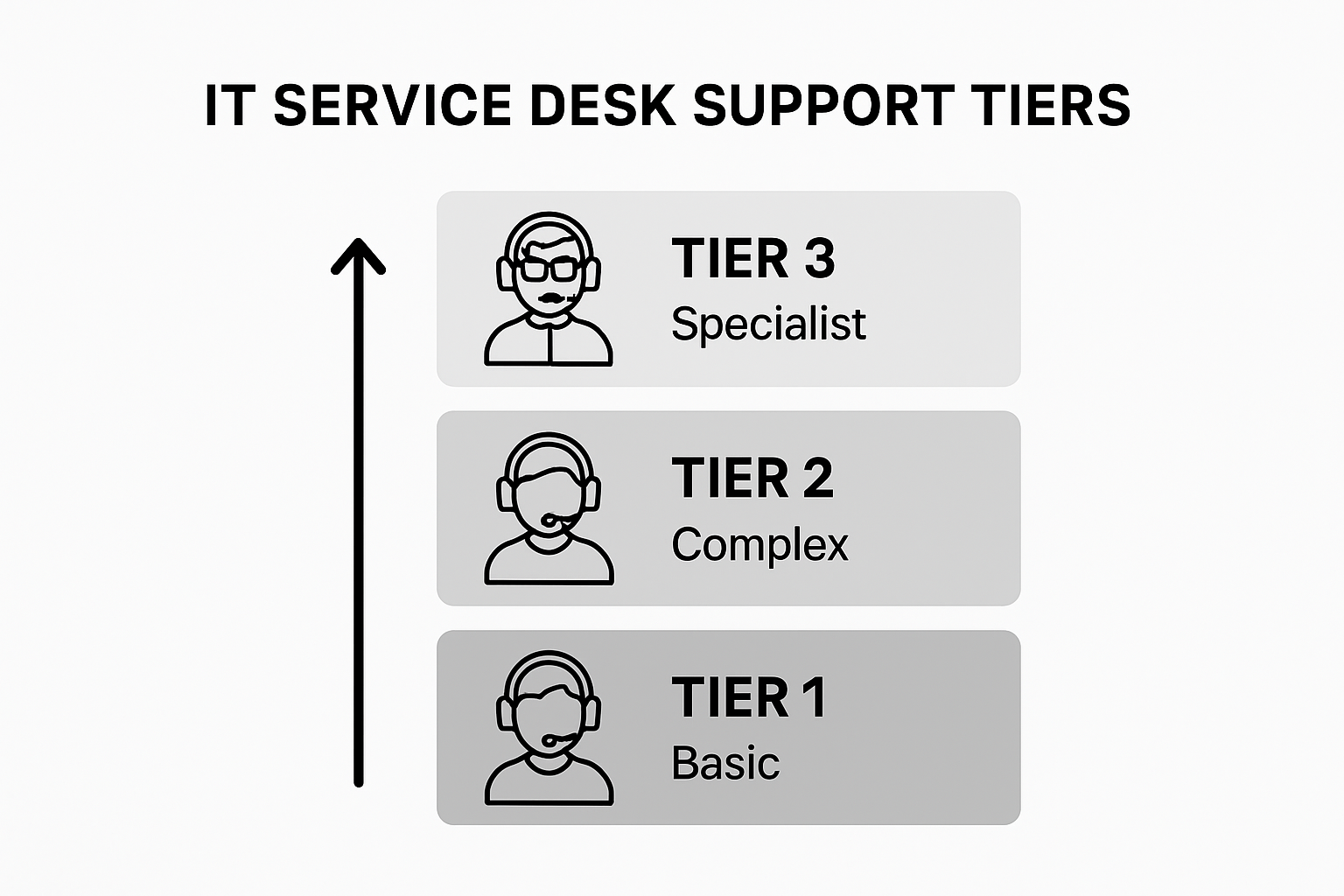
IT service desks typically operate through a multi-tiered support model that allows for progressively specialised problem-solving. The support structure generally comprises:
Each tier represents a deeper level of technical expertise, enabling systematic and efficient problem resolution. When exploring IT support strategies, businesses can optimize their technological support infrastructure.
The following table compares the roles of each technical support tier within an IT service desk, highlighting their distinct responsibilities and focus areas.
| Support Tier | Description | Typical Issues Handled |
|---|---|---|
| First-line support | Initial point of contact for users, resolving general queries | Password resets, software installation, basic errors |
| Second-line support | More advanced technical assistance | Hardware faults, network issues, complex software |
| Specialist support | In-depth expertise for rare or highly technical issues | Security breaches, system integrations, major outages |
Modern IT service desks are not merely reactive support centres but proactive technological management platforms. They continuously collect and analyse performance data to identify systemic issues, predict potential technological challenges, and recommend strategic improvements. By tracking metrics such as response times, resolution rates, and user satisfaction, service desk teams transform raw data into actionable technological insights that drive organisational efficiency.
IT service desk operations are built upon sophisticated frameworks that transform technological support from a reactive function into a strategic business asset. Understanding these foundational concepts enables organisations to optimise their technological support infrastructure.
This table summarises the key concepts that underpin IT service desk operations, providing concise definitions for each and clarifying their role within the support framework.
| Concept | Definition |
|---|---|
| Service Level Agreements | Predefined commitments outlining support response and resolution times |
| Performance Metrics | Objective measures of service efficiency and user satisfaction |
| Incident Management | Process of addressing urgent, immediate disruptions to IT services |
| Problem Management | Approach to identifying and resolving underlying, systemic IT issues |
| Knowledge Management | Systematic collection and sharing of support insights and solutions |
According to the Health Informatics Service, effective IT service desk operations rely on clearly defined performance standards. Key performance indicators and service level agreements establish precise expectations for support quality:
These metrics provide a structured approach to measuring and improving technological support effectiveness.

Successful IT service desks differentiate between incident management and problem management, two interconnected but distinct operational concepts:
By implementing robust IT support strategies, organisations can develop comprehensive frameworks that address both immediate and long-term technological challenges.
Modern IT service desks function as dynamic knowledge repositories, continuously collecting, analyzing, and sharing technological insights. This approach transforms individual problem-solving experiences into organisational intelligence. Service desk teams create and maintain comprehensive knowledge bases, documenting solution strategies, identifying recurring technological patterns, and developing predictive maintenance approaches. By treating each technological interaction as a learning opportunity, IT service desks evolve from mere support centres into strategic technological management platforms that drive organisational innovation and efficiency.
Is your business held back by recurring technology headaches, slow systems, or security threats highlighted in our article on the role of the IT Service Desk? Many local companies grapple with lost productivity, unexpected downtime, and costly repairs when their IT support is reactive rather than proactive. At J700 Group, we understand the importance of a robust IT service desk and the need for rapid issue resolution, thorough incident management, and clear service level agreements to protect your business processes and your team’s workflow.
You deserve smooth-running technology and peace of mind every day. We offer local, proactive IT support that aligns with best practices in incident handling and problem management. Take control of your business performance today. Visit J700 Group’s main site to get started, or learn why so many companies choose to outsource IT support for faster results and cost savings. Do not let another day go by with unresolved IT frustrations – act now to experience true business continuity and proactive support.
The primary purpose of an IT service desk is to serve as a centralised support function within an organisation, managing and resolving technology-related issues and service requests to ensure business continuity and operational efficiency.
An IT service desk improves business operations by providing timely support for technological issues, minimising downtime, and proactively identifying trends that help in optimising system performance and enhancing user experience.
Key responsibilities of IT service desk teams include responding to user technical issues, managing incident workflows, providing first and second-line support, and maintaining detailed records of service interactions.
An IT service desk contributes to cost efficiency by reducing operational downtime, preventing costly system failures through proactive monitoring, and optimising technology investment returns, which leads to improved revenue and productivity.
For years, businesses protected their data like a medieval castle: build a thick wall (a…
Read More
For many small and medium-sized businesses, cybersecurity is still viewed as an IT problem. Firewalls,…
Read More
Cloud technology is no longer a luxury or a cost-saving alternative to on-site servers. For…
Read More
Remember when we jokingly wondered if Apple was borrowing our name? Well, the rumours were…
Read More
AI hasn’t just changed the way we work, it has completely rewritten the rulebook for…
Read More
For many businesses, the office phone is like part of the furniture, it’s always there,…
Read More
We are thrilled to announce a significant milestone in the J700 Group journey. To keep…
Read More
For years, many small and medium-sized business owners in the North West have operated under…
Read More
In a modern healthcare setting, the stethoscope and the blood pressure cuff aren’t the only…
Read More
When people hear the word cybersecurity, they often imagine complex systems, expensive software and specialist…
Read More
As we count down to midnight, most of us are thinking about gym memberships or…
Read More
It’s Christmas Eve in Lancashire. The Preston bypass is a nightmare, the last-minute dash to…
Read More
For many businesses, the Christmas period means quieter offices, reduced staffing and systems left running…
Read More
Or: Why we’d like to have a word with Tim Cook this Christmas. There are…
Read More
Hackers Love Christmas: Learn Why your Business Could be at Risk This Holiday SeasonThe festive…
Read More
In recent months, high-profile companies like Land Rover and Co-op have made headlines due to…
Read More
Explore 7 essential tips for effective cloud solutions comparison to find the best fit for…
Read More
Learn how to secure business data for UK SMEs with this step-by-step guide focused on…
Read More
Cybersecurity basics explained for UK businesses—core concepts, major threats, essential safeguards, and compliance requirements. A…
Read More
Discover the essential role of IT support desks, core functions, key benefits, types of support,…
Read More
Discover 10 microsoft 365 alternatives for UK SMEs, comparing features and benefits to help your…
Read More
Discover the best microsoft 365 alternatives in our comparison of 10 top products to enhance…
Read More
Discover a business connectivity checklist with 7 actionable steps to boost IT reliability, security, and…
Read More
Discover 7 essential business continuity planning steps to protect your SME. Learn practical strategies for…
Read More
Small Business Office 365 comprehensive guide for UK SMEs: core features, setup process, security essentials,…
Read More
Small Business Office 365 guide for UK firms. Learn core features, setup, security, costs, and…
Read More
Small business Office 365 guide covering essential features, security, costs, local support, and practical benefits…
Read More
Follow this cybersecurity checklist for SMEs to secure your business in Lancashire and Manchester. Step-by-step…
Read More
Follow this cybersecurity checklist for SMEs to boost protection, reduce risks, and secure business data…
Read More
Cloud security explained: A comprehensive guide for UK businesses covering threat types, protection strategies, compliance,…
Read More
Data protection strategies for UK SMEs—types, key components, GDPR compliance, business risks, and best practices…
Read More
Why cybersecurity matters for UK businesses: core concepts, main risks, common threats, legal requirements, and…
Read More
Comprehensive guide to IT issues Lancashire businesses face, including security threats, system downtime, cloud solutions,…
Read More
Comprehensive guide on cyber security threats in the UK. Learn common types, key characteristics, real-world…
Read More
Follow this IT security checklist for a step-by-step process to secure your business effectively in…
Read More
Explore the benefits of managed IT services for businesses in Manchester and Lancashire, enhancing efficiency…
Read More
Explore the role of cybersecurity in business. Understand its importance, how it works, and key…
Read More
Discover 7 key advantages of Microsoft 365 for SMEs that can enhance productivity, collaboration, and…
Read More
Explore why use managed IT services and how they benefit businesses. Gain comprehensive insights on…
Read More
Comprehensive guide explaining cyber threats, focusing on their importance, how they work, and the key…
Read More