



For years, businesses protected their data like a medieval castle: build a thick wall (a…
Read More
Cyber threats are becoming more sophisticated every day and businesses are feeling the pressure. The average global cost of a single data breach soared to $4.35 million in 2022 and that figure is only climbing. Most people expect technology alone to keep them safe but what truly catches out companies is how these attacks expertly target people just as much as machines. The real vulnerability often lies with human nature itself.
| Takeaway | Explanation |
|---|---|
| Cyber threats are complex digital risks. | These risks target systems and networks, potentially causing data breaches and operational disruption. |
| Understanding threat classifications is essential. | Classifying threats helps devise specific defence strategies tailored to different attack types. |
| Investing in cybersecurity is crucial for survival. | Robust cybersecurity measures protect against financial losses and reputational damage from breaches. |
| Continuous learning aids in threat awareness. | Staying updated on emerging threats enables proactive risk management and enhances security preparedness. |
| Cybersecurity impacts organisational trust. | Compromised data can erode customer confidence and harm a business’s reputation significantly. |
Cyber threats represent sophisticated digital risks that target computer systems, networks, and digital infrastructures with malicious intent. These complex digital dangers can compromise data integrity, disrupt operational capabilities, and potentially cause significant financial and reputational damage to organisations.
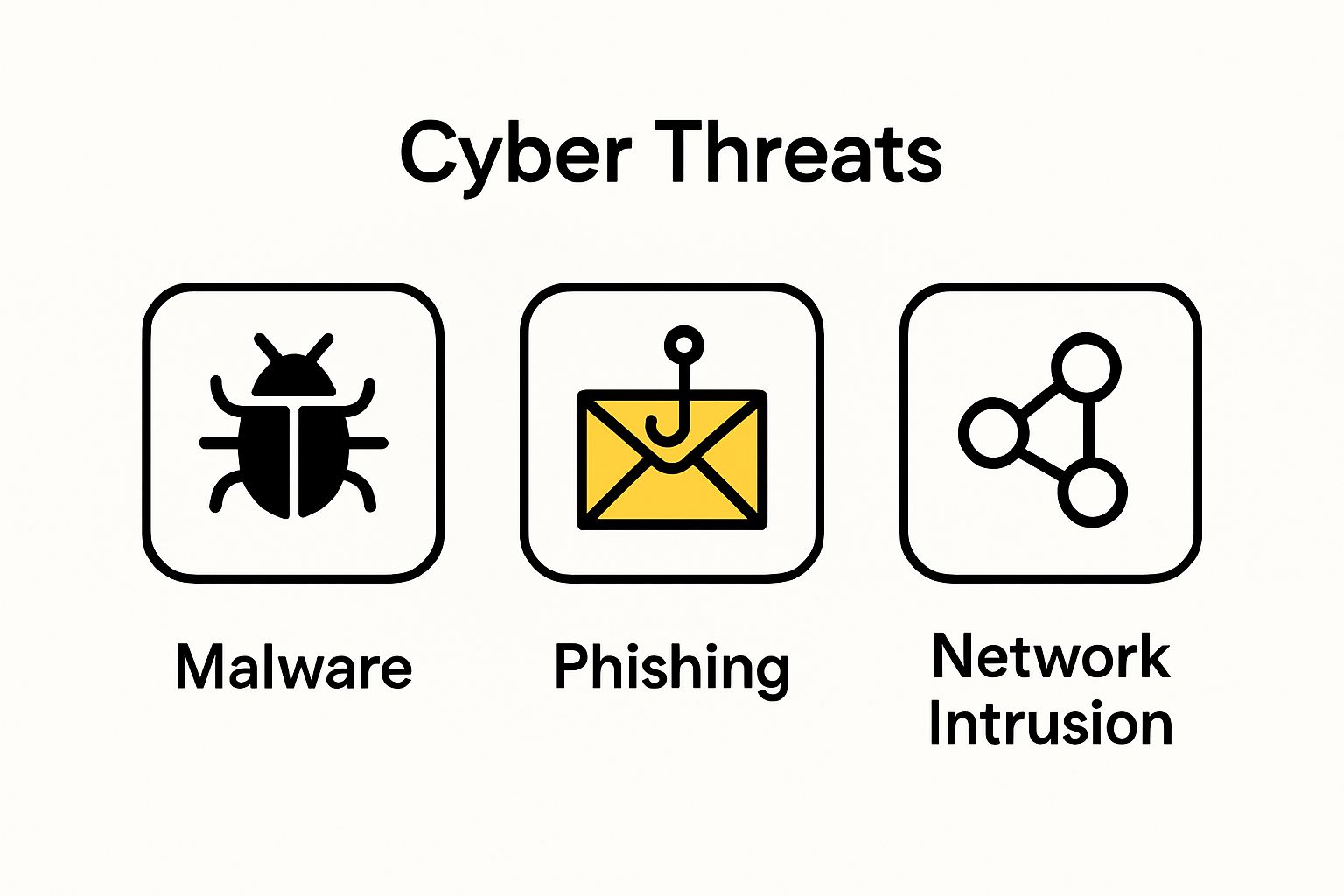
The table below summarises the primary classifications of cyber threats, their key characteristics, and typical impacts on organisations, providing a concise reference to enhance reader understanding.
| Classification | Description | Example Impact |
|---|---|---|
| Malware Attacks | Malicious software designed to infiltrate or damage systems | Data corruption, downtime |
| Phishing Attempts | Deceptive communications tricking users into revealing information | Credential theft, access gain |
| Network Intrusion | Unauthorised access targeting digital infrastructure | Breach of data, service loss |
Cyber threats are typically categorised into several distinct classifications based on their origin, methodology, and potential impact. According to NCSC UK, these classifications help security professionals develop targeted defence strategies.
The primary classifications of cyber threats include:
Modern cyber threats demonstrate increasingly sophisticated characteristics that make them challenging to detect and mitigate. Research from Verizon’s Data Breach Investigations Report highlights the evolving nature of these digital risks.
Key characteristics include rapid technological adaptation, polymorphic attack techniques, and the ability to exploit multiple vulnerability points simultaneously. These threats often leverage complex social engineering strategies, blending technical sophistication with psychological manipulation.
Professional cyber security teams must continuously update their knowledge and defensive mechanisms to stay ahead of these dynamic and evolving digital risks. Understanding the nuanced characteristics of cyber threats is crucial for developing robust protective strategies that safeguard organisational digital assets and maintain operational resilience.
Cybersecurity has transformed from a technical consideration to a critical business survival strategy. Modern organisations face unprecedented digital risks that threaten operational continuity, financial stability, and organisational reputation. Understanding the profound importance of cybersecurity is no longer optional but essential for sustainable business performance.
The financial consequences of cybersecurity breaches extend far beyond immediate monetary losses. According to IBM’s Cost of Data Breach Report, the average global cost of a data breach in 2022 reached $4.35 million, demonstrating the substantial economic impact of inadequate digital protection.
Potential economic consequences include:
Cybersecurity serves as a comprehensive shield protecting an organisation’s most valuable digital resources. Protecting sensitive information requires a multifaceted approach that addresses technological vulnerabilities and human factors. Learn more about securing your business infrastructure through strategic defensive mechanisms.
Modern cybersecurity strategies encompass more than technology implementation. They involve creating a holistic security culture that empowers employees to recognize and respond to potential digital threats proactively. This approach transforms cybersecurity from a technical solution into a strategic organisational capability.
By prioritizing robust cybersecurity measures, businesses can safeguard their digital ecosystems, maintain operational resilience, and build trust with stakeholders in an increasingly complex technological landscape.
Cyber threats represent highly sophisticated digital attacks that exploit complex technological vulnerabilities and human psychological weaknesses. These malicious strategies involve intricate mechanisms designed to penetrate digital defences, compromise systems, and extract maximum potential value from their targeted infiltrations.
Cyber attackers employ multiple strategic approaches to gain unauthorised access to digital environments. According to NCSC Threat Intelligence, these infiltration techniques are continually evolving to circumvent increasingly robust security protocols.
Key entry mechanisms include:
Once inside a network, cyber threats demonstrate remarkable adaptability. Research from IT Governance reveals that sophisticated attackers frequently move laterally within compromised systems, seeking to maximise potential damage and information extraction before potential detection.
Network Penetration Strategies typically involve:
Modern cyber threats operate with unprecedented complexity, blending technological sophistication with strategic human-centric approaches. Explore advanced business security strategies to understand comprehensive defensive mechanisms.
The most dangerous cyber threats do not simply aim for immediate disruption but strategically plan long-term compromises. They meticulously map organisational digital infrastructures, identify critical vulnerabilities, and design multi-stage attack sequences that can remain undetected for extended periods.
Cyber threat awareness represents a sophisticated approach to understanding digital security risks beyond traditional technological defences. This comprehensive strategy integrates technological knowledge, psychological insights, and proactive risk management techniques to create robust organisational protection mechanisms.
Effective cyber threat awareness relies on several foundational principles that guide organisational security strategies.
The following table highlights fundamental security principles essential for building robust cyber threat awareness and creating a resilient organisational security culture.
| Security Principle | Brief Explanation |
|---|---|
| Continuous Learning | Staying informed about emerging digital threats and trends |
| Proactive Risk Management | Anticipating and mitigating vulnerabilities before exploitation |
| Holistic Security Approach | Integrating technology, human awareness, and procedural defences |
Key foundational principles include:
Comprehensive cyber threat awareness demands sophisticated risk assessment techniques that go beyond traditional security paradigms. Strategic threat evaluation involves systematically identifying, categorising, and prioritising potential digital vulnerabilities.
Risk mitigation strategies typically encompass:
Explore emerging technology trends that shape digital security and understand how modern organisations can develop adaptive security capabilities. Cyber threat awareness is not merely about defending against known risks but creating flexible, responsive security ecosystems capable of anticipating and neutralising emerging digital challenges.
Successful cyber threat awareness transforms security from a reactive technical function into a strategic organisational capability. By cultivating a culture of continuous learning, vigilance, and adaptive response, businesses can develop resilient digital defence mechanisms that protect their most critical assets in an increasingly complex technological landscape.
Cyber threats have transformed from abstract technological risks into tangible business catastrophes that can instantly compromise organisational stability. These digital attacks represent sophisticated strategic challenges capable of destroying years of business development, reputation, and economic investment within moments.
The economic consequences of cyber incidents extend far beyond immediate monetary losses. According to Hiscox Cyber Readiness Report, small businesses experiencing significant cyber attacks can face potential bankruptcy, with average financial damages potentially exceeding annual turnover.
Financial repercussions typically include:
Organisational Trust represents a delicate ecosystem that can be permanently damaged by cyber incidents. When customer data becomes compromised, businesses face immediate and potentially irreversible reputation erosion.
Reputational damage mechanisms include:
Understand how strategic cybersecurity approaches protect business infrastructure and mitigate potential operational risks. Cyber threats can strategically disable critical business systems, interrupt supply chains, and compromise sensitive communication networks.
Beyond immediate technical failures, cyber attacks can create profound psychological impacts within organisations. They generate uncertainty, reduce employee morale, and challenge fundamental assumptions about digital safety, transforming technological vulnerabilities into complex human and strategic challenges that extend well beyond immediate technical remediation.

Feeling overwhelmed by the ever-growing risks outlined in our guide to understanding modern cyber threats? If cybersecurity jargon like malware, phishing or lateral movement has sparked concern, you are not alone. Many local businesses discover too late that lacking robust digital protection can lead to expensive disruptions, reputational harm and a loss of client trust. Do not let your business become another statistic of preventable online attacks. Explore our Cyber Security Solutions to see how J700 Group crafts proactive defences tailored for organisations across Lancashire and the North West.

Take control of your digital safety today. Reach out to your local experts for clear, friendly advice and a strategy built for your business needs. Contact us now through our online form to secure peace of mind, or dive deeper into our full range of technology services. Your business reputation and continuity depend on timely action—do not wait until your defences are tested.
Cyber threats are primarily categorised into malware attacks, phishing attempts, and network intrusions. Each of these types aims to compromise computer systems, steal sensitive information, or disrupt operations.
Modern cyber threats constantly evolve by leveraging rapid technological advancements, employing polymorphic attack techniques, and exploiting various vulnerabilities simultaneously. This adaptability makes them increasingly difficult to detect and mitigate.
The economic consequences of cybersecurity breaches can include direct financial losses, operational disruptions, reputational damage, and potential legal penalties. These costs can accumulate and significantly affect an organisation’s financial stability.
To enhance cybersecurity awareness, organisations should focus on continuous learning, proactive risk management, and adopting a holistic security approach that integrates technology, human factors, and procedural defences.
For years, businesses protected their data like a medieval castle: build a thick wall (a…
Read More
For many small and medium-sized businesses, cybersecurity is still viewed as an IT problem. Firewalls,…
Read More
Cloud technology is no longer a luxury or a cost-saving alternative to on-site servers. For…
Read More
Remember when we jokingly wondered if Apple was borrowing our name? Well, the rumours were…
Read More
AI hasn’t just changed the way we work, it has completely rewritten the rulebook for…
Read More
For many businesses, the office phone is like part of the furniture, it’s always there,…
Read More
We are thrilled to announce a significant milestone in the J700 Group journey. To keep…
Read More
For years, many small and medium-sized business owners in the North West have operated under…
Read More
In a modern healthcare setting, the stethoscope and the blood pressure cuff aren’t the only…
Read More
When people hear the word cybersecurity, they often imagine complex systems, expensive software and specialist…
Read More
As we count down to midnight, most of us are thinking about gym memberships or…
Read More
It’s Christmas Eve in Lancashire. The Preston bypass is a nightmare, the last-minute dash to…
Read More
For many businesses, the Christmas period means quieter offices, reduced staffing and systems left running…
Read More
Or: Why we’d like to have a word with Tim Cook this Christmas. There are…
Read More
Hackers Love Christmas: Learn Why your Business Could be at Risk This Holiday SeasonThe festive…
Read More
In recent months, high-profile companies like Land Rover and Co-op have made headlines due to…
Read More
Explore 7 essential tips for effective cloud solutions comparison to find the best fit for…
Read More
Learn how to secure business data for UK SMEs with this step-by-step guide focused on…
Read More
Cybersecurity basics explained for UK businesses—core concepts, major threats, essential safeguards, and compliance requirements. A…
Read More
Discover the essential role of IT support desks, core functions, key benefits, types of support,…
Read More
Discover 10 microsoft 365 alternatives for UK SMEs, comparing features and benefits to help your…
Read More
Discover the best microsoft 365 alternatives in our comparison of 10 top products to enhance…
Read More
Discover a business connectivity checklist with 7 actionable steps to boost IT reliability, security, and…
Read More
Discover 7 essential business continuity planning steps to protect your SME. Learn practical strategies for…
Read More
Small Business Office 365 comprehensive guide for UK SMEs: core features, setup process, security essentials,…
Read More
Small Business Office 365 guide for UK firms. Learn core features, setup, security, costs, and…
Read More
Small business Office 365 guide covering essential features, security, costs, local support, and practical benefits…
Read More
Follow this cybersecurity checklist for SMEs to secure your business in Lancashire and Manchester. Step-by-step…
Read More
Follow this cybersecurity checklist for SMEs to boost protection, reduce risks, and secure business data…
Read More
Cloud security explained: A comprehensive guide for UK businesses covering threat types, protection strategies, compliance,…
Read More
Data protection strategies for UK SMEs—types, key components, GDPR compliance, business risks, and best practices…
Read More
Why cybersecurity matters for UK businesses: core concepts, main risks, common threats, legal requirements, and…
Read More
Comprehensive guide to IT issues Lancashire businesses face, including security threats, system downtime, cloud solutions,…
Read More
Comprehensive guide on cyber security threats in the UK. Learn common types, key characteristics, real-world…
Read More
Follow this IT security checklist for a step-by-step process to secure your business effectively in…
Read More
Explore the benefits of managed IT services for businesses in Manchester and Lancashire, enhancing efficiency…
Read More
Explore the role of cybersecurity in business. Understand its importance, how it works, and key…
Read More
Discover 7 key advantages of Microsoft 365 for SMEs that can enhance productivity, collaboration, and…
Read More
Explore why use managed IT services and how they benefit businesses. Gain comprehensive insights on…
Read More
Comprehensive guide explaining cyber threats, focusing on their importance, how they work, and the key…
Read More