


For years, businesses protected their data like a medieval castle: build a thick wall (a…
Read More
Nearly 93% of business cyber incidents now begin with a simple phishing email, not some shadowy hacker breaking advanced defences. This surprising statistic reshapes how Lancashire and Manchester businesses must think about cybersecurity. From hidden costs and legal obligations to the very real threat of downtime, today’s digital world demands a wider understanding of how cyber risks can quietly slip into any organisation and what real steps are needed to stop them.
| Point | Details |
|---|---|
| Cybersecurity is a Collaborative Effort | Protecting digital assets requires both technological solutions and heightened human awareness to minimize vulnerabilities. |
| Phishing is the Most Common Cyber Threat | Phishing incidents account for 93% of cyber breaches, highlighting the need for training and awareness among employees. |
| SMEs Must Implement Essential Cybersecurity Measures | Practical strategies such as multi-factor authentication and employee training are crucial for safeguarding against threats. |
| Legal Compliance is Critical | Understanding and adhering to evolving legal frameworks is necessary for managing cybersecurity risks and protecting organizational integrity. |
Cybersecurity isn’t just about complex technological defence mechanisms—it’s fundamentally about protecting your organisation’s digital assets from potential threats. Many Lancashire and Manchester businesses mistakenly believe cybersecurity is exclusively a technical challenge, when in reality, human behaviour plays a critical role in maintaining digital safety.
According to the 2025 Cyber Security Breaches Survey, phishing remains the most prevalent cyber crime, accounting for an astonishing 93% of business incidents. This statistic powerfully challenges the common misconception that cyber threats are predominantly sophisticated technical attacks. Instead, most vulnerabilities emerge through simple human interactions:
For businesses across Lancashire, from Preston to Blackburn, understanding that cybersecurity is a collaborative effort between technology and human awareness is crucial. Implementing comprehensive training programmes, establishing clear security protocols, and fostering a culture of digital vigilance can dramatically reduce an organisation’s risk profile. Remember: your team’s awareness is often the most powerful firewall against potential cyber threats.
Businesses across Lancashire and Manchester face an increasingly complex cybersecurity landscape where threats are not just technical challenges but strategic risks capable of disrupting entire organisations. The digital threat environment has transformed dramatically, with cybercriminals becoming more sophisticated and targeted in their approaches.
According to the UK National Cyber Security Centre, there has been a staggering 50% year‑on‑year rise in ‘highly significant’ cyber incidents, impacting major brands like Jaguar Land Rover, Marks & Spencer, and Co‑op. These attacks span multiple threat vectors:
Moreover, a recent government‑commissioned survey revealed alarming statistics: 43% of businesses and an overwhelming 91% of universities experienced cyberattacks in the past year. Surprisingly, many of these attacks originated from unexpected sources, including British teenagers using rented ransomware tools. Read our comprehensive guide on preventing cybersecurity mistakes to understand how even small vulnerabilities can lead to significant breaches. For businesses in Preston, Blackburn, and across Lancashire, understanding these evolving threats is no longer optional—it’s a critical survival strategy in our interconnected digital ecosystem.
Here’s a summary comparing major cyber threats affecting UK businesses:
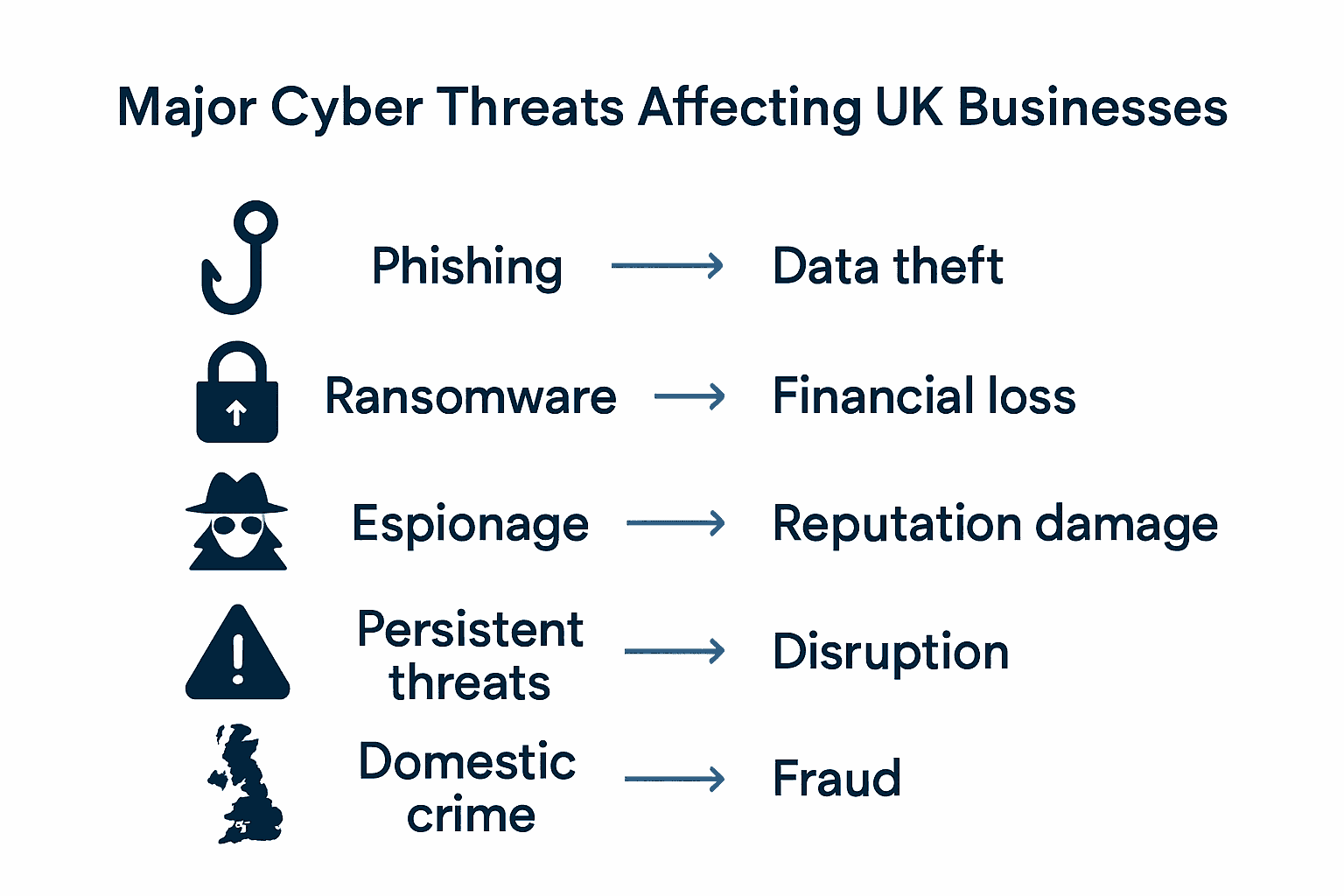
| Threat Type | Description | Typical Impact |
|---|---|---|
| Phishing | Deceptive emails targeting staff | Data breaches Credential theft |
| Ransomware | Malware locks critical files | Operational shutdown Financial loss |
| Cyber Espionage | State-backed data theft | Intelligence loss Reputational harm |
| Advanced Persistent Threats | Stealthy, prolonged cyber attacks | Extended system compromise |
| Domestic Cybercrime | Attacks by UK-based actors | Regulatory risk Disrupted services |
Cybersecurity for small and medium enterprises isn’t about implementing complex, expensive systems—it’s about strategic, practical steps that create robust digital defences. Businesses across Lancashire and Manchester need accessible strategies that protect their digital assets without overwhelming their resources or technical capabilities.
According to the 2025 Cyber Security Breaches Survey, SMEs are increasingly recognising the importance of cybersecurity, with 32% of businesses focusing on additional staff training and communications. However, the survey reveals a critical gap: only 21% of businesses have implemented technical controls across all five key security areas, and Cyber Essentials certification remains low at just 12%.
Key essential cybersecurity measures for SMEs include:
Advanced endpoint protection strategies can significantly reduce vulnerabilities. For businesses in Preston, Blackburn, and across the North West, implementing these measures isn’t just a technical requirement—it’s a critical business survival strategy. The goal is creating a security-aware culture where every team member understands their role in maintaining digital resilience.

Navigating the legal landscape of cybersecurity is crucial for businesses across Lancashire and Manchester. The digital regulatory environment has become increasingly complex, with legal frameworks evolving to address the sophisticated cyber threats facing modern organisations.
According to research on the Computer Misuse Act 1990, 80% of cybersecurity professionals express concern about potentially breaking the law while investigating cyber threats. Remarkably, 91% of businesses argue that the current legislation hampers their ability to effectively respond to cybersecurity challenges, highlighting a significant disconnect between legal frameworks and practical defensive needs.
Key legal and compliance considerations for UK businesses include:
Cyber Attacks Devastate UK Icons – Secure Your Business Now provides deeper insights into these challenges. The Online Safety Act 2023 represents a significant shift, imposing statutory duties with potential fines up to £18 million or 10% of turnover for non-compliance. For businesses in Preston, Blackburn, and across the North West, understanding these legal obligations isn’t just about avoiding penalties—it’s about building a robust, responsible digital infrastructure that protects both the organisation and its stakeholders.
Businesses across Lancashire and Manchester face increasingly sophisticated cybersecurity risks that can devastate operations, reputation, and financial stability. Poor cybersecurity isn’t just a technical problem—it’s a fundamental business vulnerability that can lead to catastrophic consequences.
According to the 2025 Cyber Security Breaches Survey, businesses experienced an average of 8.58 million cyber crimes in the past year, with non-phishing cyber crime costing approximately £990 per business. These aren’t just numbers—they represent real financial and operational risks that can cripple small to medium enterprises.
Key risks of poor cybersecurity include:
Learn how to strategically organise your cybersecurity approach to mitigate these risks effectively. For businesses in Preston, Blackburn, and across the North West, proactive cybersecurity isn’t an option—it’s a critical survival strategy. Implementing robust defence mechanisms, continuous staff training, and adaptive security protocols can transform these potential threats into manageable risks.
Are you concerned about phishing emails, poor password habits, or staff accidentally exposing your business to cyber threats? As highlighted in our article, these risks are not only common but can leave your business vulnerable to financial loss and reputational harm. If you want clarity and confidence in your digital protection, J700 Group offers solutions tailored for Lancashire SMEs. For a deeper dive into how real local companies are improving their defences, explore our Cyber Security insights.

Do not let digital threats disrupt your operations or put your sensitive data at risk. Start building a safer business environment today with help from a local team that understands your unique challenges. Contact our experts for proactive IT support and robust cybersecurity protection at J700 Group – Contact Us. For more business-focused technology tips, visit our Business resource hub. Take the first step now and secure your Lancashire business with proven guidance and friendly support.
Cybersecurity refers to the practices, technologies, and processes designed to protect computers, networks, and data from unauthorized access, theft, damage, or disruption.
Human behavior is crucial in cybersecurity because many threats, like phishing attacks, exploit human interactions. Raising awareness and training employees can significantly reduce vulnerabilities.
Some common cyber threats include phishing emails, ransomware attacks, cyber espionage, advanced persistent threats, and domestic cybercrime. Each type poses unique risks to organisations.
SMEs can enhance cybersecurity by implementing multi-factor authentication, conducting regular employee training, establishing automated software patching, and adopting a 3-2-1 backup strategy for data protection.
For years, businesses protected their data like a medieval castle: build a thick wall (a…
Read More
For many small and medium-sized businesses, cybersecurity is still viewed as an IT problem. Firewalls,…
Read More
Cloud technology is no longer a luxury or a cost-saving alternative to on-site servers. For…
Read More
Remember when we jokingly wondered if Apple was borrowing our name? Well, the rumours were…
Read More
AI hasn’t just changed the way we work, it has completely rewritten the rulebook for…
Read More
For many businesses, the office phone is like part of the furniture, it’s always there,…
Read More
We are thrilled to announce a significant milestone in the J700 Group journey. To keep…
Read More
For years, many small and medium-sized business owners in the North West have operated under…
Read More
In a modern healthcare setting, the stethoscope and the blood pressure cuff aren’t the only…
Read More
When people hear the word cybersecurity, they often imagine complex systems, expensive software and specialist…
Read More
As we count down to midnight, most of us are thinking about gym memberships or…
Read More
It’s Christmas Eve in Lancashire. The Preston bypass is a nightmare, the last-minute dash to…
Read More
For many businesses, the Christmas period means quieter offices, reduced staffing and systems left running…
Read More
Or: Why we’d like to have a word with Tim Cook this Christmas. There are…
Read More
Hackers Love Christmas: Learn Why your Business Could be at Risk This Holiday SeasonThe festive…
Read More
In recent months, high-profile companies like Land Rover and Co-op have made headlines due to…
Read More
Explore 7 essential tips for effective cloud solutions comparison to find the best fit for…
Read More
Learn how to secure business data for UK SMEs with this step-by-step guide focused on…
Read More
Cybersecurity basics explained for UK businesses—core concepts, major threats, essential safeguards, and compliance requirements. A…
Read More
Discover the essential role of IT support desks, core functions, key benefits, types of support,…
Read More
Discover 10 microsoft 365 alternatives for UK SMEs, comparing features and benefits to help your…
Read More
Discover the best microsoft 365 alternatives in our comparison of 10 top products to enhance…
Read More
Discover a business connectivity checklist with 7 actionable steps to boost IT reliability, security, and…
Read More
Discover 7 essential business continuity planning steps to protect your SME. Learn practical strategies for…
Read More
Small Business Office 365 comprehensive guide for UK SMEs: core features, setup process, security essentials,…
Read More
Small Business Office 365 guide for UK firms. Learn core features, setup, security, costs, and…
Read More
Small business Office 365 guide covering essential features, security, costs, local support, and practical benefits…
Read More
Follow this cybersecurity checklist for SMEs to secure your business in Lancashire and Manchester. Step-by-step…
Read More
Follow this cybersecurity checklist for SMEs to boost protection, reduce risks, and secure business data…
Read More
Cloud security explained: A comprehensive guide for UK businesses covering threat types, protection strategies, compliance,…
Read More
Data protection strategies for UK SMEs—types, key components, GDPR compliance, business risks, and best practices…
Read More
Why cybersecurity matters for UK businesses: core concepts, main risks, common threats, legal requirements, and…
Read More
Comprehensive guide to IT issues Lancashire businesses face, including security threats, system downtime, cloud solutions,…
Read More
Comprehensive guide on cyber security threats in the UK. Learn common types, key characteristics, real-world…
Read More
Follow this IT security checklist for a step-by-step process to secure your business effectively in…
Read More
Explore the benefits of managed IT services for businesses in Manchester and Lancashire, enhancing efficiency…
Read More
Explore the role of cybersecurity in business. Understand its importance, how it works, and key…
Read More
Discover 7 key advantages of Microsoft 365 for SMEs that can enhance productivity, collaboration, and…
Read More
Explore why use managed IT services and how they benefit businesses. Gain comprehensive insights on…
Read More
Comprehensive guide explaining cyber threats, focusing on their importance, how they work, and the key…
Read More