



Why Zero Trust Security Is No Longer Optional for Lancashire and Manchester SMEs Most small…
Read More
The new Online Media Literacy Strategy from the Department for Digital, Culture, Media, and Sport (DCMS) is aimed at supporting 170+ organisations to improve media literacy rates in the UK, and thereby help young people to spot disinformation.
As an aside, misinformation is information that is simply wrong, inaccurate or misleading (without necessarily having any intention to propagate the misinformation) whereas disinformation is a subset of it, i.e. information that is deliberately wrong, inaccurate or misleading.
As aside to the aside, mistrust and distrust are roughly the same in meaning (i.e. not to trust someone or something) although, according to Dictionary.com, distrust implies having evidence to support that feeling.
The Strategy, which was promised in the government’s online harms white paper, is intended to help tackle the problem that many young people in the UK are not able to distinguish between disinformation/misinformation and truth in what they read online. For example:
Ofcom figures show that 4 out of 10 UK adult internet users don’t possess the skills to critically assess content online.
National Literacy Trust research figures show that only 2 percent of children have the skills they need to identify misinformation, half of teachers (53.5 percent) think that the national curriculum doesn’t educate children with the literacy skills they need to identify fake news, and 2 in 5 parents (39 percent) don’t watch, listen to, or read news with their child at home.
The fact that many young people may have been deterred from accepting the COVID-19 vaccine and/or have believed misinformation and conspiracy theories about the origins and causes of the pandemic have highlighted the problem. For example, popular stories believed by some in the UK, highlighted in University of Cambridge research (Oct 2020) include that:
– COVID-19 was engineered in a Wuhan laboratory (22 percent believed it).
– The pandemic is “part of a plot to enforce global vaccination” (13 percent).
– 5G telecommunication towers worsen COVID-19 symptoms (8 percent).
Back in October 2020, Cambridge’s Winton Centre for Risk and Evidence Communication + UK Cabinet Office: Go Viral!, studied correlations between certain beliefs and demographic categories and the perceived reliability of misinformation. They discovered that:
– High levels of trust in science equates to low levels of susceptibility to false information (across all nations).
– Better Numeracy skills are a predictor of greater resistance to misinformation.
– Being older is linked to lower susceptibility to COVID-19 misinformation.
– Identifying as more right-wing /politically conservative is associated with a higher likelihood of believing COVID-19 conspiracies.
– With COVID-19, a tiny increase (one-seventh) in how reliably misinformation is perceived leads to a much bigger (23 percent) drop in the likelihood that the person will agree to get vaccinated.
Ultimately, as summarised by the minister for digital and culture Caroline Dinenage last week, “False or confused information spread online could threaten public safety and undermine our democracy.”
The newly announced strategy is to teach a wide variety of UK organisations to teach others to get a better understanding of the online world, and how to critically analyse the content they see, thereby helping them to spot misinformation.
Criticism or the strategy includes that:
– It is possibly an opportunity missed and is less of a strategy and more a shopping list of useful actions that mirror what’s gone before rather than charting new directions (says LSE’s Professor Sonia Livingstone).
– The strategy appears to blame the user for the problems of the digital world.
– The strategy may be weaker than it could be because it is linked to the Online Safety Bills, so focuses on reducing consumer harms rather than addressing the breadth and depth of the media literacy agenda.
Challenges for the strategy include:
– Exposure to misinformation and disinformation can be influenced by changes to algorithm design and content feeds, thereby meaning that tech companies have a part to play.
– Motivations for believing (and wanting to spread) misinformation are varied, can be complicated and, therefore, anti-vaxxer mentalities / ‘cult’ type and attitudes are difficult to break down and challenge, even with well-meaning teaching.
In terms of tackling health emergencies effectively, education and tackling misinformation are vital. Many young people have social media as their main source of news, so giving many other organisations the means to educate young people in how to critically evaluate what they read is well-meaning and could have a value for young people and society as a whole going forward, which in turn will have a value to businesses.
However, social media and other platforms use algorithms, which also influence what is presented to young people, which means that tech companies have an important role and responsibility to play in tackling the problem. The problem of misinformation is being tackled to a degree on social media using e.g., fact-checking, and curated news services, but the issue of misinformation is wide, and it is debatable how much of an effect the new strategy will have upon it. One of the strengths of the new strategy, however, is that it is leveraging the power of many other trusted organisations to help deliver it.

Why Zero Trust Security Is No Longer Optional for Lancashire and Manchester SMEs Most small…
Read More
A practical guide for SMEs across Lancashire and the North West If you’ve been hearing…
Read More
Running a business in Lancashire is hard enough without your IT company adding to your…
Read More
Most businesses don’t lose data because of a dramatic cyberattack. They lose it, or expose…
Read More
For manufacturers, downtime isn’t just frustrating, it’s expensive. When production stops, everything slows down. Orders…
Read More
Artificial Intelligence is no longer something businesses are experimenting with. In 2026, it’s becoming part…
Read More
An email landed in my inbox this week from “Jonathan Cundliffe” — our Managing Director.…
Read More
For years, businesses protected their data like a medieval castle: build a thick wall (a…
Read More
For many small and medium-sized businesses, cybersecurity is still viewed as an IT problem. Firewalls,…
Read More
Cloud technology is no longer a luxury or a cost-saving alternative to on-site servers. For…
Read More
Remember when we jokingly wondered if Apple was borrowing our name? Well, the rumours were…
Read More
AI hasn’t just changed the way we work, it has completely rewritten the rulebook for…
Read More
For many businesses, the office phone is like part of the furniture, it’s always there,…
Read More
We are thrilled to announce a significant milestone in the J700 Group journey. To keep…
Read More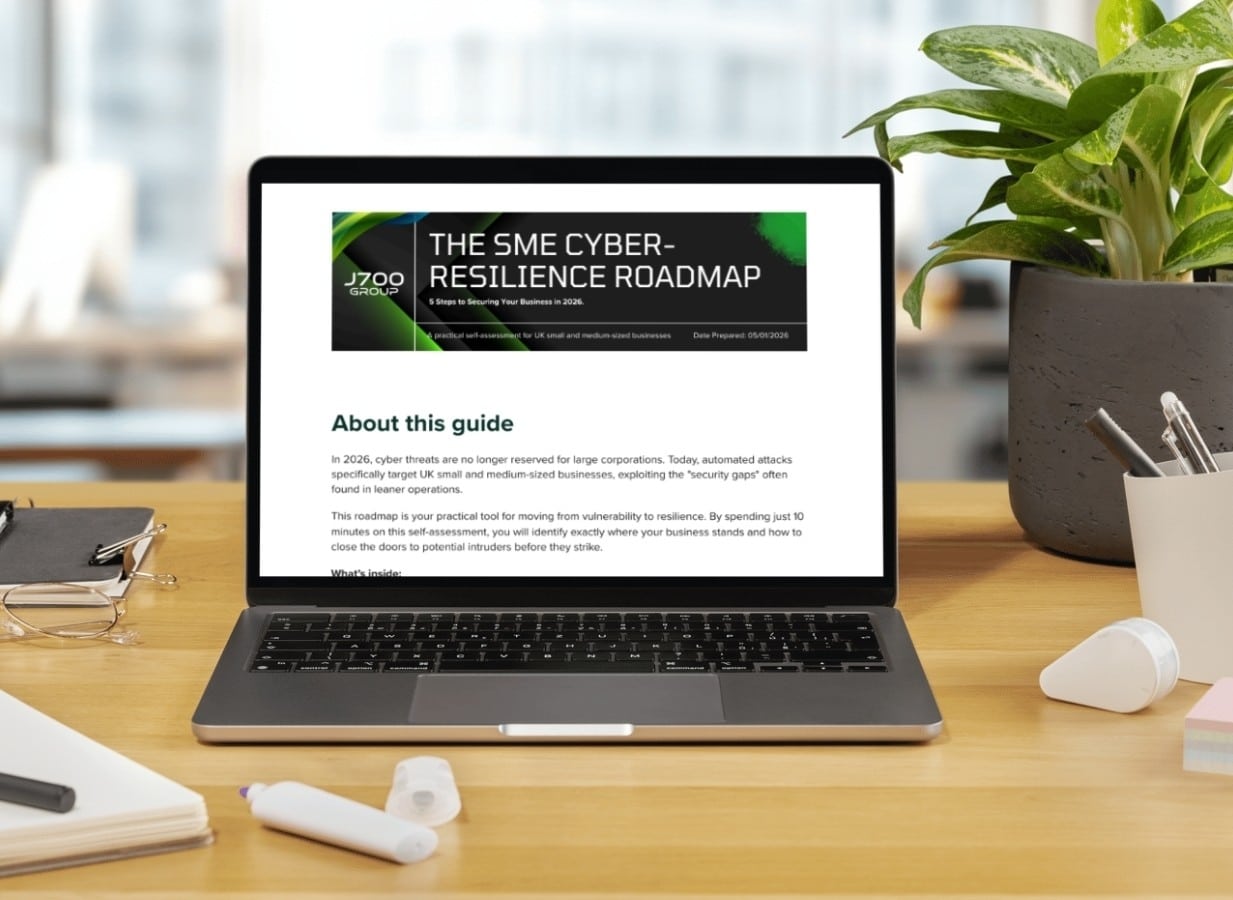
For years, many small and medium-sized business owners in the North West have operated under…
Read More
In a modern healthcare setting, the stethoscope and the blood pressure cuff aren’t the only…
Read More
When people hear the word cybersecurity, they often imagine complex systems, expensive software and specialist…
Read More
As we count down to midnight, most of us are thinking about gym memberships or…
Read More
It’s Christmas Eve in Lancashire. The Preston bypass is a nightmare, the last-minute dash to…
Read More
For many businesses, the Christmas period means quieter offices, reduced staffing and systems left running…
Read More
Or: Why we’d like to have a word with Tim Cook this Christmas. There are…
Read More
Hackers Love Christmas: Learn Why your Business Could be at Risk This Holiday SeasonThe festive…
Read More
In recent months, high-profile companies like Land Rover and Co-op have made headlines due to…
Read More
Explore 7 essential tips for effective cloud solutions comparison to find the best fit for…
Read More
Learn how to secure business data for UK SMEs with this step-by-step guide focused on…
Read More
Cybersecurity basics explained for UK businesses—core concepts, major threats, essential safeguards, and compliance requirements. A…
Read More
Discover the essential role of IT support desks, core functions, key benefits, types of support,…
Read More
Discover 10 microsoft 365 alternatives for UK SMEs, comparing features and benefits to help your…
Read More
Discover the best microsoft 365 alternatives in our comparison of 10 top products to enhance…
Read More
Discover a business connectivity checklist with 7 actionable steps to boost IT reliability, security, and…
Read More
Discover 7 essential business continuity planning steps to protect your SME. Learn practical strategies for…
Read More
Small Business Office 365 comprehensive guide for UK SMEs: core features, setup process, security essentials,…
Read More
Small Business Office 365 guide for UK firms. Learn core features, setup, security, costs, and…
Read More
Small business Office 365 guide covering essential features, security, costs, local support, and practical benefits…
Read More
Follow this cybersecurity checklist for SMEs to secure your business in Lancashire and Manchester. Step-by-step…
Read More
Follow this cybersecurity checklist for SMEs to boost protection, reduce risks, and secure business data…
Read More
Cloud security explained: A comprehensive guide for UK businesses covering threat types, protection strategies, compliance,…
Read More
Data protection strategies for UK SMEs—types, key components, GDPR compliance, business risks, and best practices…
Read More
Why cybersecurity matters for UK businesses: core concepts, main risks, common threats, legal requirements, and…
Read More
Comprehensive guide to IT issues Lancashire businesses face, including security threats, system downtime, cloud solutions,…
Read More