



For years, businesses protected their data like a medieval castle: build a thick wall (a…
Read More
Cyber attacks can wipe out years of business progress in minutes. Nearly 60 percent of small businesses shut down within six months after a major cyber attack. This may sound harsh, but the real surprise is most victims had no idea how vulnerable they were until it was too late.
| Takeaway | Explanation |
|---|---|
| Cyber security is essential for business survival | A significant percentage of small businesses fail after cyber attacks, making cyber security crucial for longevity. |
| Proactive measures prevent costly breaches | Implementing continuous monitoring and threat detection can avert potential exploits before they affect operations. |
| Small businesses are prime targets for cybercriminals | With limited security resources, small businesses attract attackers looking for easy access to valuable data. |
| Employee training is pivotal for security | Regularly training staff on security awareness strengthens the overall defence against cyber threats. |
| Legal compliance requires robust cyber security | Adhering to regulations like GDPR necessitates effective cyber security practices to avoid penalties. |
Cyber security services are specialised professional solutions designed to protect businesses from digital threats, vulnerabilities, and potential cyber attacks. These comprehensive protection strategies help small businesses safeguard their critical digital assets, sensitive information, and technological infrastructure against increasingly sophisticated online risks.
At its core, cyber security services function like a comprehensive digital shield for organisations. They encompass a range of technical and strategic approaches to prevent, detect, and respond to potential security breaches. According to IBM’s Cyber Resilience Report, over 60% of small businesses experiencing a significant cyber attack go out of business within six months, highlighting the critical nature of robust digital protection.
Small businesses are particularly vulnerable because they often lack dedicated IT security teams and comprehensive protection strategies. Cyber security services address this gap by providing:
The table below outlines key features of comprehensive cyber security services, helping small businesses identify essential components for effective digital protection.
| Component | Description |
|---|---|
| Continuous Threat Monitoring | Ongoing surveillance to detect and respond to threats |
| Advanced Firewall & Network Security | Protection against unauthorised digital access |
| Regular Vulnerability Assessments | Scheduled checks and scans for security weaknesses |
| Incident Response Planning | Prepared strategies for handling and recovering from attacks |
| Employee Awareness Training | Programmes to educate staff on cyber risks and prevention |
Implementing professional cyber security services is no longer optional but a fundamental business requirement. Cybersecurity Ventures estimates global cybercrime damages will reach astronomical levels, making proactive protection essential. These services go beyond simple antivirus software, offering comprehensive risk management that protects a business’s reputation, financial stability, and operational continuity.
Beyond technical protection, cyber security services help businesses understand their domain security vulnerabilities, develop resilient digital strategies, and build a culture of security awareness that empowers employees to recognise and respond to potential threats effectively.
Cyber security is not merely a technical concern but a critical business survival strategy that protects organisations from potentially devastating digital risks. Small businesses represent particularly attractive targets for cybercriminals due to their often limited technological defences and valuable digital assets.
National Cyber Security Centre research indicates that small businesses experience approximately 65,000 attempted cyber attacks every single day. These attacks range from sophisticated phishing campaigns to malware infiltrations designed to exploit technological vulnerabilities.
Small businesses face unique cyber security challenges including:
The potential consequences of inadequate cyber security extend far beyond immediate financial losses. Cyber incidents can fundamentally undermine customer trust, potentially causing permanent reputational damage. Cyber Attacks Devastate UK Icons demonstrates how even established organisations can suffer significant setbacks from security breaches.
Statistically, small businesses experiencing major cyber attacks face a staggering 60% probability of closing permanently within six months of the incident.
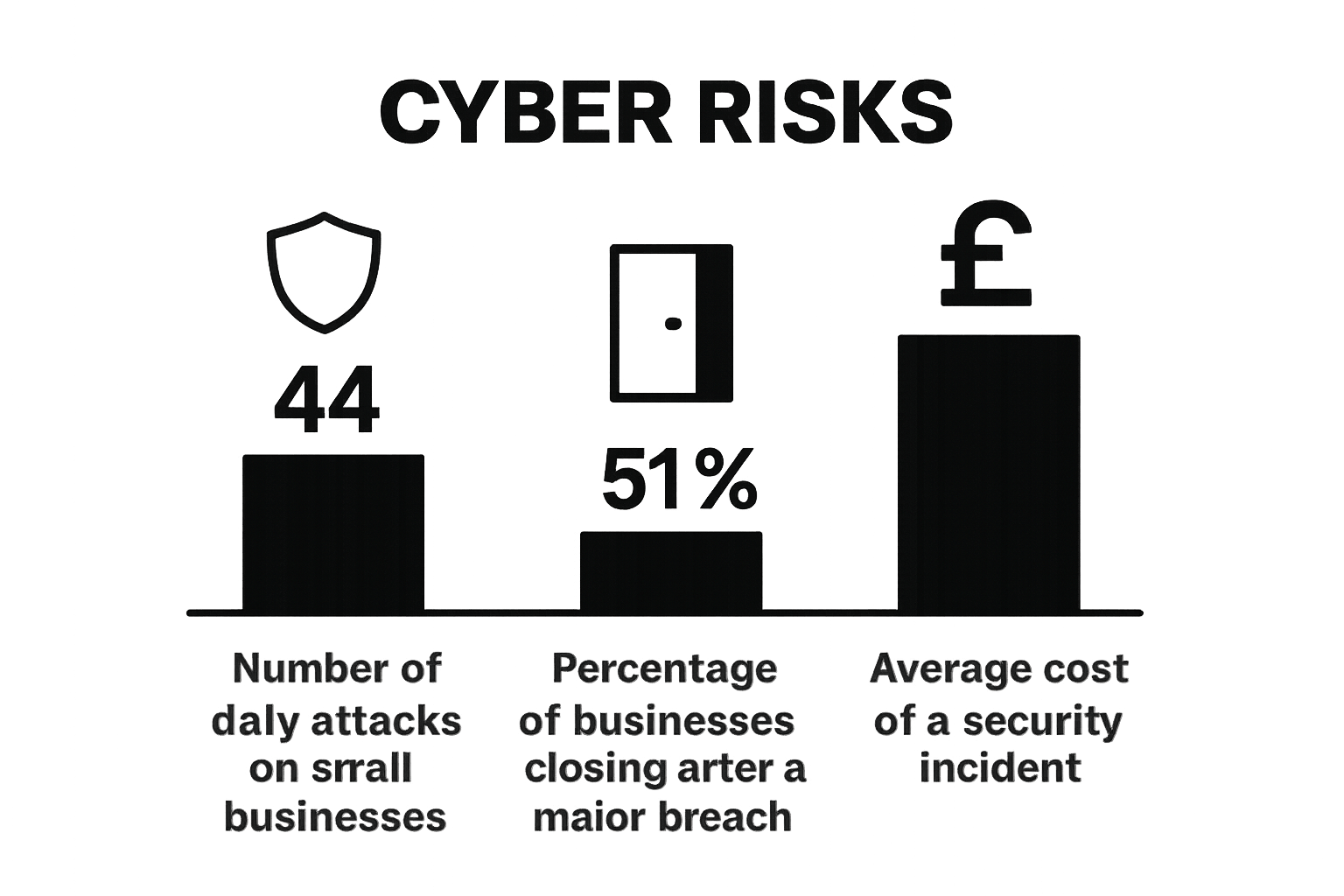 This stark reality underscores why proactive cyber security is not optional but an essential business protection mechanism.
Moreover, regulatory environments are increasingly demanding robust cyber security practices. Data protection regulations like GDPR impose substantial financial penalties for organisations failing to implement adequate digital security measures, making comprehensive cyber security services a critical compliance requirement for modern businesses.
The digital landscape presents a complex array of cyber threats that can cripple small businesses, targeting their most vulnerable technological and human resources. Understanding these threats is the first critical step towards developing robust defensive strategies that protect organisational assets and operational continuity.
Verizon’s Data Breach Investigations Report highlights that small businesses are disproportionately targeted by cybercriminals seeking easy technological entry points. Modern cyber threats have evolved from simple malware installations to intricate, multi-layered attack strategies designed to exploit specific organisational vulnerabilities.
The most prevalent digital threats include:
This table summarises the primary types of cyber threats targeting small businesses and their typical impact, enhancing understanding of the risks faced in the digital landscape.
| Threat Type | Description | Potential Impact |
|---|---|---|
| Phishing | Deceptive attempts to trick employees | Data leakage, credential compromise |
| Ransomware | Malicious encryption demanding payment | Data loss, financial extortion |
| Social Engineering | Manipulation of trust to gain access | System breach, confidential data theft |
| Unpatched Software Exploitation | Attacks exploiting outdated or vulnerable software | System compromise, operational outage |
| Credential Theft | Stealing login or authentication details | Unauthorised access, data breaches |
Cyber attacks are not merely technical incidents but strategic operations aimed at causing maximum organisational disruption. Financial losses from these incidents can range from immediate monetary theft to long-term reputational damage. 10 Biggest Cybersecurity Mistakes of Small Companies reveals that many businesses unknowingly create vulnerabilities through simple operational oversights.
Statistically, cybercriminals target small businesses because they perceive them as having weaker security infrastructures. A single successful breach can compromise sensitive customer data, financial records, and operational systems, potentially causing irreparable harm to the business’s credibility and financial stability. The cascading effects of these incidents can extend far beyond immediate financial losses, potentially leading to complete business failure.
Cyber security services represent a comprehensive technological defence ecosystem designed to protect businesses from sophisticated digital threats. These services integrate multiple strategic approaches to create robust, adaptive protection mechanisms that safeguard critical organisational assets and digital infrastructure.
National Cyber Security Centre recommends a multi-layered approach to digital security that encompasses technical, human, and strategic defence components. Modern cyber security services go beyond traditional antivirus software, offering intricate protection strategies that address complex technological vulnerabilities.
Key protection components typically include:
Effective cyber security services operate on a proactive rather than reactive model, anticipating potential threats before they materialise. Cybersecurity Awareness Month Essential Business Cyber Hygiene emphasises the importance of continuous monitoring and adaptive defence strategies.
These services function as a comprehensive digital immune system, continuously analysing network traffic, identifying potential intrusion attempts, and implementing immediate protective measures. By combining advanced technological tools with human expertise, cyber security services create a dynamic defence environment that can rapidly respond to emerging digital risks and protect organisational integrity.
Cyber security services transform complex digital protection into actionable, strategic defence mechanisms that adapt to evolving technological landscapes. These services operate through sophisticated, integrated systems designed to identify, prevent, and neutralise potential digital threats before they can compromise organisational infrastructure.
Gartner Research reveals that effective cyber security services function like an advanced early warning system, continuously scanning digital environments for potential vulnerabilities. The process involves real-time network monitoring, behavioural analysis, and automated threat identification mechanisms that can detect unusual patterns or potential security breaches within milliseconds.
Practical implementation typically involves:
Cyber security services operate on a proactive defence model, moving beyond traditional reactive approaches. How to Organise Your Cybersecurity Strategy into Left and Right of Boom demonstrates the importance of anticipatory security strategies that prevent incidents before they occur.
When potential threats are detected, these services immediately trigger sophisticated response protocols. This might involve automatically blocking suspicious IP addresses, quarantining potentially infected systems, or alerting security personnel about emerging risks. The goal is not just detection but rapid, intelligent intervention that minimises potential damage and maintains continuous operational integrity.

Many small businesses struggle to recover from the shock of a security breach. The article highlighted how lacking dedicated cyber defences makes you an easy target for attacks that could compromise your reputation or even close your doors. Small businesses face continual threats and limited resources. Ignoring these risks puts customer trust and your entire business at stake. Get expert support from specialists who understand the realities you face in Lancashire and the North West.

Do not let your business become another statistic. Explore our Cyber Security expertise to see how we deliver advanced solutions designed for local SMEs. Our team at J700 Group provides proactive protection, managed IT services, and strategic advice that keeps your systems safe and your operations uninterrupted. Take control of your digital security today. Book a confidential review with our specialists by visiting Contact J700 Group. Secure your future and experience true peace of mind.
Cyber security services are professional solutions designed to protect small businesses from digital threats, vulnerabilities, and potential cyber attacks, ensuring the safeguarding of critical digital assets and sensitive information.
Small businesses are particularly vulnerable to cyber attacks due to limited resources and lack of dedicated IT security personnel. Cyber security services provide essential protection against sophisticated online risks that could otherwise threaten their operational continuity.
Small businesses face various threats including phishing attacks, ransomware, credential theft, and exploitation of unpatched software vulnerabilities, all of which can lead to significant financial and reputational damage.
Cyber security services use continuous monitoring, advanced threat detection, and strategic response protocols to identify and neutralise potential threats, enabling proactive defence against cyber incidents and ensuring ongoing operational integrity.
For years, businesses protected their data like a medieval castle: build a thick wall (a…
Read More
For many small and medium-sized businesses, cybersecurity is still viewed as an IT problem. Firewalls,…
Read More
Cloud technology is no longer a luxury or a cost-saving alternative to on-site servers. For…
Read More
Remember when we jokingly wondered if Apple was borrowing our name? Well, the rumours were…
Read More
AI hasn’t just changed the way we work, it has completely rewritten the rulebook for…
Read More
For many businesses, the office phone is like part of the furniture, it’s always there,…
Read More
We are thrilled to announce a significant milestone in the J700 Group journey. To keep…
Read More
For years, many small and medium-sized business owners in the North West have operated under…
Read More
In a modern healthcare setting, the stethoscope and the blood pressure cuff aren’t the only…
Read More
When people hear the word cybersecurity, they often imagine complex systems, expensive software and specialist…
Read More
As we count down to midnight, most of us are thinking about gym memberships or…
Read More
It’s Christmas Eve in Lancashire. The Preston bypass is a nightmare, the last-minute dash to…
Read More
For many businesses, the Christmas period means quieter offices, reduced staffing and systems left running…
Read More
Or: Why we’d like to have a word with Tim Cook this Christmas. There are…
Read More
Hackers Love Christmas: Learn Why your Business Could be at Risk This Holiday SeasonThe festive…
Read More
In recent months, high-profile companies like Land Rover and Co-op have made headlines due to…
Read More
Explore 7 essential tips for effective cloud solutions comparison to find the best fit for…
Read More
Learn how to secure business data for UK SMEs with this step-by-step guide focused on…
Read More
Cybersecurity basics explained for UK businesses—core concepts, major threats, essential safeguards, and compliance requirements. A…
Read More
Discover the essential role of IT support desks, core functions, key benefits, types of support,…
Read More
Discover 10 microsoft 365 alternatives for UK SMEs, comparing features and benefits to help your…
Read More
Discover the best microsoft 365 alternatives in our comparison of 10 top products to enhance…
Read More
Discover a business connectivity checklist with 7 actionable steps to boost IT reliability, security, and…
Read More
Discover 7 essential business continuity planning steps to protect your SME. Learn practical strategies for…
Read More
Small Business Office 365 comprehensive guide for UK SMEs: core features, setup process, security essentials,…
Read More
Small Business Office 365 guide for UK firms. Learn core features, setup, security, costs, and…
Read More
Small business Office 365 guide covering essential features, security, costs, local support, and practical benefits…
Read More
Follow this cybersecurity checklist for SMEs to secure your business in Lancashire and Manchester. Step-by-step…
Read More
Follow this cybersecurity checklist for SMEs to boost protection, reduce risks, and secure business data…
Read More
Cloud security explained: A comprehensive guide for UK businesses covering threat types, protection strategies, compliance,…
Read More
Data protection strategies for UK SMEs—types, key components, GDPR compliance, business risks, and best practices…
Read More
Why cybersecurity matters for UK businesses: core concepts, main risks, common threats, legal requirements, and…
Read More
Comprehensive guide to IT issues Lancashire businesses face, including security threats, system downtime, cloud solutions,…
Read More
Comprehensive guide on cyber security threats in the UK. Learn common types, key characteristics, real-world…
Read More
Follow this IT security checklist for a step-by-step process to secure your business effectively in…
Read More
Explore the benefits of managed IT services for businesses in Manchester and Lancashire, enhancing efficiency…
Read More
Explore the role of cybersecurity in business. Understand its importance, how it works, and key…
Read More
Discover 7 key advantages of Microsoft 365 for SMEs that can enhance productivity, collaboration, and…
Read More
Explore why use managed IT services and how they benefit businesses. Gain comprehensive insights on…
Read More
Comprehensive guide explaining cyber threats, focusing on their importance, how they work, and the key…
Read More